


Page 368 - Clinical Application of Mechanical Ventilation
P. 368
334    Chapter 11


                                                100
                                              V (L/min)  50                                       50% End Flow


                                                                          5 L/min End Flow


                                                            1       2        3       4       5        6       7


                                              P (cm H 2 O)  2100                                Increased End Flow


                                                 40                     Increased End Flow      Increased End P TA
                                                                        Increased End P
                                                                                     TA

                                                                  P ALV                     P ALV

                                                22          1       2       3        4       5       6        7  © Cengage Learning 2014

                                                                            Time (sec)
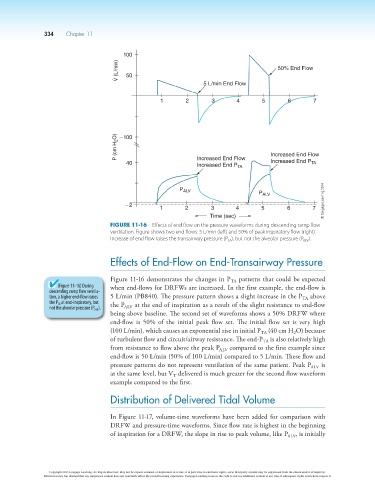
                                            Figure 11-16  Effects of end flow on the pressure waveforms during descending ramp flow
                                            ventilation. Figure shows two end flows: 5 L/min (left) and 50% of peak inspiratory flow (right).
                                            Increase of end flow raises the transairway pressure (P TA ), but not the alveolar pressure (P ALV ).


                                            Effects of End-Flow on End-Transairway Pressure


                                            Figure 11-16 demonstrates the changes in P  patterns that could be expected
                                                                                   TA
                          (Figure 11-16) During   when end-flows for DRFWs are increased. In the first example, the end-flow is
                        descending ramp flow ventila-
                        tion, a higher end-flow raises   5 L/min (PB840). The pressure pattern shows a slight increase in the P  above
                                                                                                          TA
                        the P TA  at end-inspiratory, but   the P   at the end of inspiration as a result of the slight resistance to end-flow
                        not the alveolar pressure (P ALV ).  ALV
                                            being above baseline. The second set of waveforms shows a 50% DRFW where
                                            end-flow is 50% of the initial peak flow set. The initial flow set is very high
                                            (100 L/min), which causes an exponential rise in initial P  (40 cm H O) because
                                                                                                       2
                                                                                             TA
                                            of turbulent flow and circuit/airway resistance. The end-P  is also relatively high
                                                                                             TA
                                            from resistance to flow above the peak P ALV  compared to the first example since
                                            end-flow is 50 L/min (50% of 100 L/min) compared to 5 L/min. These flow and
                                            pressure patterns do not represent ventilation of the same patient. Peak P ALV  is
                                            at the same level, but V  delivered is much greater for the second flow waveform
                                                                T
                                            example compared to the first.

                                            Distribution of Delivered Tidal Volume


                                            In Figure 11-17, volume-time waveforms have been added for comparison with
                                            DRFW and pressure-time waveforms. Since flow rate is highest in the beginning
                                            of inspiration for a DRFW, the slope in rise to peak volume, like P ALV , is initially


                        Copyright 2013 Cengage Learning. All Rights Reserved. May not be copied, scanned, or duplicated, in whole or in part. Due to electronic rights, some third party content may be suppressed from the eBook and/or eChapter(s).
                      Editorial review has deemed that any suppressed content does not materially affect the overall learning experience. Cengage Learning reserves the right to remove additional content at any time if subsequent rights restrictions require it.

