


Page 374 - Clinical Application of Mechanical Ventilation
P. 374
340    Chapter 11


                                             Based on research, auto-PEEP should be avoided if possible, and external PEEP
                                            applied instead. A valuable advantage of having graphics is that auto-PEEP can be
                                            readily observed and prevented whenever lung conditions have changed or ventila-
                          Graphics can be used to
                        titrate and increase the T I  to   tor settings have been altered. Graphics can be used to titrate and increase the T
                                                                                                                 I
                        an appropriate inverse-ratio   to an appropriate inverse-ratio level without causing gas trapping or auto-PEEP.
                        level without causing gas
                        trapping or auto-PEEP.  This management technique serves to increase mean P ALV  and improve oxygenation
                                            at lower peak P ALV  to reduce the potential of barotraumas.

                      PRESSURE SUPPORT AND SPONTANEOUS
                      VENTILATION


                                            Pressure Support Ventilation (PSV)
                          In PSV, only the pressure
                        support level is preset. The V T
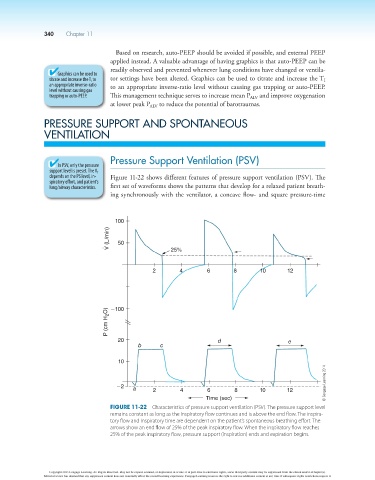
                        depends on the PS level, in-  Figure 11-22 shows different features of pressure support ventilation (PSV). The
                        spiratory effort, and patient’s
                        lung/airway characteristics.  first set of waveforms shows the patterns that develop for a relaxed patient breath-
                                            ing synchronously with the ventilator, a concave flow- and square pressure-time


                                             100
                                           V (L/min)  50       25%


                                                         2        4        6        8       10       12


                                           P (cm H 2 O)  2100


                                              20                               d                      e
                                                     b      c

                                              10
                                                                                                                  © Cengage Learning 2014

                                              22   a      2       4        6        8       10       12

                                                                           Time (sec)
                                            Figure 11-22  Characteristics of pressure support ventilation (PSV). The pressure support level
                                            remains constant as long as the inspiratory flow continues and is above the end flow. The inspira-
                                            tory flow and inspiratory time are dependent on the patient’s spontaneous breathing effort. The
                                            arrows show an end flow of 25% of the peak inspiratory flow. When the inspiratory flow reaches
                                            25% of the peak inspiratory flow, pressure support (inspiration) ends and expiration begins.


                        Copyright 2013 Cengage Learning. All Rights Reserved. May not be copied, scanned, or duplicated, in whole or in part. Due to electronic rights, some third party content may be suppressed from the eBook and/or eChapter(s).
                      Editorial review has deemed that any suppressed content does not materially affect the overall learning experience. Cengage Learning reserves the right to remove additional content at any time if subsequent rights restrictions require it.

