


Page 49 - Clinical Application of Mechanical Ventilation
P. 49
Principles of Mechanical Ventilation  15


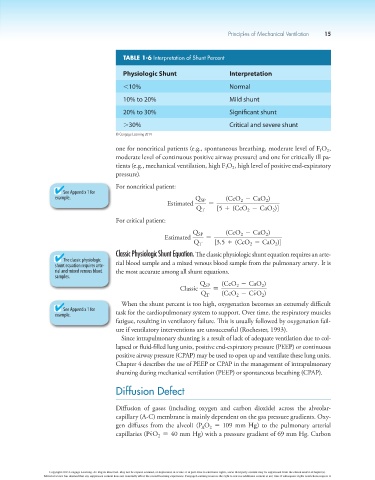
                                                TABLE 1-6 Interpretation of Shunt Percent

                                                Physiologic Shunt                  Interpretation

                                                ,10%                               Normal

                                                10% to 20%                         Mild shunt
                                                20% to 30%                         Significant shunt

                                                .30%                               Critical and severe shunt
                                             © Cengage Learning 2014

                                             one for noncritical patients (e.g., spontaneous breathing, moderate level of F O ,
                                                                                                                I
                                                                                                                  2
                                             moderate level of continuous positive airway pressure) and one for critically ill pa-
                                             tients (e.g., mechanical ventilation, high F O , high level of positive end-expiratory
                                                                                   2
                                                                                 I
                                             pressure).
                                             For noncritical patient:
                            See Appendix 1 for
                          example.                                     Q         (CcO - CaO )
                                                              Estimated   SP  =       2       2
                                                                        Q T   [5 + (CcO - CaO )]
                                                                                                 2
                                                                                        2
                                             For critical patient:
                                                                       Q         (CcO - CaO )
                                                             Estimated   SP  =        2       2
                                                                       Q T    [3.5 + (CcO - CaO )]
                                                                                         2
                                                                                                 2
                                             Classic Physiologic Shunt Equation. The classic physiologic shunt equation requires an arte-
                            The classic physiologic   rial blood sample and a mixed venous blood sample from the pulmonary artery . It is
                          shunt equation requires arte-
                          rial and mixed venous blood   the most accurate among all shunt equations.
                          samples.
                                                                         Q      (CcO - CaO )
                                                                  Classic   SP  =    2     #  2
                                                                         Q T    (CcO - CvO )
                                                                                     2
                                                                                             2
                                               When the shunt percent is too high, oxygenation becomes an extremely difficult
                            See Appendix 1 for
                          example.           task for the cardiopulmonary system to support. Over time, the respiratory muscles
                                             fatigue, resulting in ventilatory failure. This is usually followed by oxygenation fail-
                                             ure if ventilatory interventions are unsuccessful (Rochester, 1993).
                                               Since intrapulmonary shunting is a result of lack of adequate ventilation due to col-
                                             lapsed or fluid-filled lung units, positive end-expiratory pressure (PEEP) or continuous
                                             positive airway pressure (CPAP) may be used to open up and ventilate these lung units.
                                             Chapter 4 describes the use of PEEP or CPAP in the management of intrapulmonary
                                             shunting during mechanical ventilation (PEEP) or spontaneous breathing (CPAP).

                                             Diffusion Defect


                                             Diffusion  of  gases  (including  oxygen  and  carbon  dioxide)  across  the  alveolar-
                                             capillary (A-C) membrane is mainly dependent on the gas pressure gradients. Oxy-
                                             gen diffuses from the alveoli (P O  5 109 mm Hg) to the pulmonary arterial
                                                                            2
                                                                         A
                                                         #
                                             capillaries (PvO = 40 mm Hg) with a pressure gradient of 69 mm Hg. Carbon
                                                           2


                        Copyright 2013 Cengage Learning. All Rights Reserved. May not be copied, scanned, or duplicated, in whole or in part. Due to electronic rights, some third party content may be suppressed from the eBook and/or eChapter(s).
                      Editorial review has deemed that any suppressed content does not materially affect the overall learning experience. Cengage Learning reserves the right to remove additional content at any time if subsequent rights restrictions require it.

