


Page 186 - Cardiac Nursing
P. 186
LWBK340-c07_p153-176.qxd  6/29/09  10:14 PM  Page 162 Aptara Inc.


                  162    PA R T  II / Physiologic and Pathologic Responses

                  calcium ions. Large or rapid transfusions of citrated blood cause
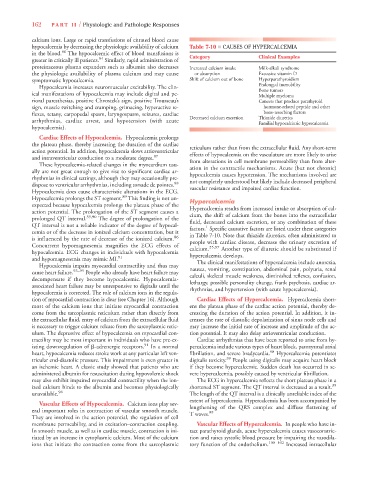
                  hypocalcemia by decreasing the physiologic availability of calcium  Table 7-10 ■ CAUSES OF HYPERCALCEMIA
                  in the blood. 86  The hypocalcemic effect of blood transfusions is  Category  Clinical Examples
                                        84
                  greater in critically ill patients. Similarly, rapid administration of
                  proteinaceous plasma expanders such as albumin also decreases  Increased calcium intake  Milk-alkali syndrome
                  the physiologic availability of plasma calcium and may cause  or absorption  Excessive vitamin D
                  symptomatic hypocalcemia.                           Shift of calcium out of bone  Hyperparathyroidism
                                                                                             Prolonged immobility
                     Hypocalcemia increases neuromuscular excitability. The clin-
                                                                                             Bone tumors
                  ical manifestations of hypocalcemia may include digital and pe-            Multiple myeloma
                  rioral paresthesias, positive Chvostek’s sign, positive Trousseau’s        Cancers that produce parathyroid
                  sign, muscle twitching and cramping, grimacing, hyperactive re-             hormone-related peptide and other
                  flexes, tetany, carpopedal spasm, laryngospasm, seizures, cardiac            bone-resorbing factors
                                                                      Decreased calcium excretion  Thiazide diuretics
                  arrhythmias, cardiac arrest, and  hypotension (with acute
                                                                                             Familial hypocalciuric hypercalcemia
                  hypocalcemia).
                     Cardiac Effects of Hypocalcemia.  Hypocalcemia prolongs
                  the plateau phase, thereby increasing the duration of the cardiac
                                                                      reticulum rather than from the extracellular fluid. Any short-term
                  action potential. In addition, hypocalcemia slows atrioventricular
                  and intraventricular conduction to a moderate degree. 87  effects of hypocalcemia on the vasculature are more likely to arise
                                                                      from alterations in cell membrane permeability than from alter-
                     These hypocalcemia-related changes in the myocardium usu-
                                                                      ation in the contractile mechanisms. Acute (but not chronic)
                  ally are not great enough to give rise to significant cardiac ar-
                                                                      hypocalcemia causes hypotension. The mechanisms involved are
                  rhythmias in clinical settings, although they may occasionally pre-
                  dispose to ventricular arrhythmias, including torsade de pointes. 88  not completely understood but likely include decreased peripheral
                                                                      vascular resistance and impaired cardiac function.
                  Hypocalcemia does cause characteristic alterations in the ECG.
                                                89
                  Hypocalcemia prolongs the ST segment. This finding is not un-  Hypercalcemia
                  expected because hypocalcemia prolongs the plateau phase of the
                                                                      Hypercalcemia results from increased intake or absorption of cal-
                  action potential. The prolongation of the ST segment causes a
                  prolonged QT interval. 39,90  The degree of prolongation of the  cium, the shift of calcium from the bones into the extracellular
                                                                      fluid, decreased calcium excretion, or any combination of these
                  QT interval is not a reliable indicator of the degree of hypocal-  1
                                                                      factors. Specific causative factors are listed under these categories
                  cemia or of the decrease in ionized calcium concentration, but it
                  is influenced by the rate of decrease of the ionized calcium. 86  in Table 7-10. Note that thiazide diuretics, often administered to
                                                                      people with cardiac disease, decrease the urinary excretion of
                  Concurrent hypomagnesemia magnifies the ECG effects of    25,97
                                                                      calcium.  Another type of diuretic should be substituted if
                  hypocalcemia. ECG changes in individuals with hypocalcemia
                  and hypomagnesemia may mimic MI. 91                 hypercalcemia develops.
                                                                        The clinical manifestations of hypercalcemia include anorexia,
                     Hypocalcemia impairs myocardial contractility and thus may
                  cause heart failure. 92–95  People who already have heart failure may  nausea, vomiting, constipation, abdominal pain, polyuria, renal
                                                                      calculi, skeletal muscle weakness, diminished reflexes, confusion,
                  decompensate if they become hypocalcemic. Hypocalcemia-
                                                                      lethargy, possible personality change, frank psychosis, cardiac ar-
                  associated heart failure may be unresponsive to digitalis until the
                                                                      rhythmias, and hypertension (with acute hypercalcemia).
                  hypocalcemia is corrected. The role of calcium ions in the regula-
                  tion of myocardial contraction is clear (see Chapter 16). Although  Cardiac Effects of Hypercalcemia.  Hypercalcemia short-
                  most of the calcium ions that initiate myocardial contraction  ens the plateau phase of the cardiac action potential, thereby de-
                  come from the sarcoplasmic reticulum rather than directly from  creasing the duration of the action potential. In addition, it in-
                  the extracellular fluid, entry of calcium from the extracellular fluid  creases the rate of diastolic depolarization of sinus node cells and
                  is necessary to trigger calcium release from the sarcoplasmic retic-  may increase the initial rate of increase and amplitude of the ac-
                  ulum. The depressive effect of hypocalcemia on myocardial con-  tion potential. It may also delay atrioventricular conduction.
                  tractility may be most important in individuals who have pre-ex-  Cardiac arrhythmias that have been reported to arise from hy-
                  isting downregulation of  -adrenergic receptors. 91  In a normal  percalcemia include various types of heart block, paroxysmal atrial
                  heart, hypocalcemia reduces stroke work at any particular left ven-  fibrillation, and severe bradycardia. 98  Hypercalcemia potentiates
                  tricular end-diastolic pressure. This impairment is even greater in  digitalis toxicity. 39  People using digitalis may acquire heart block
                  an ischemic heart. A classic study showed that patients who are  if they become hypercalcemic. Sudden death has occurred in se-
                  administered albumin for resuscitation during hypovolemic shock  vere hypercalcemia, possibly caused by ventricular fibrillation.
                  may also exhibit impaired myocardial contractility when the ion-  The ECG in hypercalcemia reflects the short plateau phase in a
                  ized calcium binds to the albumin and becomes physiologically  shortened ST segment. The QT interval is decreased as a result. 39
                  unavailable. 96                                     The length of the QT interval is a clinically unreliable index of the
                                                                      extent of hypercalcemia. Hypercalcemia has been accompanied by
                     Vascular Effects of Hypocalcemia.  Calcium ions play sev-  lengthening of the QRS complex and  diffuse  flattening of
                  eral important roles in contraction of vascular smooth muscle.  T waves. 99
                  They are involved in the action potential, the regulation of cell
                  membrane permeability, and in excitation–contraction coupling.  Vascular Effects of Hypercalcemia.  In people who have in-
                  In smooth muscle, as well as in cardiac muscle, contraction is ini-  tact parathyroid glands, acute hypercalcemia causes vasoconstric-
                  tiated by an increase in cytoplasmic calcium. Most of the calcium  tion and raises systolic blood pressure by impairing the vasodila-
                  ions that initiate the contraction come from the sarcoplasmic  tory function of the endothelium. 100–102  Increased intracellular

