


Page 190 - Cardiac Nursing
P. 190
LWBK340-c07_p153-176.qxd  6/29/09  10:14 PM  Page 166 Aptara Inc.


                  166    PA R T  II / Physiologic and Pathologic Responses

                  depend on the specific role of that electrolyte in normal cardio-  carbonic acid is excreted as the two gases CO 2 and H 2 O, it some-
                                                                                        d
                                                                                        d
                  vascular function.                                  times is called volatile acid.
                     People who do not have cardiovascular disease may acquire an  Metabolic acids are produced primarily from the metabolism
                  electrolyte imbalance that subsequently causes cardiovascular im-  of phosphate-containing compounds and amino acids that con-
                  pairment. In addition, people who have pre-existing cardiovascu-  tain sulfur. These metabolic acids include sulfuric and phosphoric
                  lar disease have specific risk factors for electrolyte imbalances. If  acids. Metabolic acids are handled differently by the body than is
                  imbalances develop in these individuals, then the cardiovascular  carbonic acid. For this reason, they sometimes are called noncar-
                  effects of the electrolyte imbalances may cause severe disturbance  bonic acids or nonvolatile acids.
                  to an already compromised cardiovascular system. Successful nurs-  Cellular metabolism also produces small amounts of base (bi-
                                                                                       –
                  ing management of these individuals involves careful assessment of  carbonate ions; HCO 3 ) as a result of oxidation of small organic
                  risk factors, elimination of those risk factors when possible, sur-  anions such as citrate. Much more metabolic acid is produced
                  veillance for the manifestations of fluid and electrolyte imbalances,  than base. In a standard adult, a net 50 to 100 mEq of hydrogen
                  and nursing interventions to protect and support function during  ions is generated per day from metabolism. 3
                  the correction of fluid and electrolyte imbalances. 1
                                                                      Acid Buffering
                                                                      Buffers in the body act to minimize changes in pH because of gain
                     PRINCIPLES OF ACID–BASE                          of acid or base. They neutralize acids by taking up excess hydro-
                     BALANCE                                          gen ions and neutralize bases by releasing hydrogen ions. Buffers
                                                                      are located in all body fluids; however, the most important buffers
                  The degree of acidity of the body fluids plays an important role in  are those in the extracellular fluid, intracellular fluid, bone, and
                  physiology. It influences the structure and function of many en-  urine. Different body fluids contain different buffers, which meet
                  zymes and also modifies the affinity between oxygen and hemo-  specific needs (Table 7-14).
                  globin. Deviations of acid–base balance from normal can affect  The major extracellular buffer is the carbonic acid–bicarbon-
                  cellular function and tissue oxygenation. In the extreme, these im-  ate–carbon dioxide buffer system (commonly termed the bicar-
                  balances can be fatal.                              bonate buffer system). Carbonic acid is a weak acid, which means
                                                                      that it dissociates partially when in solution so that it is in equi-
                                                                      librium with bicarbonate and hydrogen ions. The carbonic acid
                  Terminology Review
                                                                      concentration can be altered by variations in alveolar ventilation

                  An acid is a substance that donates hydrogen ions (H ) in solu-  (variations in CO 2 excretion). The chemical equation for the bi-
                  tion. A base is a substance that accepts hydrogen ions. The more  carbonate buffer system is written as follows:
                  hydrogen ions a solution contains, the more acidic it is. The ac-  CO 2
 H 2 O Δ  H 2 CO 3 Δ  H

  HCO 3

                  tual number of hydrogen ions in extracellular fluid is small and  carbon dioxide  water  carbonic acid  hydrogen ion  bicarbonate ion
                  unwieldy to write (0.00004 mmol/L). 135  Therefore, the degree of
                  acidity of body fluids is reported as the pH. The pH is the nega-  To maintain the pH of the blood within the normal range, there
                  tive logarithm of the hydrogen ion concentration. It ranges from  must be 20 bicarbonate ions for every carbonic acid molecule.
                  1 (very acidic) to 14 (very alkaline). A pH of 7 is neutral. The  The Henderson–Hasselbalch equation, a mathematical descrip-
                  blood is normally slightly alkaline. The normal pH range of the  tion of the pH of a buffered solution, shows how this 20:1 ratio is
                  blood is 7.35 to 7.45. If the pH of the blood falls below the nor-  necessary:  [A ]

                  mal range (i.e., becomes more acidic), the person has acidemia.  pH   pKa
 log  (general equation)
                                                              3
                  The process that tends to decrease the pH is called acidosis. Sim-   [HA]
                  ilarly, if the pH of the blood rises above the normal range (i.e., be-  [HCO 3 ]  (substituting values for

                  comes more alkaline), the person has alkalemia. The process that  pH   6.1
 log   bicarbonate buffer system)
                  tends to increase the pH is called alkalosis.                       [H 2 CO 3 ]
                                                                                      20
                                                                          pH   6.1
 log
                  Processes Involved in Acid–Base                                      1
                  Balance                                                 pH   6.1
 1.3
                  Normal cellular metabolism continually produces acids, which  pH   7.4
                  can cause dangerous acidemia without the closely regulated
                  processes by which the body maintains pH within the normal
                  range. After acid production, the processes of acid buffering and
                  acid excretion work to maintain or re-establish a normal pH.
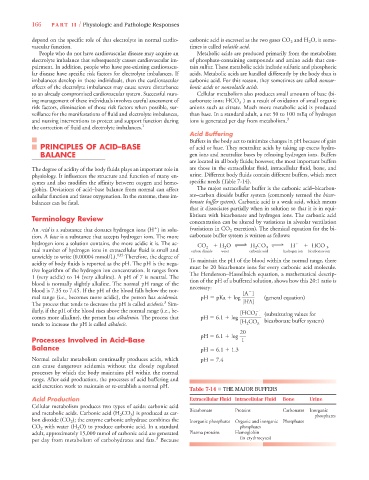
                                                                      Table 7-14 ■ THE MAJOR BUFFERS
                  Acid Production                                     Extracellular Fluid Intracellular Fluid  Bone  Urine
                  Cellular metabolism produces two types of acids: carbonic acid
                  and metabolic acids. Carbonic acid (H 2 CO 3 ) is produced as car-  Bicarbonate  Proteins  Carbonates  Inorganic
                                                                                                               phosphates
                  bon dioxide (CO 2 ); the enzyme carbonic anhydrase combines the  Inorganic phosphates  Organic and inorganic  Phosphates
                  CO 2 with water (H 2 O) to produce carbonic acid. In a standard     phosphates
                  adult, approximately 15,000 mmol of carbonic acid are generated  Plasma proteins  Hemoglobin
                                                           3
                  per day from metabolism of carbohydrates and fats. Because          (in erythrocytes)

