


Page 188 - Cardiac Nursing
P. 188
LWBK340-c07_p153-176.qxd  6/29/09  10:14 PM  Page 164 Aptara Inc.


                  164    PA R T  II / Physiologic and Pathologic Responses

                     A classic study demonstrated that heart muscle magnesium con-
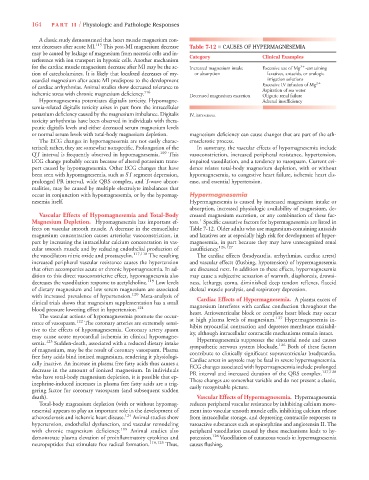
                  tent decreases after acute MI. 115  This post-MI magnesium decrease  Table 7-12 ■ CAUSES OF HYPERMAGNESEMIA
                  may be caused by leakage of magnesium from necrotic cells and in-
                                                                      Category                Clinical Examples
                  terference with ion transport in hypoxic cells. Another mechanism
                  for the cardiac muscle magnesium decrease after MI may be the ac-  Increased magnesium intake   Excessive use of Mg 2
 -containing
                  tion of catecholamines. It is likely that localized decreases of my-  or absorption  laxatives, antacids, or urologic
                  ocardial magnesium after acute MI predispose to the development              irrigation solutions
                                                                                              Excessive IV infusion of Mg 2
                  of cardiac arrhythmias. Animal studies show decreased tolerance to          Aspiration of sea water
                  ischemic stress with chronic magnesium deficiency. 116  Decreased magnesium excretion  Oliguric renal failure
                     Hypomagnesemia potentiates digitalis toxicity. Hypomagne-                Adrenal insufficiency
                  semia-related digitalis toxicity arises in part from the intracellular
                  potassium deficiency caused by the magnesium imbalance. Digitalis  IV, intravenous.
                  toxicity arrhythmias have been observed in individuals with thera-
                  peutic digitalis levels and either decreased serum magnesium levels
                  or normal serum levels with total-body magnesium depletion.  magnesium deficiency can cause changes that are part of the ath-
                     The ECG changes in hypomagnesemia are not easily charac-  erosclerotic process.
                  terized; rather, they are somewhat nonspecific. Prolongation of the  In summary, the vascular effects of hypomagnesemia include
                  QT interval is frequently observed in hypomagnesemia. 109  This  vasoconstriction, increased peripheral resistance, hypertension,
                  ECG change probably occurs because of altered potassium trans-  impaired vasodilation, and a tendency to vasospasm. Current evi-
                  port caused by hypomagnesemia. Other ECG changes that have  dence relates total-body magnesium depletion, with or without
                  been seen with hypomagnesemia, such as ST segment depression,  hypomagnesemia, to congestive heart failure, ischemic heart dis-
                  prolonged PR interval, wide QRS complex, and T-wave abnor-  ease, and essential hypertension.
                  malities, may be caused by multiple electrolyte imbalances that
                  occur in conjunction with hypomagnesemia, or by the hypomag-  Hypermagnesemia
                  nesemia itself.                                     Hypermagnesemia is caused by increased magnesium intake or
                                                                      absorption, increased physiologic availability of magnesium, de-
                     Vascular Effects of Hypomagnesemia and Total-Body  creased magnesium excretion, or any combination of these fac-
                                                                         1
                  Magnesium Depletion.  Hypomagnesemia has important ef-  tors. Specific causative factors for hypermagnesemia are listed in
                  fects on vascular smooth muscle. A decrease in the extracellular  Table 7-12. Older adults who use magnesium-containing antacids
                  magnesium concentration causes arteriolar vasoconstriction, in  and laxatives are at especially high risk for development of hyper-
                  part by increasing the intracellular calcium concentration in vas-  magnesemia, in part because they may have unrecognized renal
                  cular smooth muscle and by reducing endothelial production of  insufficiency. 126,127
                  the vasodilators nitric oxide and prostacyclin. 117,118  The resulting  The cardiac effects (bradycardia, arrhythmias, cardiac arrest)
                  increased peripheral vascular resistance causes the hypertension  and vascular effects (flushing, hypotension) of hypermagnesemia
                  that often accompanies acute or chronic hypomagnesemia. In ad-  are discussed next. In addition to these effects, hypermagnesemia
                  dition to this direct vasoconstrictive effect, hypomagnesemia also  may cause a subjective sensation of warmth, diaphoresis, drowsi-
                  decreases the vasodilation response to acetylcholine. 119  Low levels  ness, lethargy, coma, diminished deep tendon reflexes, flaccid
                  of dietary magnesium and low serum magnesium are associated  skeletal muscle paralysis, and respiratory depression.
                  with increased prevalence of hypertension.  120  Meta-analysis of  Cardiac Effects of Hypermagnesemia.  A plasma excess of
                  clinical trials shows that magnesium supplementation has a small  magnesium interferes with cardiac conduction throughout the
                  blood pressure lowering effect in hypertension. 121  heart. Atrioventricular block or complete heart block may occur
                     The vascular actions of hypomagnesemia promote the occur-  at high plasma levels of magnesium. 127  Hypermagnesemia in-
                  rence of vasospasm. 122  The coronary arteries are extremely sensi-  hibits myocardial contraction and depresses membrane excitabil-
                  tive to the effects of hypomagnesemia. Coronary artery spasm  ity, although intracellular contractile mechanisms remain intact.
                  may cause acute myocardial ischemia in clinical hypomagne-  Hypermagnesemia suppresses the sinoatrial node and causes
                  semia. 123  Sudden-death, associated with a reduced dietary intake  sympathetic nervous system blockade. 126  Both of these factors
                  of magnesium, may be the result of coronary vasospasm. Plasma  contribute to clinically significant supraventricular bradycardia.
                  free fatty acids bind ionized magnesium, rendering it physiologi-  Cardiac arrest in asystole may be fatal in severe hypermagnesemia.
                  cally inactive. An increase in plasma free fatty acids thus causes a  ECG changes associated with hypermagnesemia include prolonged
                  decrease in the amount of ionized magnesium. In individuals  PR interval and increased duration of the QRS complex. 127,128
                  who have total-body magnesium depletion, it is possible that ep-  These changes are somewhat variable and do not present a classic,
                  inephrine-induced increases in plasma free fatty acids are a trig-  easily recognizable picture.
                  gering factor for coronary vasospasm (and subsequent sudden
                  death).                                               Vascular Effects of Hypermagnesemia.  Hypermagnesemia
                     Total-body magnesium depletion (with or without hypomag-  reduces peripheral vascular resistance by inhibiting calcium move-
                  nesemia) appears to play an important role in the development of  ment into vascular smooth muscle cells, inhibiting calcium release
                  atherosclerosis and ischemic heart disease. 124  Animal studies show  from intracellular storage, and depressing contractile responses to
                  hypertension, endothelial dysfunction, and vascular remodeling  vasoactive substances such as epinephrine and angiotensin II. The
                  with chronic magnesium deficiency. 119  Animal studies also  peripheral vasodilation caused by these mechanisms leads to hy-
                  demonstrate plasma elevation of proinflammatory cytokines and  potension. 128  Vasodilation of cutaneous vessels in hypermagnesemia
                  neuropeptides that stimulate free radical formation. 116,125  Thus,  causes flushing.

