


Page 187 - Cardiac Nursing
P. 187
LWBK340-c07_p153-176.qxd  6/29/09  10:14 PM  Page 163 Aptara Inc.


                                                 C HAP TE R  7 / Fluid and Electrolyte and Acid–Base Balance and Imbalance  163

                   calcium in vascular smooth muscle also causes increased vascular  Diuretics (except for spironolactone, triamterene, and
                   resistance. In many people with essential hypertension, increased  amiloride) cause increased renal excretion of magnesium and can
                   intracellular calcium occurs with normal plasma calcium levels.  lead to hypomagnesemia. 21  Individuals with heart failure are at
                   Parathyroid hormone and parathyroid hormone-related factor are  high risk for hypomagnesemia or total-body magnesium deple-
                   implicated in transepithelial calcium transport and likely play a  tion. 103  In addition to diuretic therapy, people with heart failure
                   role in the hypertensive mechanism.                 often have congestion of the splanchnic vessels, which decreases
                                                                       magnesium absorption. Also, the secondary hyperaldosteronism
                   Magnesium Balance                                   and elevated catecholamines of heart failure increase urinary ex-
                                                                       cretion of magnesium. 104  Among people with heart failure, those
                   Magnesium balance is the net result of magnesium intake and ab-  who are hypomagnesemic have more arrhythmias than those who
                   sorption, distribution, excretion, and abnormal losses. These  are normomagnesemic and hypomagnesemia is associated with
                   components are summarized in Table 7-6. Similar to calcium,  shorter survival. 103,105  Individuals with acute MI often have ion-
                   magnesium in the plasma exists in three forms: protein-bound,  ized hypomagnesemia. 106  Hypomagnesemia may be a causative
                   complexed, and ionized (free). Only the ionized magnesium is  factor for MI as well as a result of pathophysiologic changes im-
                   physiologically active; however, the only widely available clinical  mediately after MI.
                   laboratory measure for magnesium is the total serum magnesium  Hypomagnesemia causes increased neuromuscular excitability.
                   concentration (bound, complexed, and ionized).      The signs and symptoms of hypomagnesemia include hyperactive
                     Magnesium, like potassium, is primarily an intracellular ion.  reflexes, positive Chvostek’s sign, positive Trousseau’s sign, leg and
                   For this reason, plasma levels of magnesium do not necessarily re-  foot cramps, muscle twitching, grimacing, tremors, dysphagia,
                   flect the intracellular magnesium content. Total-body magnesium  nystagmus, ataxia, tetany, seizures, extreme confusion, cardiac ar-
                   depletion may be present even when the plasma magnesium is  rhythmias, and hypertension.
                   normal. Intracellular magnesium is a cofactor for many enzymes,


                   including Na –K adenosine triphosphatase (ATPase). Changes  Cardiac Effects of Hypomagnesemia and Total-Body

                   in magnesium balance, especially hypomagnesemia, cause alter-  Magnesium Depletion.  Magnesium is a cofactor for Na –K
                   ations in ion transport across membranes. Because the function of  ATPase, the enzyme that plays a major role in the regulation of in-
                   cardiac and smooth muscle depends on ion fluxes, magnesium  tracellular potassium concentration in the myocardium. When
                   imbalances have myocardial and vascular effects.    magnesium is deficient, the decreased intracellular magnesium
                                                                       leads to decreased activity of this enzyme. As a result, the intra-
                   Hypomagnesemia and Total-Body                       cellular potassium ion concentration decreases and intracellular
                   Magnesium Depletion                                 sodium concentration increases in myocardial cells. Decreased ac-
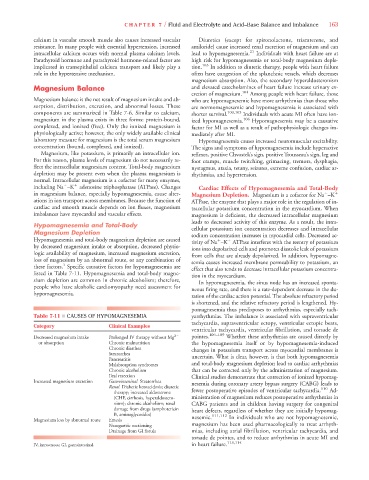
                   Hypomagnesemia and total-body magnesium depletion are caused  tivity of Na –K ATPase interferes with the reentry of potassium


                   by decreased magnesium intake or absorption, decreased physio-  ions into depolarized cells and promotes diastolic leak of potassium
                   logic availability of magnesium, increased magnesium excretion,  from cells that are already depolarized. In addition, hypomagne-
                   loss of magnesium by an abnormal route, or any combination of  semia causes increased membrane permeability to potassium, an
                             1
                   these factors. Specific causative factors for hypomagnesemia are  effect that also tends to decrease intracellular potassium concentra-
                   listed in Table 7-11. Hypomagnesemia and total-body magne-  tion in the myocardium.
                   sium depletion are common in chronic alcoholism; therefore,  In hypomagnesemia, the sinus node has an increased sponta-
                   people who have alcoholic cardiomyopathy need assessment for  neous firing rate, and there is a rate-dependent decrease in the du-
                   hypomagnesemia.
                                                                       ration of the cardiac action potential. The absolute refractory period
                                                                       is shortened, and the relative refractory period is lengthened. Hy-
                                                                       pomagnesemia thus predisposes to arrhythmias, especially tach-
                   Table 7-11 ■ CAUSES OF HYPOMAGNESEMIA               yarrhythmias. The imbalance is associated with supraventricular
                                                                       tachycardia, supraventricular ectopy, ventricular ectopic beats,
                   Category                 Clinical Examples
                                                                       ventricular tachycardia, ventricular fibrillation, and torsade de
                   Decreased magnesium intake   Prolonged IV therapy without Mg 2
  pointes. 106–109  Whether these arrhythmias are caused directly by
                     or absorption          Chronic malnutrition       the  hypomagnesemia itself or  by  hypomagnesemia-induced
                                            Chronic diarrhea           changes in potassium transport across myocardial membranes is
                                            Steatorrhea
                                            Pancreatitis               uncertain. What is clear, however, is that both hypomagnesemia
                                            Malabsorption syndromes    and total-body magnesium depletion lead to cardiac arrhythmias
                                            Chronic alcoholism         that can be corrected only by the administration of magnesium.
                                            Ileal resection            Clinical studies demonstrate that correction of ionized hypomag-
                                                     l
                   Increased magnesium excretion  Gastrointestinal: Steatorrhea  nesemia during coronary artery bypass surgery (CABG) leads to
                                                     l
                                               l
                                               l
                                            Renal: Diabetic ketoacidosis; diuretic                               110
                                             therapy; increased aldosterone  fewer postoperative episodes of ventricular tachycardia.  Ad-
                                             (CHF, cirrhosis, hyperaldostero-  ministration of magnesium reduces postoperative arrhythmias in
                                             nism); chronic alcoholism; renal  CABG patients and in children having surgery for congenital
                                             damage from drugs (amphotericin  heart defects, regardless of whether they are initially hypomag-
                                             B, aminoglycosides)             111,112
                   Magnesium loss by abnormal route  Emesis            nesemic.    In individuals who are not hypomagnesemic,
                                            Nasogastric suctioning     magnesium has been used pharmacologically to treat arrhyth-
                                            Drainage from GI fistula    mias, including atrial fibrillation, ventricular tachycardia, and
                                                                       torsade de pointes, and to reduce arrhythmias in acute MI and
                   IV, intravenous; GI, gastrointestinal.              in heart failure. 113,114

