


Page 183 - Cardiac Nursing
P. 183
LWBK340-c07_p153-176.qxd  6/29/09  10:14 PM  Page 159 Aptara Inc.


                                                 C HAP TE R  7 / Fluid and Electrolyte and Acid–Base Balance and Imbalance  159

                                                                       4.0 mEq/L are necessary in individuals who have cardiac arrhyth-
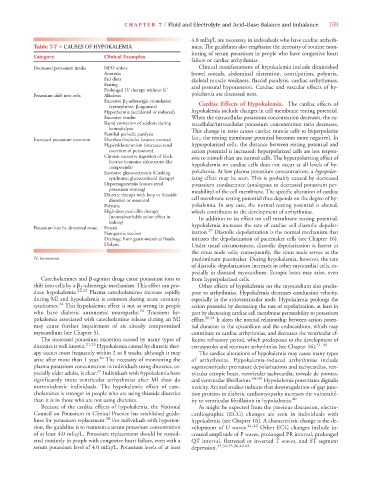
                   Table 7-7 ■ CAUSES OF HYPOKALEMIA                   mias. The guidelines also emphasize the necessity of routine mon-
                                                                       itoring of serum potassium in people who have congestive heart
                   Category               Clinical Examples
                                                                       failure or cardiac arrhythmias.
                   Decreased potassium intake  NPO orders                Clinical manifestations of hypokalemia include diminished
                                          Anorexia                     bowel sounds, abdominal distention, constipation, polyuria,
                                          Fad diets                    skeletal muscle weakness, flaccid paralysis, cardiac arrhythmias,
                                          Fasting
                                          Prolonged IV therapy without K
  and postural hypotension. Cardiac and vascular effects of hy-
                   Potassium shift into cells  Alkalosis               pokalemia are discussed next.
                                          Excessive   2 -adrenergic stimulation
                                            (epinephrine,  -agonists)    Cardiac Effects of Hypokalemia.  The cardiac effects of
                                          Hypothermia (accidental or induced)  hypokalemia include changes in cell membrane resting potential.
                                          Excessive insulin            When the extracellular potassium concentration decreases, the ex-
                                          Rapid correction of acidosis during   tracellular/intracellular potassium concentration ratio decreases.
                                            hemodialysis               This change in ratio causes cardiac muscle cells to hyperpolarize
                                          Familial periodic paralysis
                   Increased potassium excretion  Diarrhea (includes laxative overuse)  (i.e., the resting membrane potential becomes more negative). In
                                          Hyperaldosteronism (increases renal  hyperpolarized cells, the distance between resting potential and
                                            excretion of potassium)    action potential is increased; hyperpolarized cells are less respon-
                                          Chronic excessive ingestion of black  sive to stimuli than are normal cells. The hyperpolarizing effect of
                                            licorice (contains aldosterone-like
                                            compounds)                 hypokalemia on cardiac cells does not occur at all levels of hy-
                                          Excessive glucocorticoids (Cushing   pokalemia. At low plasma potassium concentrations, a hypopolar-
                                            syndrome; glucocorticoid therapy)  izing effect may be seen. This is probably caused by decreased
                                          Hypomagnesemia (causes renal  potassium conductance (analogous to decreased potassium per-
                                            potassium wasting)         meability) of the cell membrane. The specific alteration of cardiac
                                          Diuretic therapy with loop or thiazide
                                            diuretics or mannitol      cell membrane resting potential thus depends on the degree of hy-
                                          Polyuria                     pokalemia. In any case, the normal resting potential is altered,
                                          High-dose penicillin therapy   which contributes to the development of arrhythmias.
                                            (nonreabsorbable anion effect in   In addition to its effect on cell membrane resting potential,
                                            kidney)
                   Potassium loss by abnormal route  Emesis            hypokalemia increases the rate of cardiac cell diastolic depolar-
                                                                            29
                                          Nasogastric suction          ization.  Diastolic depolarization is the normal mechanism that
                                          Drainage from gastrointestinal fistula  initiates the depolarization of pacemaker cells (see Chapter 16).
                                          Dialysis                     Under usual circumstances, diastolic depolarization is fastest in
                                                                       the sinus node cells; consequently, the sinus node serves as the
                   IV, intravenous.                                    predominant pacemaker. During hypokalemia, however, the rate
                                                                       of diastolic depolarization increases in other myocardial cells, es-
                                                                       pecially in diseased myocardium. Ectopic beats may arise, even
                     Catecholamines and  -agonist drugs cause potassium ions to  from hyperpolarized cells.
                   shift into cells by a   2 -adrenergic mechanism. This effect can pro-  Other effects of hypokalemia on the myocardium also predis-
                   duce hypokalemia. 22,23  Plasma catecholamines increase rapidly  pose to arrhythmias. Hypokalemia decreases conduction velocity,
                   during MI and hypokalemia is common during acute coronary  especially in the atrioventricular node. Hypokalemia prolongs the
                   syndromes. 24  This hypokalemic effect is not as strong in people  action potential by decreasing the rate of repolarization, at least in
                   who have diabetic autonomic neuropathy. 24  Transient hy-  part by decreasing cardiac cell membrane permeability to potassium
                   pokalemia associated with catecholamine release during an MI  efflux. 30,31  It alters the normal relationship between action poten-
                   may cause further impairment of an already compromised  tial duration in the epicardium and the endocardium, which may
                   myocardium (see Chapter 5).                         contribute to cardiac arrhythmias, and decreases the ventricular ef-
                     The increased potassium excretion caused by many types of  fective refractory period, which predisposes to the development of
                   diuretics is well known. 21,25  Hypokalemia caused by diuretic ther-  extrasystoles and reentrant arrhythmias (see Chapter 16). 31–33
                   apy occurs most frequently within 2 to 8 weeks, although it may  The cardiac alterations of hypokalemia may cause many types
                   arise after more than 1 year. 26  The necessity of monitoring the  of arrhythmias. Hypokalemia-induced arrhythmias include
                   plasma potassium concentration in individuals using diuretics, es-  supraventricular premature depolarizations and tachycardias, ven-
                                        27
                   pecially older adults, is clear. Individuals with hypokalemia have  tricular ectopic beats, ventricular tachycardia, torsade de pointes,
                   significantly more ventricular arrhythmias after MI than  do  and ventricular fibrillation. 34–39  Hypokalemia potentiates digitalis
                   normokalemic individuals. The  hypokalemic effect of cate-  toxicity. Animal studies indicate that downregulation of gap junc-
                   cholamines is stronger in people who are using thiazide diuretics  tion proteins in diabetic cardiomyopathy increases the vulnerabil-
                   than it is in those who are not using diuretics.    ity to ventricular fibrillation in hypokalemia. 40
                     Because of the cardiac effects of hypokalemia, the National  As might be expected from the previous discussion, electro-
                   Council on Potassium in Clinical Practice has established guide-  cardiographic (ECG) changes are seen in individuals with
                   lines for potassium replacement. 28  For individuals with hyperten-  hypokalemia (see Chapter 16). A characteristic change is the de-
                   sion, the guideline is to maintain a serum potassium concentration  velopment of U waves. 41,42  Other ECG changes include in-
                   of at least 4.0 mEq/L. Potassium replacement should be consid-  creased amplitude of P waves, prolonged PR interval, prolonged
                   ered routinely in people with congestive heart failure, even with a  QT interval, flattened or inverted T waves, and ST segment
                   serum potassium level of 4.0 mEq/L. Potassium levels of at least  depression. 23,32,35,36,42,43

