


Page 259 - Cardiac Nursing
P. 259
LWBK340-c10_p211-244.qxd  30/06/2009  10:47 AM  Page 235 Aptara


                                                               C HAP TE R 1 0 / History Taking and Physical Examination  235


                       S 4 S 1  S 3  S 4 S 1  S 3    S 4 S 1  S 3
                                            S
                              S
                                                            S
                                                             2
                                              2
                               2
                                                                               S 1        S OS              S 1
                                                                                           2
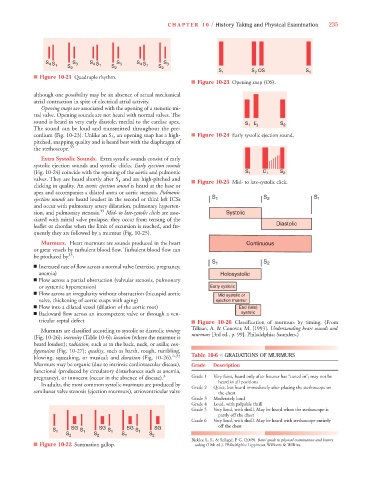
                   ■ Figure 10-21 Quadruple rhythm.
                                                                       ■ Figure 10-23 Opening snap (OS).
                   although one possibility may be an absence of actual mechanical
                   atrial contraction in spite of electrical atrial activity.
                     Opening snaps are associated with the opening of a stenotic mi-
                   tral valve. Opening sounds are not heard with normal valves. The
                   sound is heard in very early diastole, medial to the cardiac apex.   S 1  E j    S 2
                   The sound can be loud and transmitted throughout the pre-
                   cordium (Fig. 10-23). Unlike an S 3 , an opening snap has a high-  ■ Figure 10-24 Early systolic ejection sound.
                   pitched, snapping quality and is heard best with the diaphragm of
                   the stethoscope. 33
                     Extra Systolic Sounds. Extra systolic sounds consist of early
                   systolic ejection sounds and systolic clicks. Early ejection sounds
                   (Fig. 10-24) coincide with the opening of the aortic and pulmonic    S 1   C 1   S 2
                   valves. They are heard shortly after S 1 and are high-pitched and  ■ Figure 10-25 Mid- to late-systolic click.
                   clicking in quality. An aortic ejection sound is heard at the base or
                   apex and accompanies a dilated aorta or aortic stenosis. Pulmonic
                   ejection sounds are heard loudest in the second or third left ICSs  S 1    S 2              S 1
                   and occur with pulmonary artery dilatation, pulmonary hyperten-
                   sion, and pulmonary stenosis. 33  Mid- to late-systolic clicks are asso-  Systolic
                   ciated with mitral valve prolapse; they occur from tensing of the
                   leaflet or chordae when the limit of excursion is reached, and fre-             Diastolic
                   quently they are followed by a murmur (Fig. 10-25).
                     Murmurs. Heart murmurs are sounds produced in the heart             Continuous
                   or great vessels by turbulent blood flow. Turbulent blood flow can
                              33
                   be produced by :
                                                                             S 1              S 2
                   ■ Increased rate of flow across a normal valve (exercise, pregnancy,
                     anemia)                                                    Holosystolic
                   ■ Flow across a partial obstruction (valvular stenosis, pulmonary
                     or systemic hypertension)                               Early systolic
                   ■ Flow across an irregularity without obstruction (bicuspid aortic
                                                                               Mid systolic or
                     valve, thickening of aortic cusps with aging)             ejection murmur
                   ■ Flow into a dilated vessel (dilation of the aortic root)         End (late)
                   ■ Backward flow across an incompetent valve or through a ven-        systolic
                     tricular septal defect                            ■ Figure 10-26 Classification of murmurs by timing. (From
                     Murmurs are classified according to systolic or diastolic timing  Tilkian, A. & Conover, M. [1993]. Understanding heart sounds and
                   (Fig. 10-26); intensity (Table 10-6); location (where the murmur is  murmurs [3rd ed., p. 99]. Philadelphia: Saunders.)
                   heard loudest); radiation, such as to the back, neck, or axilla; con-
                   figuration (Fig. 10-27); quality, such as harsh, rough, rumbling,
                   blowing, squeaking, or musical; and duration (Fig. 10-26). 6,33  Table 10-6 ■ GRADATIONS OF MURMURS
                   Murmurs may be organic (due to intrinsic cardiovascular disease),  Grade  Description
                   functional (produced by circulatory disturbances such as anemia,
                   pregnancy), or innocent (occur in the absence of disease). 3  Grade 1  Very faint, heard only after listener has “tuned in”; may not be
                                                                               heard in all positions
                     In adults, the most common systolic murmurs are produced by
                                                                       Grade 2  Quiet, but heard immediately after placing the stethoscope on
                   semilunar valve stenosis (ejection murmurs), atrioventricular valve  the chest
                                                                       Grade 3  Moderately loud
                                                                       Grade 4  Loud, with palpable thrill
                                                                       Grade 5  Very loud, with thrill. May be heard when the stethoscope is
                                                                               partly off the chest
                                                                       Grade 6  Very loud, with thrill. May be heard with stethoscope entirely
                                                                               off the chest
                         S 1   SG  S 1  SG  S 1  SG  S 1  SG
                              S 2      S 2      S 2      S 2
                                                                       Bickley, L. S., & Szilagyi, P. G. (2009). Bates’ guide to physical examination and history
                   ■ Figure 10-22 Summation gallop.                     taking (10th ed.). Philadelphia: Lippincott Williams & Wilkins.

