


Page 294 - Cardiac Nursing
P. 294
g
                                           g
                                          Pa
                                           g
                                              70
                                              70
                                            e 2
                                            e 2
                                          Pa
                                   1:1
                                     8 P
                                   1
                                   1:1
                                        M
                                          Pa
                                     8 P
                                        M
                                                   a
                                                   a
                                                   a
                                                   a
                                                      c.
                                                      c.
                                                    In
                                                    In
                                                  ara
                                                 p
                                                 p
                                                A
                                                A
                                                  t
                                                  ara
                                                 p
                                                  t
                                   1
                      7-2
                      7-2
                    26
                        76.
                          q
                          q
                        76.
         LWBK340-c12_
         LWB
         LWB K34 0-c 12_ p p pp267-276.qxd  6/29/09  11:18 PM  Page 270 Aptara Inc.
            K34
                    26
                 12_
               0-c
                          q
                              /29
                             6
                             6
                              /29
                                /09
                                /09
                                /09
                                    1
                           xd
                           xd
                  270    P A R T  III / Assessment of Heart Disease
                                                         AICD
                                                         pacer
                                            AICD
                                            pacer tip
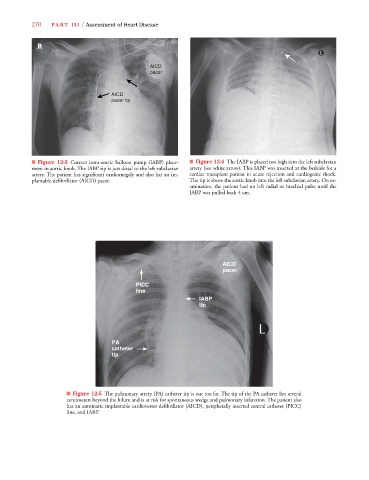
                  ■ Figure 12-3 Correct intra-aortic balloon pump (IABP) place-  ■ Figure 12-4 The IABP is placed too high into the left subclavian
                  ment in aortic knob. The IABP tip is just distal to the left subclavian  artery (see white arrow). This IABP was inserted at the bedside for a
                  artery. The patient has significant cardiomegaly and also has an im-  cardiac transplant patient in acute rejection and cardiogenic shock.
                  plantable defibrillator (AICD) pacer.                The tip is above the aortic knob into the left subclavian artery. On ex-
                                                                      amination, the patient had no left radial or brachial pulse until the
                                                                      IABP was pulled back 4 cm.
                                                                                 AICD
                                                                                 pacer
                                                    PICC
                                                    line
                                                                         IABP
                                                                         tip
                                             PA
                                             catheter
                                             tip


                              ■ Figure 12-5 The pulmonary artery (PA) catheter tip is out too far. The tip of the PA catheter lies several
                              centimeters beyond the hilum and is at risk for spontaneous wedge and pulmonary infarction. The patient also
                              has an automatic implantable cardioverter defibrillator (AICD), peripherally inserted central catheter (PICC)
                              line, and IABP.

