


Page 295 - Cardiac Nursing
P. 295
g
                                           g
                                          Pa
                                          Pa
                                            e 2
                                              71
                                           g
                                            e 2
                                          Pa
                                   1:1
                                   1:1
                                   1
                                   1
                                        M
                                        M
                                     8 P
                                     8 P
                                              71
                                                   a
                                                   a
                                                   a
                                                   a
                                                      c.
                                                      c.
                                                    In
                                                    In
                                                  ara
                                                 p
                                                 p
                                                A
                                                A
                                                  t
                                                  ara
                                                 p
                                                  t
                                    1
                        76.
                        76.
                      7-2
                      7-2
                          q
                           xd
                           xd
                          q
                          q
                    26
         LWBK340-c12_
            K34
         LWB K34 0-c 12_ pp267-276.qxd  6/29/09  11:18 PM  Page 271 Aptara Inc.
         LWB
               0-c
                   p
                    26
                 12_
                   p
                              /29
                              /29
                                /09
                                /09
                                /09
                             6
                             6
                                                                   C HAPTER 12 / Radiologic Examination of the Chest  271
                                                            Proximal end
                                                            fractured pacer
                                                            lead
                                           Pacer
                                           generator
                                                                      Atrial pacer lead
                                                                    Ventricular pacer lead
                                                                  Distal tip fractured
                                                                  pacer lead
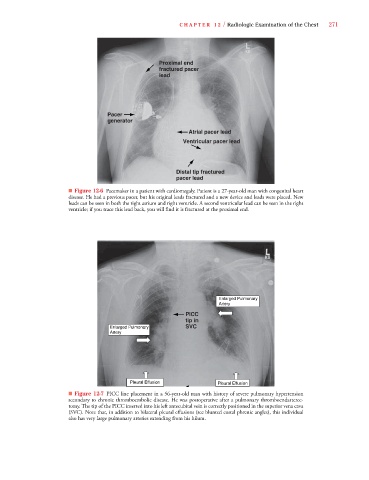
                              ■ Figure 12-6 Pacemaker in a patient with cardiomegaly. Patient is a 27-year-old man with congenital heart
                              disease. He had a previous pacer, but his original leads fractured and a new device and leads were placed. New
                              leads can be seen in both the right atrium and right ventricle. A second ventricular lead can be seen in the right
                              ventricle; if you trace this lead back, you will find it is fractured at the proximal end.
                                                                                Enlarged Pulmonary
                                                                                Artery
                                                                     PICC
                                                                     tip in
                                            Enlarged Pulmonary       SVC
                                            Artery
                                                   Pleural Effusion            Pleural Effusion
                              ■ Figure 12-7 PICC line placement in a 56-year-old man with history of severe pulmonary hypertension
                              secondary to chronic thromboembolic disease. He was postoperative after a pulmonary thromboendarterec-
                              tomy. The tip of the PICC inserted into his left antecubital vein is correctly positioned in the superior vena cava
                              (SVC). Note that, in addition to bilateral pleural effusions (see blunted costal phrenic angles), this individual
                              also has very large pulmonary arteries extending from his hilum.

