


Page 325 - Cardiac Nursing
P. 325
M
                                        M
                                     0 P
                                     0 P
                                          Pa
                                           g
                                           g
                                          Pa
                                           g
                              /29
                                /09
                             6
                              /29
                                /09
                                   0:3
                                   0:3
                                   1
                                   1
                                            e 3
                                                  ara
                                                   a
                                                  t
                                                  ara
                                                   a
                                                      c.
                                                      c.
                                                    In
                                                    In
                                              01
                                                A
                                            e 3
                                              01
                                                A
                                                 p
                                                  t
                                                 p
                                                 p
                             6
         LWB
            K34
         LWB
                    30
         LWBK340-c15_ p p pp300-332.qxd  6/29/09  10:30 PM  Page 301 Aptara Inc.
                 15_
                 15_
               0-c
            K34
               0-c
                          q
                          q
                          q
                           xd
                           xd
                        32.
                      0-3
                    30
                        32.
                      0-3
                                                                                C HAPTER 1 5 / Electrocardiography  301
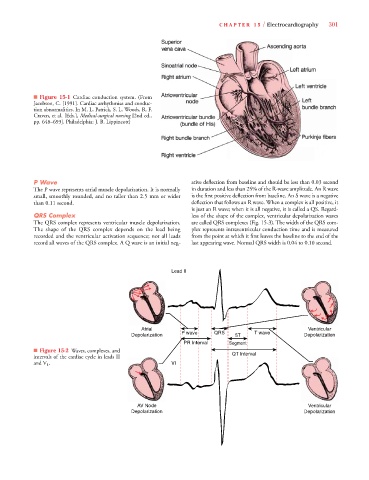
                   ■ Figure 15-1 Cardiac conduction system. (From
                   Jacobson, C. [1991]. Cardiac arrhythmias and conduc-
                   tion abnormalities. In M. L. Patrick, S. L. Woods, R. F.
                   Craven, et al. [Eds.], Medical-surgical nursing [2nd ed.,
                   pp. 648–693]. Philadelphia: J. B. Lippincott)
                   P Wave                                              ative deflection from baseline and should be less than 0.03 second
                   The P wave represents atrial muscle depolarization. It is normally  in duration and less than 25% of the R-wave amplitude. An R wave
                   small, smoothly rounded, and no taller than 2.5 mm or wider  is the first positive deflection from baseline. An S wave is a negative
                   than 0.11 second.                                   deflection that follows an R wave. When a complex is all positive, it
                                                                       is just an R wave; when it is all negative, it is called a QS. Regard-
                   QRS Complex                                         less of the shape of the complex, ventricular depolarization waves
                   The QRS complex represents ventricular muscle depolarization.  are called QRS complexes (Fig. 15-3). The width of the QRS com-
                   The shape of the QRS complex  depends on the  lead  being  plex represents intraventricular conduction time and is measured
                   recorded and the ventricular activation sequence; not all leads  from the point at which it first leaves the baseline to the end of the
                   record all waves of the QRS complex. A Q wave is an initial neg-  last appearing wave. Normal QRS width is 0.04 to 0.10 second.
                                                                Lead II
                                                      Atrial                                                 Ventricular
                                                   Depolarization  P wave     QRS    ST    T wave          Depolarization
                                                                        te
                                                                    PR Interval    Segment
                   ■ Figure 15-2 Waves, complexes, and
                                                                                        e
                                                                                         r
                   intervals of the cardiac cycle in leads II                       QT Interval
                   and V 1 .                                    VI

                                                     AV Node                                                 Ventricular
                                                   Depolarization                                          Depolarization

