


Page 326 - Cardiac Nursing
P. 326
/09
                                /09
                                   1
                             6
                              /29
                              /29
                                     0 P
                                     0 P
                                        M
                                   1
                                   0:3
                                   0:3
                      0-3
                        32.
                        32.
                    30
                    30
                      0-3
                           xd
                           xd
                             6
                          q
                          q
                          q
                                        M
                                                  t
                                                  ara
                                                  ara
                                                 p
                                                 p
                                                  t
                                                    In
                                                      c.
                                                      c.
                                                   a
                                                   a
                                                    In
                                           g
                                           g
                                            e 3
                                          Pa
                                          Pa
                                           g
                                                A
                                                A
                                                 p
                                            e 3
                                              02
                                              02
                   p
            K34
         LWB
            K34
               0-c
               0-c
         LWB
                 15_
                   p
         LWBK340-c15_ pp300-332.qxd  6/29/09  10:30 PM  Page 302 Aptara Inc.
                 15_
                  302    P A R T  III / Assessment of Heart Disease
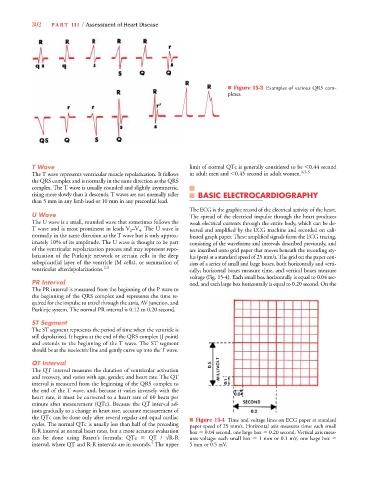
                                                                                   ■ Figure 15-3 Examples of various QRS com-
                                                                                   plexes.
                  T Wave                                              limit of normal QTc is generally considered to be  0.44 second
                  The T wave represents ventricular muscle repolarization. It follows  in adult men and  0.45 second in adult women. 2,3,5
                  the QRS complex and is normally in the same direction as the QRS
                  complex. The T wave is usually rounded and slightly asymmetric,
                  rising more slowly than it descends. T waves are not normally taller  BASIC ELECTROCARDIOGRAPHY
                  than 5 mm in any limb lead or 10 mm in any precordial lead.
                                                                      The ECG is the graphic record of the electrical activity of the heart.
                  U Wave                                              The spread of the electrical impulse through the heart produces
                  The U wave is a small, rounded wave that sometimes follows the  weak electrical currents through the entire body, which can be de-
                  T wave and is most prominent in leads V 2 –V 4 . The U wave is  tected and amplified by the ECG machine and recorded on cali-
                                                 V V
                  normally in the same direction as the T wave but is only approx-  brated graph paper. These amplified signals form the ECG tracing,
                  imately 10% of its amplitude. The U wave is thought to be part  consisting of the waveforms and intervals described previously, and
                  of the ventricular repolarization process and may represent repo-  are inscribed onto grid paper that moves beneath the recording sty-
                  larization of the Purkinje network or certain cells in the deep  lus (pen) at a standard speed of 25 mm/s. The grid on the paper con-
                  subepicardial layer of the ventricle (M cells), or summation of  sists of a series of small and large boxes, both horizontally and verti-
                  ventricular afterdepolarizations. 2,3               cally; horizontal boxes measure time, and vertical boxes measure
                                                                      voltage (Fig. 15-4). Each small box horizontally is equal to 0.04 sec-
                  PR Interval                                         ond, and each large box horizontally is equal to 0.20 second. On the
                  The PR interval is measured from the beginning of the P wave to
                  the beginning of the QRS complex and represents the time re-
                  quired for the impulse to travel through the atria, AV junction, and
                  Purkinje system. The normal PR interval is 0.12 to 0.20 second.
                  ST Segment
                  The ST segment represents the period of time when the ventricle is
                  still depolarized. It begins at the end of the QRS complex (J point)
                  and extends to the beginning of the T wave. The ST segment
                  should be at the isoelectric line and gently curve up into the T wave.
                  QT Interval
                  The QT interval measures the duration of ventricular activation
                  and recovery, and varies with age, gender, and heart rate. The QT
                  interval is measured from the beginning of the QRS complex to
                  the end of the T wave, and, because it varies inversely with the
                  heart rate, it must be corrected to a heart rate of 60 beats per
                  minute after measurement (QTc). Because the QT interval ad-
                  justs gradually to a change in heart rate, accurate measurement of
                  the QTc can be done only after several regular and equal cardiac  ■ Figure 15-4 Time and voltage lines on ECG paper at standard
                  cycles. The normal QTc is usually less than half of the preceding  paper speed of 25 mm/s. Horizontal axis measures time: each small
                  R-R interval at normal heart rates, but a more accurate evaluation  box   0.04 second, one large box   0.20 second. Vertical axis meas-
                  can be done using Bazett’s formula: QTc   QT /  √R-R  ures voltage: each small box   1 mm or 0.1 mV, one large box
                                                         4
                  interval, where QT and R-R intervals are in seconds. The upper  5 mm or 0.5 mV.

