


Page 358 - Cardiac Nursing
P. 358
2:1
                                   2:1
                                   1
                                    1
                                   1
                                     6 A
                                          Pa
                                          Pa
                                        M
                                     6 A
                                        M
                                /09
                           xd
                           xd
                          q
                          q
                          q
                             6
                                /09
                                /09
                              /30
                             6
                              /30
                                          Pa
                                                  ara
                                                  ara
                                                  t
                                                 p
                                                  t
                                                   a
                                                      c.
                                                      c.
                                                     In
                                                   a
                                                     In
                                                 p
                                            e 3
                                            e 3
                                           g
                                           g
                                           g
                                              34
                                                A
                                                 p
                                                A
                                              34
                                              34
                        87.
            K34
               0-c
                 16_
         LWB K34 0-c 16_ p p pp333-387.qxd  6/30/09  12:16 AM  Page 334 Aptara Inc.
         LWB
         LWBK340-c16_
                      3-3
                      3-3
                        87.
                    33
                    33
                  334    P A R T  III / Assessment of Heart Disease
                                                                      a rhythm due to abnormal automaticity is related to the membrane
                                                                      potential from which it arose: the less negative the membrane po-
                                                                      tential (i.e., the greater the depolarization), the faster the rate.
                                                                      Rhythms due to abnormal automaticity tend to occur at faster
                                                                      rates than rhythms due to normal automaticity. 1,2
                                                                      Triggered Activity Due to
                                                                      Afterdepolarizations
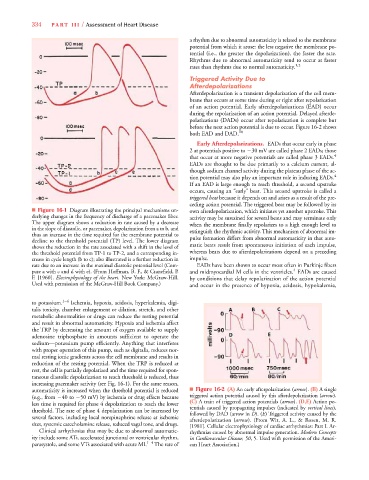
                                                                      Afterdepolarization is a transient depolarization of the cell mem-
                                                                      brane that occurs at some time during or right after repolarization
                                                                      of an action potential. Early afterdepolarizations (EAD) occur
                                                                      during the repolarization of an action potential. Delayed afterde-
                                                                      polarizations (DADs) occur after repolarization is complete but
                                                                      before the next action potential is due to occur. Figure 16-2 shows
                                                                      both EAD and DAD. 10
                                                                        Early Afterdepolarizations.  EADs that occur early in phase
                                                                      2 at potentials positive to  30 mV are called phase 2 EADs; those
                                                                      that occur at more negative potentials are called phase 3 EADs. 4
                                                                      EADs are thought to be due primarily to a calcium current, al-
                                                                      though sodium channel activity during the plateau phase of the ac-
                                                                      tion potential may also play an important role in inducing EADs. 4
                                                                      If an EAD is large enough to reach threshold, a second upstroke
                                                                      occurs, causing an “early” beat. This second upstroke is called a
                                                                      triggered beat because it depends on and arises as a result of the pre-
                                                                      ceding action potential. The triggered beat may be followed by its
                  ■ Figure 16-1 Diagram illustrating the principal mechanisms un-  own afterdepolarization, which initiates yet another upstroke. This
                  derlying changes in the frequency of discharge of a pacemaker fiber.  activity may be sustained for several beats and may terminate only
                  The upper diagram shows a reduction in rate caused by a decrease  when the membrane finally repolarizes to a high enough level to
                  in the slope of diastolic, or pacemaker, depolarization from a to b, and  extinguish the rhythmic activity. This mechanism of abnormal im-
                  thus an increase in the time required for the membrane potential to  pulse formation differs from abnormal automaticity in that auto-
                  decline to the threshold potential (TP) level. The lower diagram
                  shows the reduction in the rate associated with a shift in the level of  matic beats result from spontaneous initiation of each impulse,
                  the threshold potential from TP-1 to TP-2, and a corresponding in-  whereas beats due to afterdepolarizations depend on a preceding
                  crease in cycle length (b to c); also illustrated is a further reduction in  impulse.
                  rate due to an increase in the maximal diastolic potential level (Com-  EADs have been shown to occur most often in Purkinje fibers
                                                                                                        4
                  pare a with c and d with e). (From Hoffman, B. F., & Cranefield, P .  and midmyocardial M cells in the ventricles. EADs are caused
                  F. [1960]. Electrophysiology of the heart. New York: McGraw-Hill.  by conditions that delay repolarization of the action potential
                  Used with permission of the McGraw-Hill Book Company.)  and occur in the presence of hypoxia, acidosis, hypokalemia,
                  to potassium. 1–4  Ischemia, hypoxia, acidosis, hyperkalemia, digi-
                  talis toxicity, chamber enlargement or dilation, stretch, and other
                  metabolic abnormalities or drugs can reduce the resting potential
                  and result in abnormal automaticity. Hypoxia and ischemia affect
                  the TRP by decreasing the amount of oxygen available to supply
                  adenosine triphosphate in amounts sufficient to operate the
                  sodium—potassium pump efficiently. Anything that interferes
                  with proper operation of this pump, such as digitalis, reduces nor-
                  mal resting ionic gradients across the cell membrane and results in
                  reduction of the resting potential. When the TRP is reduced at
                  rest, the cell is partially depolarized and the time required for spon-
                  taneous diastolic depolarization to reach threshold is reduced, thus
                  increasing pacemaker activity (see Fig. 16-1). For the same reason,
                  automaticity is increased when the threshold potential is reduced  ■ Figure 16-2 (A) An early afterpolarization (arrow). (B) A single
                  (e.g., from  40 to  50 mV) by ischemia or drug effects because  triggered action potential caused by this afterdepolarization (arrow).
                  less time is required for phase 4 depolarization to reach the lower  (C) A train of triggered action potentials (arrow). (D,E) Action po-
                                                                                                                     s
                  threshold. The rate of phase 4 depolarization can be increased by  tentials caused by propagating impulses (indicated by vertical lines),
                                                                      followed by DAD (arrow in D). (E) Triggered activity caused by the
                                                                                              E
                                                                                              E
                  several factors, including local norepinephrine release at ischemic  afterdepolarization (arrow).  (From  Wit, A. L., & Rosen, M. R.
                  sites, systemic catecholamine release, reduced vagal tone, and drugs.  [1981]. Cellular electrophysiology of cardiac arrhythmias: Part I. Ar-
                     Clinical arrhythmias that may be due to abnormal automatic-  rhythmias caused by abnormal impulse generation. Modern Concepts
                  ity include some ATs, accelerated junctional or ventricular rhythm,  in Cardiovascular Disease, 50, 5. Used with permission of the Ameri-
                  parasystole, and some VTs associated with acute MI. 1–4 The rate of  can Heart Association.)

