


Page 367 - Cardiac Nursing
P. 367
g
                                           g
                                          Pa
                                           g
                                              43
                                              43
                                            e 3
                                            e 3
                                   2:1
                                     6 A
                                   1
                                   2:1
                                        M
                                          Pa
                                     6 A
                                        M
                                                A
                                                   a
                                                     In
                                                  ara
                                                   a
                                                      c.
                                                      c.
                                                     In
                                                      c.
                                                 p
                                                 p
                                                A
                                                A
                                                  t
                                                  ara
                                                 p
                                                  t
                                   1
                    33
                    33
                   p
                        87.
                      3-3
                      3-3
                 16_
            K34
            K34
         LWBK340-c16_ p pp333-387.qxd  6/30/09  12:16 AM  Page 343 Aptara Inc.
                 16_
               0-c
               0-c
                              6
                             6
                           xd
                          q
                           xd
                                /09
                                /09
                              /30
                             6
                              /30
                          q
                          q
                        87.
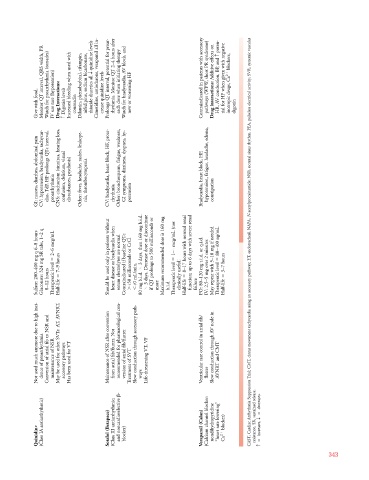
                      Monitor QT interval, QRS width, PR Watch for proarrhythmia (torsades)  Increased bleeding when used with  Dilantin, phenobarbital, rifampin, nifedipine, sodium bicarbonate,  quinidine levels Cimetidine, amiodarone, verapamil all in- Prolongs QT interval, potential for proar- rhythmia. Monitor QT 2–4 hours after each dose when initiating therapy Watch for bradycardia, AV block, and  Contraindicated in patients with accessory pathways (WPW, short PR syndrome)  Additive effects on  poten- HR, AV conduction, BP , and
                    Give with food.  IV use rare (hypotension)  Drug Interactions:  Digoxin levels  c  coumadin  thiazide diuretics all T  crease quinidine levels  new or worsening HF  Drug interactions:  digoxin
                    GI: nausea, diarrhea, abdominal pain CV: hypotension, bradycardia, tachycar- dias, TdP , HF prolongs QTc interval,  proarrhythmia CNS: cinchonism (tinnitus, hearing loss, confusion, delirium, visual  disturbances, psychosis) Other: fever, headache, rashes, leukope-  nia, thrombocytopenia  CV: bradycardia, heart block, HF, proar-  rhythmia Other: bronchospasm, fatigue, weakness, GI symptoms, dizziness, dyspnea, hy-  potension  Bradycardia, heart block, HF, hypotension, fatigue, headache, edema,  constipation  N  N
                    Sulfate: 200–400 mg q 6–8 hours Gluconate: 324 mg SR tabs, 1–2 q   8–12 hours  2–6 mcg/mL    Therapeutic level  7–9 hours     Half-life  Should be used only in patients without heart disease or bradycardia when serum electrolytes are normal Contraindicated if baseline QTc   450 milliseconds or CrCl   40 mL/min. 3 days, then 160 mg b.i.d. 80 mg b.i.d.   3 days. Decrease dose or discontinue    if QT prolongs to 500 milliseconds or  more Maximum recommended dose is 160 mg  b.i.d  1–4 mcg/mL (not Therapeutic level    c
                    Not used much anymore due to high inci-  dence of proarrhythmia Conversion of atrial fib to NSR and  maintenance of NSR May be used for other SVTs: AT, AVNRT,  accessory pathways  Has been used for VT  Maintenance of NSR after conversion from atrial fib/flutter. Not recommended for pharmacological con- version of atrial fib/flutter  Treatment of SVT Slow conduction through accessory path-  Life-threatening VT, VF  Ventricular rate control in atrial fib/  Slow conduction through AV node in  AVNRT and CMT


                                                -     ways                  flutter           decreases.
                      (Class IA antiarrhythmic)  Sotalol (Betapace) (Class III antiarrhythmic;  and noncardioselective  Verapamil (Calan) (Calcium channel blocker:  nondihydropyridine  “heart rate lowering”  blocker)  resistance, SR, sustained release.    increases, T


                    Quinidine                    blocker)                        Ca 2


                                                                                             c
                                                                                                                   343

