


Page 371 - Cardiac Nursing
P. 371
xd
                           xd
                                              47
                                              47
                             6
                              /30
                                /09
                             6
                              /30
                          q
                                                A
                      3-3
                                                 p
                                                A
                      3-3
                          q
                          q
                        87.
                        87.
                                /09
                                          Pa
                                           g
                                          Pa
                                          Pa
                                           g
                                            e 3
                                              47
                                           g
                                            e 3
                                        M
                                   1
                                   1
                                /09
                                    1
                                   2:1
                                     6 A
                                        M
                                   2:1
                                     6 A
            K34
               0-c
         LWBK340-c16_
         LWB K34 0-c 16_ p p pp333-387.qxd  6/30/09  12:16 AM  Page 347 Aptara Inc.
         LWB
                                                      c.
                                                      c.
                                                     In
                 16_
                                                     In
                                                  t
                                                  t
                                                 p
                    33
                    33
                                                  ara
                                                 p
                                                   a
                                                  ara
                                                   a
                                                             C HAPTER 1 6 / Arrhythmias and Conduction Disturbances  347
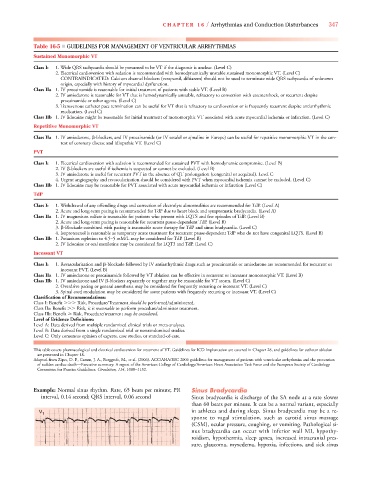
                   Table 16-5 ■ GUIDELINES FOR MANAGEMENT OF VENTRICULAR ARRHYTHMIAS
                   Sustained Monomorphic VT
                   Class I:  1. Wide QRS tachycardia should be presumed to be VT if the diagnosis is unclear. (Level C)
                          2. Electrical cardioversion with sedation is recommended with hemodynamically unstable sustained monomorphic VT. (Level C)
                            CONTRAINDICATED: Calcium channel blockers (verapamil, diltiazem) should not be used to terminate wide QRS tachycardia of unknown
                            origin, especially with history of myocardial dysfunction.
                   Class IIa 1. IV procainamide is reasonable for initial treatment of patients with stable VT. (Level B)
                          2. IV amiodarone is reasonable for VT that is hemodynamically unstable, refractory to conversion with countershock, or recurrent despite
                            procainamide or other agents. (Level C)
                          3. Transvenous catheter pace termination can be useful for VT that is refractory to cardioversion or is frequently recurrent despite antiarrhythmic
                            medication. (Level C)
                   Class IIb 1. IV lidocaine might be reasonable for initial treatment of monomorphic VT associated with acute myocardial ischemia or infarction. (Level C)
                   Repetitive Monomorphic VT
                   Class IIa 1. IV amiodarone,  -blockers, and IV procainamide (or IV sotalol or ajmaline in Europe) can be useful for repetitive monomorphic VT in the con-
                            text of coronary disease and idiopathic VT. (Level C)
                   PVT
                   Class I:  1. Electrical cardioversion with sedation is recommended for sustained PVT with hemodynamic compromise. (Level B)
                          2. IV  -blockers are useful if ischemia is suspected or cannot be excluded. (Level B)
                          3. IV amiodarone is useful for recurrent PVT in the absence of QT prolongation (congenital or acquired). Level C
                          4. Urgent angiography and revascularization should be considered with PVT when myocardial ischemia cannot be excluded. (Level C)
                   Class IIb 1. IV lidocaine may be reasonable for PVT associated with acute myocardial ischemia or infarction (Level C)
                   TdP
                   Class I:  1. Withdrawal of any offending drugs and correction of electrolyte abnormalities are recommended for TdP. (Level A)
                          2. Acute and long-term pacing is recommended for TdP due to heart block and symptomatic bradycardia. (Level A)
                   Class IIa 1. IV magnesium sulfate is reasonable for patients who present with LQTS and few episodes of TdP. (Level B)
                          2. Acute and long-term pacing is reasonable for recurrent pause-dependent TdP. (Level B)
                          3.  -Blockade combined with pacing is reasonable acute therapy for TdP and sinus bradycardia. (Level C)
                          4. Isoproterenol is reasonable as temporary acute treatment for recurrent pause-dependent TdP who do not have congenital LQTS. (Level B)
                   Class IIb 1. Potassium repletion to 4.5–5 mM/L may be considered for TdP. (Level B)
                          2. IV lidocaine or oral mexiletine may be considered for LQT3 and TdP. (Level C)
                   Incessant VT
                   Class I:  1. Revascularization and  -blockade followed by IV antiarrhythmic drugs such as procainamide or amiodarone are recommended for recurrent or
                            incessant PVT. (Level B)
                   Class IIa 1. IV amiodarone or procainamide followed by VT ablation can be effective in recurrent or incessant monomorphic VT. (Level B)
                   Class IIb 1. IV amiodarone and IV  -blockers separately or together may be reasonable for VT storm. (Level C)
                          2. Overdrive pacing or general anesthesia may be considered for frequently recurring or incessant VT. (Level C)
                          3. Spinal cord modulation may be considered for some patients with frequently recurring or incessant VT. (Level C)
                   Classification of Recommendations:
                   Class I: Benefit     Risk, Procedure/Treatment should be performed/administered.
                   Class IIa: Benefit    Risk, it is reasonable to perform procedure/administer treatment.
                   Class IIb: Benefit   Risk, Procedure/treatment may be considered.
                                                           d
                                                           d
                   Level of Evidence Definitions:
                   Level A: Data derived from multiple randomized clinical trials or meta-analyses.
                   Level B: Data derived from a single randomized trial or nonrandomized studies.
                   Level C: Only consensus opinion of experts, case studies, or standard-of-care.
                   This table covers pharmacological and electrical cardioversion for treatment of VT. Guidelines for ICD implantation are covered in Chapter 28, and guidelines for catheter ablation
                    are presented in Chapter 18.
                   Adapted from Zipes, D. P., Camm, J. A., Borggrefe, M., et al. (2006). ACC/AHA/ESC 2006 guidelines for management of patients with ventricular arrhythmias and the prevention
                    of sudden cardiac death—Executive summary: A report of the American College of Cardiology/American Heart Association Task Force and the European Society of Cardiology
                    Committee for Practice Guidelines. Circulation, 114, 1088–1132.4 4
                   Example: Normal sinus rhythm. Rate, 65 beats per minute; PR  Sinus Bradycardia
                     interval, 0.14 second; QRS interval, 0.06 second  Sinus bradycardia is discharge of the SA node at a rate slower
                                                                       than 60 beats per minute. It can be a normal variant, especially
                     V 1                                               in athletes and during sleep. Sinus bradycardia may be a re-
                                                                       sponse to vagal stimulation, such as carotid sinus massage
                                                                       (CSM), ocular pressure, coughing, or vomiting. Pathological si-
                                                                       nus bradycardia can occur with inferior wall MI, hypothy-
                                                                       roidism, hypothermia, sleep apnea, increased intracranial pres-
                                                                       sure, glaucoma, myxedema, hypoxia, infections, and sick sinus

