


Page 372 - Cardiac Nursing
P. 372
1
                                   1
                                   2:1
                                /09
                                /09
                                    1
                                        M
                                        M
                                          Pa
                                   2:1
                                     6 A
                                     6 A
                                /09
                          q
                          q
                          q
                      3-3
                        87.
                        87.
                             6
                              /30
                              /30
                           xd
                           xd
                             6
                                                  t
                                                  ara
                                                  ara
                                                 p
                                                 p
                                                  t
                                                     In
                                                      c.
                                                      c.
                                                   a
                                                   a
                                                     In
                                                 p
                                           g
                                           g
                                            e 3
                                          Pa
                                          Pa
                                           g
                                              48
                                                A
                                                A
                                            e 3
                                              48
                                              48
                      3-3
         LWB
         LWB K34 0-c 16_ p p pp333-387.qxd  6/30/09  12:16 AM  Page 348 Aptara Inc.
                    33
         LWBK340-c16_
                 16_
               0-c
            K34
                    33
                  348    P A R T  III / Assessment of Heart Disease
                  syndrome. 5,14,15  Sinus bradycardia can be a response to several  P waves: Precede every QRS; have consistent shape; may be
                  medications, including digitalis,  -blockers, calcium channel  buried in the preceding T wave
                  blockers, and antiarrhythmics.                      PR interval: Usually normal, may be difficult to measure if P
                     The following are ECG characteristics of sinus bradycardia:  waves are buried in T waves
                                                                      QRS complex: Usually normal
                  Rate: Less than 60 beats per minute                 Conduction: Normal through atria, AV node, bundle branches,
                  Rhythm: Regular                                       and ventricles
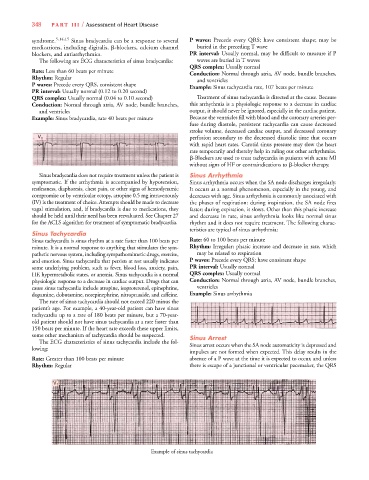
                  P waves: Precede every QRS, consistent shape        Example: Sinus tachycardia rate, 107 beats per minute
                  PR interval: Usually normal (0.12 to 0.20 second)
                  QRS complex: Usually normal (0.04 to 0.10 second)     Treatment of sinus tachycardia is directed at the cause. Because
                  Conduction: Normal through atria, AV node, bundle branches,  this arrhythmia is a physiologic response to a decrease in cardiac
                     and ventricles                                   output, it should never be ignored, especially in the cardiac patient.
                  Example: Sinus bradycardia, rate 40 beats per minute  Because the ventricles fill with blood and the coronary arteries per-
                                                                      fuse during diastole, persistent tachycardia can cause decreased
                                                                      stroke volume, decreased cardiac output, and decreased coronary
                    V 1                                               perfusion secondary to the decreased diastolic time that occurs
                                                                      with rapid heart rates. Carotid sinus pressure may slow the heart
                                                                      rate temporarily and thereby help in ruling out other arrhythmias.
                                                                       -Blockers are used to treat tachycardia in patients with acute MI
                                                                      without signs of HF or contraindications to  -blocker therapy.
                     Sinus bradycardia does not require treatment unless the patient is  Sinus Arrhythmia
                  symptomatic. If the arrhythmia is accompanied by hypotension,  Sinus arrhythmia occurs when the SA node discharges irregularly.
                  restlessness, diaphoresis, chest pain, or other signs of hemodynamic  It occurs as a normal phenomenon, especially in the young, and
                  compromise or by ventricular ectopy, atropine 0.5 mg intravenously  decreases with age. Sinus arrhythmia is commonly associated with
                  (IV) is the treatment of choice. Attempts should be made to decrease  the phases of respiration: during inspiration, the SA node fires
                  vagal stimulation, and, if bradycardia is due to medications, they  faster; during expiration, it slows. Other than this phasic increase
                  should be held until their need has been reevaluated. See Chapter 27  and decrease in rate, sinus arrhythmia looks like normal sinus
                  for the ACLS algorithm for treatment of symptomatic bradycardia.  rhythm and it does not require treatment. The following charac-
                                                                      teristics are typical of sinus arrhythmia:
                  Sinus Tachycardia
                  Sinus tachycardia is sinus rhythm at a rate faster than 100 beats per  Rate: 60 to 100 beats per minute
                  minute. It is a normal response to anything that stimulates the sym-  Rhythm: Irregular; phasic increase and decrease in rate, which
                  pathetic nervous system, including sympathomimetic drugs, exercise,  may be related to respiration
                  and emotion. Sinus tachycardia that persists at rest usually indicates  P waves: Precede every QRS; have consistent shape
                  some underlying problem, such as fever, blood loss, anxiety, pain,  PR interval: Usually normal
                  HF, hypermetabolic states, or anemia. Sinus tachycardia is a normal  QRS complex: Usually normal
                  physiologic response to a decrease in cardiac output. Drugs that can  Conduction: Normal through atria, AV node, bundle branches,
                  cause sinus tachycardia include atropine, isoproterenol, epinephrine,  ventricles
                  dopamine, dobutamine, norepinephrine, nitroprusside, and caffeine.  Example: Sinus arrhythmia
                     The rate of sinus tachycardia should not exceed 220 minus the
                  patient’s age. For example, a 40-year-old patient can have sinus
                  tachycardia up to a rate of 180 beats per minute, but a 70-year-
                  old patient should not have sinus tachycardia at a rate faster than
                  150 beats per minute. If the heart rate exceeds these upper limits,
                  some other mechanism of tachycardia should be suspected.  Sinus Arrest
                     The ECG characteristics of sinus tachycardia include the fol-  Sinus arrest occurs when the SA node automaticity is depressed and
                  lowing:
                                                                      impulses are not formed when expected. This delay results in the
                                                                                                             r
                  Rate: Greater than 100 beats per minute             absence of a P wave at the time it is expected to occur, and unless
                                                                                                             r
                  Rhythm: Regular                                     there is escape of a junctional or ventricular pacemaker, the QRS
                         V 1
                                                         Example of sinus tachycardia

