


Page 455 - Cardiac Nursing
P. 455
ara
                                                       Apt
                                                         ara
                       0-4
                                           7 A
                                                    31
                                                  e 4
                                                    31
                                                       Apt
                                                    31
                                        8:2
                                             M
                                           7 A
                                        0
                                        8:2
                                             M
                       0-4
                    p42
                                                 g
                    p42
                                                  e 4
                                9/0
                                               P
                                9/0
                               0
                               0
                                    009
                                        0
                                    009
                                  9/2
                                  9/2
                                               P
                                               P
                                                a
                                                 g
                                                a
                           qxd
                           qxd
                         38.
                         38.
                         38.
               0-c
            K34
               0-c
                 19_
                 19_
         L L LWB
         LWBK340-c19_19_p420-438.qxd  09/09/2009  08:27 AM  Page 431 Aptara
         LWB
            K34
            K34
                                                                                   C HAPTER 1 9 / Exercise Testing  431
                   by the patient’s request to stop. The reason for stopping the test
                   should be carefully recorded because the symptoms or signs  RECOVERY PERIOD
                   manifested by exercise often relate to the mechanism of impair-
                   ment. Determining the endpoint of an exercise test can be prob-  Some debate exists as to whether the postexercise recovery period
                   lematic. It requires integration of objective physiologic data and  should be an active or passive process. This decision should be
                   termination criteria with subjective judgment based on clinical  made on the basis of the purpose of the exercise test. If the test is
                   experience. Some patients may be unable or unwilling to exer-  performedfor diagnostic purposes, then it appears to be of value
                   cise to an adequate level. In patients with suspected coronary  to place the patient in the supine position immediately after stop-
                   disease, a symptom-limited, maximal test is usually more diag-  ping exercise. The increase in venous return to the heart observed
                   nostic. Thus, patients should be instructed to exercise to the  in the supine position results in increases in ventricular volume,
                   point at which they can no longer continue because of fatigue,  wall stress, and, consequently, myocardial oxygen demand. Several
                   dyspnea, or other symptoms. They should be informed that the  studies have shown that ST-segment abnormalities are enhanced
                   test will be terminated if abnormal responses are observed by the  in the supine position and that an active recovery may attenuate
                   operators. Although patients should be encouraged to exercise as  the magnitude of these changes. 4,73  Once thought to be false-
                   long as possible, they should not be pushed beyond their capacity  positive responses, ST-segment changes 2 to 4 minutes into
                   and any request to stop the test should be honored. Inability to  recovery are now known to be particularly important for the de-
                   fully monitor the patient’s responses because of technical difficul-  tection of ischemia. Patients with symptom-limiting angina or
                   ties should result in immediate termination of the test. Most prob-  dyspnea may become more uncomfortable in the supine position
                   lems can be avoided by having an experienced physician, nurse, or  and should recover in a seated upright or semirecumbent position.
                   exercise physiologist standing next to the patient, measuring blood  If the test is performedfor nondiagnostic purposes such as for a
                   pressure and assessing patient appearance during the test. The ex-  fitness evaluation in a healthy or athletic person, then an active re-
                   ercise technician should operate the recorder and treadmill, take  covery may be safer and more comfortable.
                   appropriate tracings, enter data on a form, and alert the physician  Typically, an active recovery period consists of walking on the
                   to any abnormalities that may appear on the monitor.  treadmill at a speed of 1.5 to 2.0 mph or continuing to pedal the
                     Although many efforts have been made to objectify maximal  cycle ergometer slowly at a work rate ranging from 0 to 25 W. An
                   effort, such as age-predicted maximal heart rate, a plateau in oxy-  active recovery decreases the risk of hypotension and may mini-
                   gen uptake, exceeding the ventilatory threshold, or a respiratory  mize the risk of dysrhythmias secondary to elevated cate-
                   exchange ratio greater than unity, all have considerable measure-  cholamines in the postexercise period. Standing recovery should
                   ment error and intersubject variability. 50,68–71  This variability oc-  be avoided because of potential complications associated with ve-
                   curs regardless of the population tested. The 95% confidence lim-  nous pooling. Regardless of the method of recovery, patients
                   its  for maximal  heart rate  based on age,  for example, range  should be monitored for at least 6 to 8 minutes into the postexer-
                   considerably (see Fig. 19-3); therefore, this endpoint is maximal  cise period. Blood pressure, the electrocardiogram, and symptoms
                                              17
                   for some and submaximal for others. The classic index of a per-  should be monitored and recorded at 2-minute intervals for the
                   son’s cardiopulmonary limits, a plateau in oxygen uptake, is not  duration of the recovery period. The recovery period should be ex-
                   observed in many patients, is poorly reproducible, and has been  tended as long as necessary to resolve symptoms or abnormal he-
                   confused by the many different criteria applied. 68–71  Although  modynamic or electrocardiographic responses. After completion
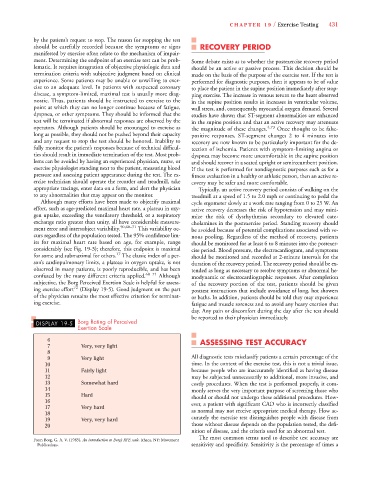
                   subjective, the Borg Perceived Exertion Scale is helpful for assess-  of the recovery portion of the test, patients should  be given
                   ing exercise effort 72  (Display 19-5). Good judgment on the part  posttest instructions that include avoidance of long, hot showers
                   of the physician remains the most effective criterion for terminat-  or baths. In addition, patients should be told they may experience
                   ing exercise.                                       fatigue and muscle soreness and to avoid any heavy exertion that
                                                                       day. Any pain or discomfort during the day after the test should
                                                                       be reported to their physician immediately.
                    DISPLAY 19-5  Borg Rating of Perceived
                                 Exertion Scale
                        6                                                ASSESSING TEST ACCURACY
                        7          Very, very light
                        8
                        9          Very light                          All diagnostic tests misclassify patients a certain percentage of the
                       10                                              time. In the context of the exercise test, this is not a trivial issue,
                       11          Fairly light                        because people who are inaccurately identified as havingdisease
                       12                                              may be subjected unnecessarily to additional, more invasive, and
                       13          Somewhat hard                       costly procedures. When the test is performedproperly, it com-
                       14                                              monly serves the very important purpose of screening those who
                       15          Hard                                should or should not undergo these additional procedures. How-
                       16                                              ever, a patient with significant CAD who is incorrectly classified
                       17          Very hard
                       18                                              as normal may not receive appropriate medical therapy. How ac-
                       19          Very, very hard                     curately the exercise test distinguishes people withdisease from
                       20                                              those without disease depends on the population tested, the defi-
                                                                       nition of disease, and the criteria used for an abnormal test.
                                                                         The most common terms used to describe test accuracy are
                   From Borg, G. A. V. (1985). An introduction to Borg’s RPE scale. Ithaca, NY: Movement
                    Publications.                                      sensitivity and specificity. Sensitivity is the percentage of times a

