


Page 52 - Cardiac Nursing
P. 52
92806_c01.qxd  11/21/11  10:30 AM  Page 28


                     28   PA R T  I / Anatomy and Physiology


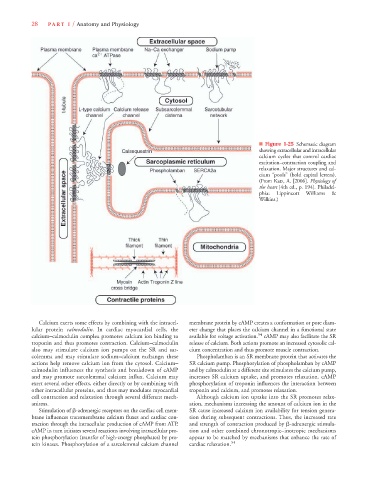
                                                                                               ■ Figure 1-25 Schematic diagram
                                                                                               showing extracellular and intracellular
                                                                                               calcium cycles that control cardiac
                                                                                               excitation–contraction coupling and
                                                                                               relaxation. Major structures and cal-
                                                                                               cium “pools” (bold capital letters).
                                                                                               (From Katz, A. [2006]. Physiology of
                                                                                               the heart [4th ed., p. 194]. Philadel-
                                                                                               phia: Lippincott  Williams &
                                                                                               Wilkins.)


                       Calcium exerts some effects by combining with the intracel-  membrane protein by cAMP creates a conformation or pore diam-
                    lular protein  calmodulin. In cardiac myocardial cells, the  eter change that places the calcium channel in a functional state
                    calcium–calmodulin complex promotes calcium ion binding to  available for voltage activation. 54  cAMP may also facilitate the SR
                    troponin and thus promotes contraction. Calcium–calmodulin  release of calcium. Both actions promote an increased cytosolic cal-
                    also may stimulate calcium ion pumps on the SR and sar-  cium concentration and thus promote muscle contraction.
                    colemma and may stimulate sodium–calcium exchange; these  Phospholamban is an SR membrane protein that activates the
                    actions help remove calcium ion from the cytosol. Calcium–  SR calcium pump. Phosphorylation of phospholamban by cAMP
                    calmodulin influences the synthesis and breakdown of cAMP  and by calmodulin at a different site stimulates the calcium pump,
                    and may promote sarcolemmal calcium influx. Calcium may  increases SR calcium uptake, and promotes relaxation. cAMP
                    exert several other effects, either directly or by combining with  phosphorylation of troponin influences the interaction between
                    other intracellular proteins, and thus may modulate myocardial  troponin and calcium, and promotes relaxation.
                    cell contraction and relaxation through several different mech-  Although calcium ion uptake into the SR promotes relax-
                    anisms.                                             ation, mechanisms increasing the amount of calcium ion in the
                       Stimulation of  -adrenergic receptors on the cardiac cell mem-  SR cause increased calcium ion availability for tension genera-
                    brane influences transmembrane calcium fluxes and cardiac con-  tion during subsequent contractions. Thus, the increased rate
                    traction through the intracellular production of cAMP from ATP.  and strength of contraction produced by  -adrenergic stimula-
                    cAMP in turn initiates several reactions involving intracellular pro-  tion and other combined chronotropic–inotropic mechanisms
                    tein phosphorylation (transfer of high-energy phosphates) by pro-  appear to be matched by mechanisms that enhance the rate of
                    tein kinases. Phosphorylation of a sarcolemmal calcium channel  cardiac relaxation. 54

