


Page 504 - Cardiac Nursing
P. 504
LWBK340-c21_p460-510.qxd  09/09/2009  08:28 AM  Page 480 Aptara


                  480    PA R T  III / Assessment of Heart Disease


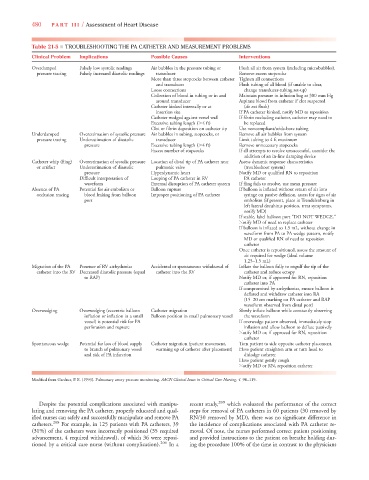
                  Table 21-5 ■ TROUBLESHOOTING THE PA CATHETER AND MEASUREMENT PROBLEMS
                  Clinical Problem  Implications         Possible Causes              Interventions
                  Overdamped      Falsely low systolic readings  Air bubbles in the pressure tubing or   Flush all air from system (including microbubbles).
                    pressure tracing  Falsely increased diastolic readings  transducer  Remove excess stopcocks
                                                         More than three stopcocks between catheter Tighten all connections
                                                           and transducer             Flush tubing of all blood (if unable to clear,
                                                         Loose connections              change transducer-tubing set-up)
                                                         Collection of blood in tubing or in and   Maintain pressure in infusion bag at 300 mm Hg
                                                           around transducer          Aspirate blood from catheter if clot suspected
                                                         Catheter kinked internally or at   (do not flush)
                                                           insertion site             If PA catheter kinked, notify MD to reposition
                                                         Catheter wedged against vessel wall  If fibrin occluding catheter, catheter may need to
                                                         Excessive tubing length ( 4 ft)  be replaced
                                                         Clot or fibrin deposition on catheter tip  Use noncompliant/wide-bore tubing
                  Underdamped     Overestimation of systolic pressure  Air bubbles in tubing, stopcocks, or   Remove all air bubbles from system
                    pressure tracing  Underestimation of diastolic   transducer       Limit tubing to 4 ft maximum
                                    pressure             Excessive tubing length ( 4 ft)  Remove unnecessary stopcocks
                                                         Excess number of stopcocks   If all attempts to resolve unsuccessful, consider the
                                                                                        addition of an in-line damping device
                  Catheter whip (fling)   Overestimation of systolic pressure  Location of distal tip of PA catheter near   Assess dynamic response characteristics
                    or artifact   Underestimation of diastolic   pulmonic valve         (troubleshoot system)
                                    pressure             Hyperdynamic heart           Notify MD or qualified RN to reposition
                                  Difficult interpretation of   Looping of PA catheter in RV  PA catheter
                                    waveform             External disruption of PA catheter system  If fling fails to resolve, use mean pressure
                  Absence of PA   Potential for air embolism or    Balloon rupture    If balloon is inflated without return of air into
                                                                                                                   f
                    occlusion tracing  blood leaking from balloon   Improper positioning of PA catheter  syringe on passive deflation, assess for signs of air
                                                                          A
                                    port                                                embolism (if present, place in Trendelenburg in
                                                                                        left lateral decubitus position, treat symptoms,
                                                                                        notify MD)
                                                                                      If stable, label balloon port “DO NOT WEDGE.”
                                                                                      Notify MD of need to replace catheter
                                                                                      If balloon is inflated to 1.5 mL, without change in
                                                                                        waveform from PA to PA wedge pattern, notify
                                                                                        MD or qualified RN of need to reposition
                                                                                        catheter
                                                                                      Once catheter is repositioned, assess the amount of
                                                                                        air required for wedge (ideal volume
                                                                                        1.25–1.5 mL)
                  Migration of the PA   Presence of RV arrhythmias  Accidental or spontaneous withdrawal of   Inflate the balloon fully to engulf the tip of the
                    catheter into the RV Decreased diastolic pressure (equal   catheter into the RV  catheter and reduce ectopy
                                    to RAP)                                           Notify MD or, if approved for RN, reposition
                                                                                        catheter into PA
                                                                                      If compromised by arrhythmias, ensure balloon is
                                                                                        deflated and withdraw catheter into RA
                                                                                        (15–20 cm marking on PA catheter and RAP
                                                                                        waveform observed from distal port)
                  Overwedging     Overwedging (eccentric balloon   Catheter migration  Slowly inflate balloon while constantly observing
                                    inflation or inflation in a small   Balloon position in small pulmonary vessel  the waveform
                                    vessel) is potential risk for PA                  If overwedge pattern observed, immediately stop
                                    perforation and rupture                             inflation and allow balloon to deflate passively
                                                                                      Notify MD or, if approved for RN, reposition
                                                                                        catheter
                  Spontaneous wedge  Potential for loss of blood supply   Catheter migration (patient movement,   Turn patient to side opposite catheter placement.
                                    to branch of pulmonary vessel   warming up of catheter after placement)  Have patient straighten arm or turn head to
                                    and risk of PA infarction                           dislodge catheter
                                                                                      Have patient gently cough
                                                                                      Notify MD or RN, reposition catheter

                                                                                      4
                                                                                      4
                  Modified from Gardner, P. E. (1993). Pulmonary artery pressure monitoring. AACN Clinical Issues in Critical Care Nursing, 4, 98–119.

                     Despite the potential complications associated with manipu-  recent study, 209  which evaluated the performance of the correct
                  lating and removing the PA catheter, properly educated and qual-  steps for removal of PA catheters in 60 patients (30 removed by
                  ified nurses can safely and successfully manipulate and remove PA  RN/30 removed by MD), there was no significant difference in
                  catheters. 208  For example, in 125 patients with PA catheters, 39  the incidence of complications associated with PA catheter re-
                  (31%) of the catheters were incorrectly positioned (35 required  moval. Of note, the nurses performed correct patient positioning
                  advancement, 4 required withdrawal), of which 36 were reposi-  and provided instructions to the patient on breathe holding dur-
                  tioned by a critical care nurse (without complication). 206  In a  ing the procedure 100% of the time in contrast to the physicians

