


Page 503 - Cardiac Nursing
P. 503
qxd
                                                    79
                                                    79
                                  9/2
                                9/0
                               0
                                                  e 4
                       0-5
                                                 g
                                               P
                    p46
                         10.
                         10.
                                    009
            K34
               0-c
                 21_
            K34
         LWB K34 0-c 21_ p46 0-5 10. qxd  0 9/0 9/2 009  0 0 8:2 8 A M  P a a g e 4 79  Apt ara
         L L LWB
         LWBK340-c21_21_p460-510.qxd  09/09/2009  08:28 AM  Page 479 Aptara
                                                       Apt
                                        8:2
                                           8 A
                                               P
                                             M
                                                         ara
                                                                           C HAPTER 2 1 / Hemodynamic Monitoring   479
                            Pre-relaxation                             DISPLAY 21-6 Removal of PA Catheter
                         30                    Mid-Point  End-Expiration  1. Verify the order to remove the catheter
                         20
                                                                         2. Assemble necessary equipment
                      Pulmonary Artery Occlusion Pressure (mm Hg)  10 0  Post-relaxation  Ventilator  3. Document on the flow sheet the ECG rhythm and vital
                                             Inspiratory Nadir
                                                                           signs before initiating the procedure
                                                                         4. Explain the procedure to the patient
                                                                         5. Transfer IV infusions from PA catheter ports to side
                         30
                                                                           port of introducer or discontinue IV solutions if appro-
                                                                           priate
                         20
                                                                         6. Ensure that the patient remains in hemodynamically
                                       End-Expiration
                                                                           stable condition after transfer of infusions to side port
                         10
                                                                         7. Turn off any remaining infusions to distal and proximal
                          0
                               1 sec                                       ports
                                                                         8. Ensure that the balloon is deflated by lining up the red
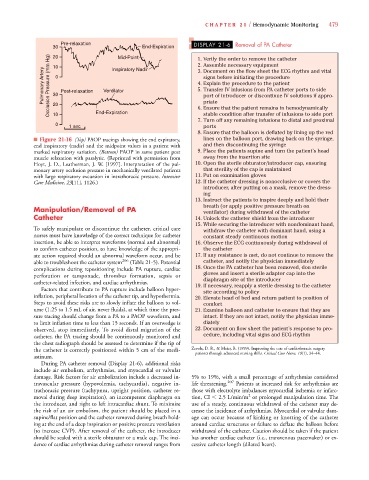
                   ■ Figure 21-16 (Top) PAOP tracings showing the end expiratory,  lines on the balloon port, drawing back on the syringe,
                   end inspiratory (nadir) and the midpoint values in a patient with  and then discontinuing the syringe
                   marked respiratory variation. (Bottom) PAOP in same patient post  9. Place the patients supine and turn the patient’s head
                   muscle relaxation with paralytic. (Reprinted with permission from  away from the insertion site
                   Hoyt, J. D., Leatherman, J. W. [1997]. Interpretation of the pul-  10. Open the sterile obturator/introducer cap, ensuring
                   monary artery occlusion pressure in mechanically ventilated patients  that sterility of the cap is maintained
                   with large respiratory excursion in intrathoracic pressure. Intensive  11. Put on examination gloves
                   Care Medicine, 23[11], 1126.)                        12. If the catheter dressing is nonocclusive or covers the
                                                                           introducer, after putting on a mask, remove the dress-
                                                                           ing
                                                                        13. Instruct the patients to inspire deeply and hold their
                                                                           breath (or apply positive pressure breath on
                   Manipulation/Removal of PA                              ventilator) during withdrawal of the catheter
                   Catheter                                             14. Unlock the catheter shield from the introducer
                                                                        15. While securing the introducer with nondominant hand,
                   To safely manipulate or discontinue the catheter, critical care  withdraw the catheter with dominant hand, using a
                   nurses must have knowledge of the correct technique for catheter  constant steady continuous motion
                   insertion, be able to interpret waveforms (normal and abnormal)  16. Observe the ECG continuously during withdrawal of
                   to confirm catheter position, to have knowledge of the appropri-  the catheter
                   ate action required should an abnormal waveform occur, and be  17. If any resistance is met, do not continue to remove the
                   able to troubleshoot the catheter system 206  (Table 21-5). Potential  catheter, and notify the physician immediately
                   complications during repositioning include PA rupture, cardiac  18. Once the PA catheter has been removed, don sterile
                   perforation or tamponade, thrombus  formation, sepsis or  gloves and insert a sterile adaptor cap into the
                                                                           diaphragm site of the introducer
                   catheter-related infection, and cardiac arrhythmias.  19.If necessary, reapply a sterile dressing to the catheter
                     Factors that contribute to PA rupture include balloon hyper-  site according to policy
                   inflation, peripheral location of the catheter tip, and hypothermia.  20. Elevate head of bed and return patient to position of
                   Steps to avoid these risks are to slowly inflate the balloon to vol-  comfort
                   ume (1.25 to 1.5 mL of air, never fluids), at which time the pres-  21. Examine balloon and catheter to ensure that they are
                   sure tracing should change from a PA to a PAOP waveform, and  intact. If they are not intact, notify the physician imme-
                   to limit inflation time to less than 15 seconds. If an overwedge is  diately
                   observed, stop immediately. To avoid distal migration of the  22. Document on flow sheet the patient’s response to pro-
                   catheter, the PA tracing should be continuously monitored and  cedure, including vital signs and ECG rhythm
                   the chest radiograph should be assessed to determine if the tip of
                   the catheter is correctly positioned within 5 cm of the medi-  Zevola, D. R., & Maier, B. (1999). Improving the care of cardiothoracic surgery
                                                                        patients through advanced nursing skills. Critical Care Nurse, 19(1), 34–44.
                   astinum.
                     During PA catheter removal (Display 21-6), additional risks
                   include air embolism, arrhythmias, and myocardial or valvular
                   damage. Risk factors for air embolization include a decreased in-  5% to 19%, with a small percentage of arrhythmias considered
                   travascular pressure (hypovolemia, tachycardia), negative in-  life threatening. 207  Patients at increased risk for arrhythmias are
                   trathoracic pressure (tachypnea, upright position, catheter re-  those with electrolyte imbalances myocardial ischemia or infarc-
                                                                                         2
                   moval during deep inspiration), an incompetent diaphragm on  tion, CI   2.5 L/min/m or prolonged manipulation time. The
                   the introducer, and right to left intracardiac shunt. To minimize  use of a steady, continuous withdrawal of the catheter may de-
                   the risk of an air embolism, the patient should be placed in a  crease the incidence of arrhythmias. Myocardial or valvular dam-
                   supine/flat position and the catheter removed during breath hold-  age can occur because of kinking or knotting of the catheter
                   ing at the end of a deep inspiration or positive pressure ventilation  around cardiac structures or failure to deflate the balloon before
                   (to increase CVP). After removal of the catheter, the introducer  withdrawal of the catheter. Caution should be taken if the patient
                   should be sealed with a sterile obturator or a male cap. The inci-  has another cardiac catheter (i.e., transvenous pacemaker) or ex-
                   dence of cardiac arrhythmias during catheter removal ranges from  cessive catheter length (dilated heart).

