


Page 502 - Cardiac Nursing
P. 502
LWBK340-c21_p460-510.qxd  09/09/2009  08:28 AM  Page 478 Aptara


                  478    PA R T  III / Assessment of Heart Disease


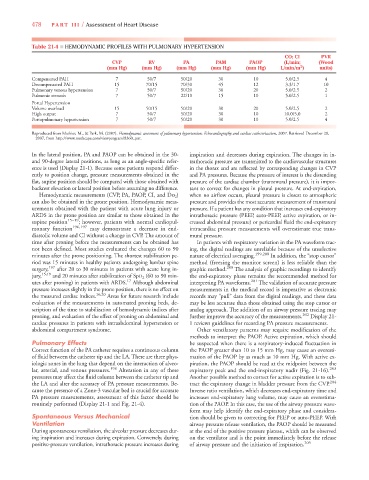
                  Table 21-4 ■ HEMODYNAMIC PROFILES WITH PULMONARY HYPERTENSION
                                                                                                     CO; CI      PVR
                                             CVP         RV         PA         PAM        PAOP       (L/min;    (Wood
                                                                                                          2 2 2
                                           (mm Hg)    (mm Hg)     (mm Hg)    (mm Hg)    (mm Hg)     L/min/m )    units)
                  Compensated PAH             7         50/7       50/20       30          10        5.0/2.5      4
                  Decompensated PAH          15         70/15      70/30       45          12        3.3/1.7      10
                  Pulmonary venous hypertension  7      50/7       50/20       30          20        5.0/2.5      2
                  Pulmonic stenosis           7         50/7       22/10       15          10        5.0/2.5      1
                  Portal Hypertension
                  Volume overload            15         50/15      50/20       30          20        5.0/2.5      2
                  High output                 7         50/7       50/20       30          10        10.0/5.0     2
                  Portopulmonary hypertension  7        50/7       50/20       30          10        5.0/2.5      4

                                                                                                     7
                  Reproduced from Mathier, M., & Park, M. (2007). Hemodynamic assessment of pulmonary hypertension: Echocardiography and cardiac catheterization, 2007. Retrieved December 28,
                                                                                                     7
                    2007, from http://www.medscape.com/viewprogram/8360_pnt.
                  In the lateral position, PA and PAOP can be obtained in the 30-  inspiration and decreases during expiration. The changes in in-
                  and 90-degree lateral positions, as long as an angle-specific refer-  trathoracic pressure are transmitted to the cardiovascular structures
                  ence is used (Display 21-1). Because some patients respond differ-  in the thorax and are reflected by corresponding changes in CVP
                  ently to position change, pressure measurements obtained in the  and PA pressures. Because the pressure of interest is the distending
                  flat, supine position should be compared with those obtained with  pressure of the cardiac chamber (transmural pressure), it is impor-
                  backrest elevation or lateral position before assuming no difference.  tant to correct for changes in pleural pressure. At end-expiration,
                     Hemodynamic measurements (CVP, PA, PAOP, CI, and   )  when no airflow occurs, pleural pressure is closest to atmospheric
                  can also be obtained in the prone position. Hemodynamic meas-  pressure and provides the most accurate measurement of transmural
                  urements obtained with the patient with acute lung injury or  pressure. If a patient has any condition that increases end-expiratory
                  ARDS in the prone position are similar to those obtained in the  intrathoracic pressure (PEEP, auto-PEEP, active expiration, or in-
                  supine position 15–19 ; however, patients with normal cardiopul-  creased abdominal pressure) or pericardial fluid the end-expiratory
                  monary  function 196,197  may  demonstrate a  decrease in end-  intracardiac pressure measurements will overestimate true trans-
                  diastolic volume and CI without a change in CVP. The amount of  mural pressure.
                  time after proning before the measurements can be obtained has  In patients with respiratory variation in the PA waveform trac-
                  not been defined. Most studies evaluated the changes 60 to 90  ing, the digital readings are unreliable because of the unselective
                  minutes after the prone positioning. The shortest stabilization pe-  nature of electrical averaging. 199,200  In addition, the “stop cursor”
                  riod was 15 minutes in healthy patients undergoing lumbar spine  method (freezing the monitor screen) is less reliable than the
                  surgery, 197  after 20 to 30 minutes in patients with acute lung in-  graphic method. 200  The analysis of graphic recordings to identify
                  jury, 15,19  and 20 minutes after stabilization of SpO 2 (60 to 90 min-  the end-expiratory phase remains the recommended method for
                  utes after proning) in patients with ARDS. 17  Although abdominal  interpreting PA waveforms. 201  The validation of accurate pressure
                  pressure increases slightly in the prone position, there is no effect on  measurements in the medical record is imperative as electronic
                  the measured cardiac indices. 16,20  Areas for future research include  records may “pull” data from the digital readings, and these data
                  evaluation of the measurements in automated proning beds, de-  may be less accurate than those obtained using the stop cursor or
                  scription of the time to stabilization of hemodynamic indices after  analog approach. The addition of an airway pressure tracing may
                  proning, and evaluation of the effect of proning on abdominal and  further improve the accuracy of the measurements. 202  Display 21-
                  cardiac pressures in patients with intraabdominal hypertension or  1 reviews guidelines for recording PA pressure measurements.
                  abdominal compartment syndrome.                       Other ventilatory patterns may require modification of the
                                                                      methods to interpret the PAOP. Active expiration, which should
                  Pulmonary Effects                                   be suspected when there is a respiratory-induced fluctuation in
                  Correct function of the PA catheter requires a continuous column  the PAOP greater than 10 to 15 mm Hg, may cause an overesti-
                  of fluid between the catheter tip and the LA. There are three phys-  mation of the PAOP by as much as 10 mm Hg. With active ex-
                  iologic zones in the lung that depend on the interaction of alveo-  piration, the PAOP should be read at the midpoint between the
                  lar, arterial, and venous pressures. 198  Alteration in any of these  expiratory peak and the end-inspiratory nadir (Fig. 21-16). 203
                  pressures may affect the fluid column between the catheter tip and  Another possible method to correct for active expiration is to sub-
                  the LA and alter the accuracy of PA pressure measurements. Be-  tract the expiratory change in bladder pressure from the CVP . 204
                  cause the presence of a Zone-3 vascular bed is crucial for accurate  Inverse ratio ventilation, which decreases end-expiratory time and
                  PA pressure measurements, assessment of this factor should be  increases end-expiratory lung volume, may cause an overestima-
                  routinely performed (Display 21-1 and Fig. 21-4).   tion of the PAOP. In this case, the use of the airway pressure wave-
                                                                      form may help identify the end-expiratory phase and considera-
                  Spontaneous Versus Mechanical                       tion should be given to correcting for PEEP or auto-PEEP. With
                  Ventilation                                         airway pressure release ventilation, the PAOP should be measured
                  During spontaneous ventilation, the alveolar pressure decreases dur-  at the end of the positive pressure plateau, which can be observed
                  ing inspiration and increases during expiration. Conversely, during  on the ventilator and is the point immediately before the release
                  positive-pressure ventilation, intrathoracic pressure increases during  of airway pressure and the initiation of inspiration. 205

