


Page 536 - Cardiac Nursing
P. 536
LWBK340-c22_p511-536.qxd  30/06/2009  11:00 AM  Page 512 Aptara


                  512    PA R T  IV / Pathophysiology and Management of Heart Disease


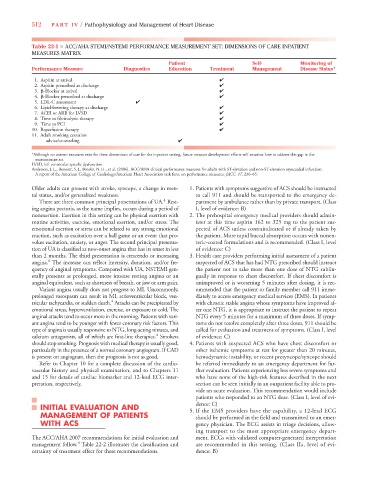
                  Table 22-1 ■ ACC/AHA STEMI/NSTEMI PERFORMANCE MEASUREMENT SET: DIMENSIONS OF CARE INPATIENT
                  MEASURES MATRIX
                                                               Patient                     Self-          Monitoring of
                  Performance Measure           Diagnostics    Education     Treatment     Management     Disease Status*
                   1. Aspirin at arrival                                        ✔
                   2. Aspirin prescribed at discharge                           ✔
                   3.  -Blocker at arrival                                      ✔
                   4.  -Blocker prescribed at discharge                         ✔
                   5. LDL-C assessment              ✔
                   6. Lipid-lowering therapy at discharge                       ✔
                   7. ACEI or ARB for LVSD                                      ✔
                   8. Time to fibrinolytic therapy                               ✔
                   9. Time to PCI                                               ✔
                  10. Reperfusion therapy                                       ✔
                  11. Adult smoking cessation
                       advice/counseling                          ✔

                  *Although no current measures exist for these dimensions of care for the inpatient setting, future measure development efforts will examine how to address this gap in the
                    measurement set.
                  LVSD, left ventricular systolic dysfunction.
                  Anderson, J.L., Bennett, S.J., Brooks, N.H., et al. (2006). ACC/AHA clinical performance measures for adults with ST-elevation and non-ST-elevation myocardial infarction:
                    A report of the American College of Cardiology/American Heart Association task force on performance measures. JACC, 47, 236–65.
                  Older adults can present with stroke, syncope, a change in men-  1. Patients with symptoms suggestive of ACS should be instructed
                  tal status, and/or generalized weakness.              to call 911 and should be transported to the emergency de-
                                                             4
                     There are three common principal presentations of UA. Rest-  partment by ambulance rather than by private transport. (Class
                  ing angina pectoris, as the name implies, occurs during a period of  I, level of evidence: B)
                  nonexertion. Exertion in this setting can be physical exertion with  2.The prehospital emergency medical providers should admin-
                  routine activities, exercise, emotional exertion, and/or stress. The  ister at this time aspirin 162 to 325 mg to the patient sus-
                  emotional exertion or stress can be related to any strong emotional  pected of ACS unless contraindicated or if already taken by
                  reaction, such as excitation over a ball game or an event that pro-  the patient. More rapid buccal absorption occurs with nonen-
                  vokes excitation, anxiety, or anger. The second principal presenta-  teric-coated formulations and is recommended. (Class I, level
                  tion of UA is classified as new-onset angina that has its onset in less  of evidence: C)
                  than 2 months. The third presentation is crescendo or increasing  3. Health care providers performing initial assessment of a patient
                        6
                  angina. The increase can reflect intensity, duration, and/or fre-  suspected of ACS that has had NTG prescribed should instruct
                  quency of anginal symptoms. Compared with UA, NSTEMI gen-  the patient not to take more than one dose of NTG sublin-
                  erally presents as prolonged, more intense resting angina or an  gually in response to chest discomfort. If chest discomfort is
                  anginal equivalent, such as shortness of breath, or jaw or arm pain.  unimproved or is worsening 5 minutes after dosing, it is rec-
                     Variant angina usually does not progress to MI. Uncommonly,  ommended that the patient or family member call 911 imme-
                  prolonged vasospasm can result in MI, atrioventricular block, ven-  diately to access emergency medical services (EMS). In patients
                                            4
                  tricular tachycardia, or sudden death. Attacks can be precipitated by  with chronic stable angina whose symptoms have improved af-
                  emotional stress, hyperventilation, exercise, or exposure to cold. The  ter one NTG, it is appropriate to instruct the patient to repeat
                  anginal attacks tend to occur more in the morning. Patients with vari-  NTG every 5 minutes for a maximum of three doses. If symp-
                  ant angina tend to be younger with fewer coronary risk factors. This  toms do not resolve completely after three doses, 911 should be
                  type of angina is usually responsive to NTG, long-acting nitrates, and  called for evaluation and treatment of symptoms. (Class I, level
                                                           4
                  calcium antagonists, all of which are first-line therapies. Smokers  of evidence: C)
                  should stop smoking. Prognosis with medical therapy is usually good,  4. Patients with suspected ACS who have chest discomfort or
                  particularly in the presence of a normal coronary angiogram. If CAD  other ischemic symptoms at rest for greater than 20 minutes,
                  is present on angiogram, then the prognosis is not as good.  hemodynamic instability, or recent presyncope/syncope should
                     Refer to Chapter 10 for a complete discussion of the cardio-  be referred immediately to an emergency department for fur-
                  vascular history and physical examination, and to Chapters 11  ther evaluation. Patients experiencing less severe symptoms and
                  and 15 for details of cardiac biomarker and 12-lead ECG inter-  who have none of the high-risk features described in the next
                  pretation, respectively.                              section can be seen initially in an outpatient facility able to pro-
                                                                        vide an acute evaluation. This recommendation would include
                                                                        patients who responded to an NTG dose. (Class I, level of evi-
                                                                        dence: C)
                     INITIAL EVALUATION AND                           5. If the EMS providers have the capability, a 12-lead ECG
                     MANAGEMENT OF PATIENTS                             should be performed in the field and transmitted to an emer-
                     WITH ACS                                           gency physician. The ECG assists in triage decisions, allow-
                                                                        ing transport to the most appropriate emergency depart-
                  The ACC/AHA 2007 recommendations for initial evaluation and  ment. ECGs with validated computer-generated interpretation
                                 4
                  management follow. Table 22-2 illustrates the classification and  are recommended in this setting. (Class IIa, level of evi-
                  certainty of treatment effect for these recommendations.  dence: B)

