


Page 537 - Cardiac Nursing
P. 537
009
                                  009
                                6/2
                              0/0
                                6/2
                                     1
                                        0 A
                                        0 A
                                      1:0
                                     1
                                      1:0
                          q
                          q
                          q
                        36.
                        36.
                           xd
                             3
                              0/0
                             3
                           xd
                              3
                                                   p
                                                   p
                                                  A
                                                13
                                                  A
                                                   p
                                                     ara
                                                     ara
                                                     ara
                                                    t
                                                    t
                                            Pa
                                            Pa
                                          M
                                          M
                                          M
                                              g
                                               e 5
                                                13
                                               e 5
                                              g
                                              g
               0-c
            K34
         LWBK340-c22_
                      1-5
                      1-5
                 22_
                    51
                    51
                   p
         LWB
         LWB K34 0-c 22_ p pp511-536.qxd  30/06/2009  11:00 AM  Page 513 Aptara
                                                                          C HAPTER 22 / Acute Coronary Syndromes   513
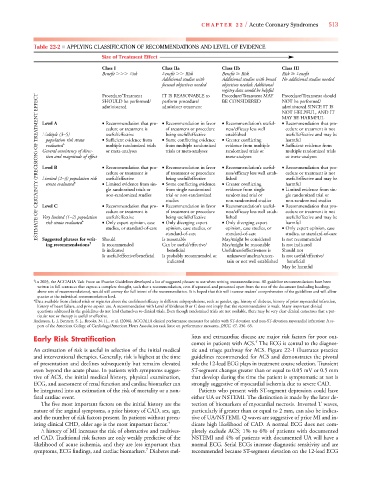
                   Table 22-2 ■ APPLYING CLASSIFICATION OF RECOMMENDATIONS AND LEVEL OF EVIDENCE
                                         Size of Treatment Effect
                                         Class I             Class IIa           Class IIb          Class III
                                         Benefit     Risk     Benefit    Risk      Benefit   Risk      Risk   Benefit
                                                             Additional studies with  Additional studies with broad  No additional studies needed
                                                             focused objectives needed  objectives needed; Additional
                                                                                 registry data would be helpful
                    ESTIMATE OF CERTAINTY (PRECISION) OF TREATMENT EFFECT
                                         Procedure/Treatment  IT IS REASONABLE to  Procedure/Treatment MAY  Procedure/Treatment should
                                         SHOULD be performed/  perform procedure/  BE CONSIDERED    NOT be performed/
                                         administered        administer treatment                   administered SINCE IT IS
                                                                                                    NOT HELPFUL, AND IT
                                                                                                    MAY BE HARMFUL
                      Level A            • Recommendation that pro- • Recommendation in favor  • Recommendation’s useful-  • Recommendation that pro-
                                           cedure or treatment is  of treatment or procedure  ness/efficacy less well   cedure or treatment is not
                      Multiple (3–5)       useful/effective   being useful/effective  established    useful/effective and may be
                       population risk strata   • Sufficient evidence from  • Some conflicting evidence  • Greater conflicting  harmful
                            d
                            d
                       evaluated*          multiple randomized trials  from multiple randomized  evidence from multiple  • Sufficient evidence from
                      General consistency of direc-  or meta-analyses  trials or meta-analyses  randomized trials or   multiple randomized trials
                       tion and magnitude of effect                               meta-analyses      or meta-analyses
                      Level B            • Recommendation that pro- • Recommendation in favor  • Recommendation’s useful-  • Recommendation that pro-
                                           cedure or treatment is  of treatment or procedure  ness/efficacy less well estab-  cedure or treatment is not
                      Limited (2–3) population risk  useful/effective  being useful/effective  lished  useful/effective and may be
                                d
                       strata evaluated*  • Limited evidence from sin- • Some conflicting evidence  • Greater conflicting  harmful
                                d
                                           gle randomized trials or  from single randomized  evidence from single  • Limited evidence from sin-
                                           non-randomized studies  trial or non-randomized  randomized trial or  gle randomized trial or
                                                              studies             non-randomized studies  non-randomized studies
                      Level C            • Recommendation that pro- • Recommendation in favor  • Recommendation’s useful-  • Recommendation that pro-
                                           cedure or treatment is  of treatment or procedure  ness/efficacy less well estab-  cedure or treatment is not
                      Very limited (1–2) population  useful/effective  being useful/effective  lished  useful/effective and may be
                                  d
                                  d
                       risk strata evaluated*  • Only expert opinion, case  • Only diverging expert  • Only diverging expert  harmful
                                           studies, or standard-of-care  opinion, case studies, or  opinion, case studies, or  • Only expert opinion, case
                                                              standard-of-care    standard-of-care   studies, or standard-of-care
                      Suggested phrases for writ-  Should    Is reasonable       May/might be considered  Is not recommended
                       ing recommendations †  Is recommended  Can be useful/effective/  May/might be reasonable  Is not indicated
                                         Is indicated          beneficial         Usefulness/effectiveness is  Should not
                                         Is useful/effective/beneficial  Is probably recommended or  unknown/unclear/uncer-  Is not useful/effective/
                                                               indicated          tain or not well established  beneficial
                                                                                                    May be harmful
                   †
                    In 2003, the ACC/AHA Task Force on Practice Guidelines developed a list of suggested phrases to use when writing recommendations. All guideline recommendations have been
                    written in full sentences that express a complete thought, such that a recommendation, even if separated and presented apart from the rest of the document (including headings
                    above sets of recommendations), would still convey the full intent of the recommendation. It is hoped that this will increase readers’ comprehension of the guidelines and will allow
                    queries at the individual recommendation level.
                   *Data available from clinical trials or registries about the usefulness/efficacy in different subpopulations, such as gender, age, history of diabetes, history of prior myocardial infarction,
                    history of heart failure, and prior aspirin use. A recommendation with Level of Evidence B or C does not imply that the recommendation is weak. Many important clinical
                    questions addressed in the guidelines do not lend themselves to clinical trials. Even though randomized trials are not available, there may be very clear clinical consensus that a par-
                    ticular test or therapy is useful or effective.
                   Anderson, L. J, Bennett, S. J., Brooks, N. H., et al. (2006). ACC/AHA clinical performance measures for adults with ST-elevation and non-ST-elevation myocardial infarction: A re-
                    port of the American College of Cardiology/American Heart Association task force on performance measures. JACC, 47, 236–65.
                   Early Risk Stratification                            litus and extracardiac disease are major risk factors for poor out-
                                                                                            4
                                                                       comes in patients with ACS. The ECG is central to the diagnos-
                   An estimation of risk is useful in selection of the initial medical  tic and triage pathway for ACS. Figure 22-1 illustrates practice
                   and interventional therapies. Generally, risk is highest at the time  guidelines recommended for ACS and demonstrates the pivotal
                   of presentation and declines subsequently but remains elevated  role the 12-lead ECG plays in treatment course selection. Transient
                   even beyond the acute phase. In patients with symptoms sugges-  ST-segment changes greater than or equal to 0.05 mV or 0.5 mm
                   tive of ACS, the initial medical history, physical examination,  that develop during the time the patient is symptomatic at rest is
                   ECG, and assessment of renal function and cardiac biomarker can  strongly suggestive of myocardial ischemia due to severe CAD.
                   be integrated into an estimation of the risk of mortality or a non-  Patients who present with ST-segment depression could have
                   fatal cardiac event.                                either UA or NSTEMI. The distinction is made by the later de-
                     The five most important factors on the initial history are the  tection of biomarkers of myocardial necrosis. Inverted T waves,
                   nature of the anginal symptoms, a prior history of CAD, sex, age,  particularly if greater than or equal to 2 mm, can also be indica-
                   and the number of risk factors present. In patients without preex-  tive of UA/NSTEMI. Q waves are suggestive of prior MI and in-
                   isting clinical CHD, older age is the most important factor. 4  dicate high likelihood of CAD. A normal ECG does not com-
                     A history of MI increases the risk of obstructive and multives-  pletely exclude ACS; 1% to 6% of patients with documented
                   sel CAD. Traditional risk factors are only weakly predictive of the  NSTEMI and 4% of patients with documented UA will have a
                   likelihood of acute ischemia, and they are less important than  normal ECG. Serial ECGs increase diagnostic sensitivity and are
                                                        7
                   symptoms, ECG findings, and cardiac biomarkers. Diabetes mel-  recommended because ST-segment elevation on the 12-lead ECG

