


Page 54 - Cardiac Nursing
P. 54
92806_c01.qxd  11/21/11  10:30 AM  Page 30


                     30   PA R T  I / Anatomy and Physiology

                                                    Thin filament
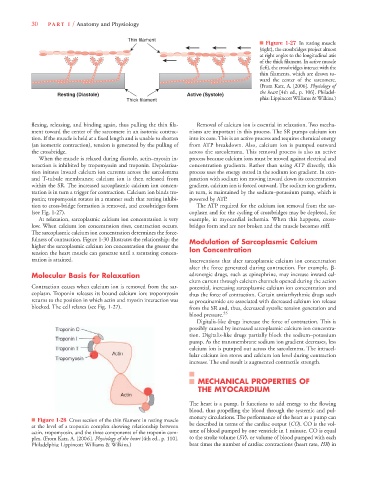
                                                                                               ■ Figure 1-27 In resting muscle
                                                                                               (right), the crossbridges project almost
                                                                                               at right angles to the longitudinal axis
                                                                                               of the thick filament. In active muscle
                                                                                               (left), the crossbridges interact with the
                                                                                               thin filaments, which are drawn to-
                                                                                               ward the center of the sarcomere.
                                                                                               (From Katz, A. [2006]. Physiology of
                                                                                               the heart [4th ed., p. 106]. Philadel-
                             Resting (Diastole)                        Active (Systole)
                                                    Thick filament                             phia: Lippincott Williams & Wilkins.)


                     flexing, releasing, and binding again, thus pulling the thin fila-  Removal of calcium ion is essential in relaxation. Two mecha-
                     ment toward the center of the sarcomere in an isotonic contrac-  nisms are important in this process. The SR pumps calcium ion
                     tion. If the muscle is held at a fixed length and is unable to shorten  into its core. This is an active process and requires chemical energy
                     (an isometric contraction), tension is generated by the pulling of  from ATP breakdown. Also, calcium ion is pumped outward
                     the crossbridge.                                   across the sarcolemma. This removal process is also an active
                       When the muscle is relaxed during diastole, actin–myosin in-  process because calcium ions must be moved against electrical and
                     teraction is inhibited by tropomyosin and troponin. Depolariza-  concentration gradients. Rather than using ATP directly, this
                     tion initates inward calcium ion currents across the sarcolemma  process uses the energy stored in the sodium ion gradient. In con-
                     and T-tubule membranes; calcium ion is then released from  junction with sodium ion moving inward down its concentration
                     within the SR. The increased sarcoplasmic calcium ion concen-  gradient, calcium ion is forced outward. The sodium ion gradient,
                     tration is in turn a trigger for contraction. Calcium ion binds tro-  in turn, is maintained by the sodium–potassium pump, which is
                     ponin; tropomyosin rotates in a manner such that resting inhibi-  powered by ATP.
                     tion to cross-bridge formation is removed, and crossbridges form  The ATP required for the calcium ion removal from the sar-
                     (see Fig. 1-27).                                   coplasm and for the cycling of crossbridges may be depleted, for
                       At relaxation, sarcoplasmic calcium ion concentration is very  example, in myocardial ischemia. When this happens, cross-
                     low. When calcium ion concentration rises, contraction occurs.  bridges form and are not broken and the muscle becomes stiff.
                     The sarcoplasmic calcium ion concentration determines the force-
                     fulness of contraction. Figure 1-30 illustrates the relationship; the  Modulation of Sarcoplasmic Calcium
                     higher the sarcoplasmic calcium ion concentration the greater the  Ion Concentration
                     tension the heart muscle can generate until a saturating concen-
                     tration is attained.                               Interventions that alter sarcoplasmic calcium ion concentration
                                                                        alter the force generated during contraction. For example,  -
                     Molecular Basis for Relaxation                     adrenergic drugs, such as epinephrine, may increase inward cal-
                                                                        cium current through calcium channels opened during the action
                     Contraction ceases when calcium ion is removed from the sar-  potential, increasing sarcoplasmic calcium ion concentration and
                     coplasm. Troponin releases its bound calcium ion; tropomyosin  thus the force of contraction. Certain antiarrhythmic drugs such
                     returns to the position in which actin and myosin interaction was  as procainamide are associated with decreased calcium ion release
                     blocked. The cell relaxes (see Fig. 1-27).         from the SR and, thus, decreased systolic tension generation and
                                                                        blood pressure. 55
                                                                           Digitalis-like drugs increase the force of contraction. This is
                                                                        possibly caused by increased sarcoplasmic calcium ion concentra-
                                                                        tion. Digitalis-like drugs partially block the sodium–potassium
                                                                        pump. As the transmembrane sodium ion gradient decreases, less
                                                                        calcium ion is pumped out across the sarcolemma. The intracel-
                                                                        lular calcium ion stores and calcium ion level during contraction
                                                                        increase. The end result is augmented contractile strength.

                                                                           MECHANICAL PROPERTIES OF
                                                                           THE MYOCARDIUM

                                                                        The heart is a pump. It functions to add energy to the flowing
                                                                        blood, thus propelling the blood through the systemic and pul-
                                                                        monary circulations. The performance of the heart as a pump can
                     ■ Figure 1-28 Cross section of the thin filament in resting muscle
                     at the level of a troponin complex showing relationship between  be described in terms of the cardiac output (CO). CO is the vol-
                     actin, tropomyosin, and the three components of the troponin com-  ume of blood pumped by one ventricle in 1 minute. CO is equal
                     plex. (From Katz, A. [2006]. Physiology of the heart [4th ed., p. 110].  to the stroke volume (SV), or volume of blood pumped with each
                     Philadelphia: Lippincott Williams & Wilkins.)      beat times the number of cardiac contractions (heart rate, HR) in

