


Page 583 - Cardiac Nursing
P. 583
p
                                6/2
                                                   p
                                                   p
                                  009
                                  009
                                6/2
                                                  A
                                                    t
                              3
                             3
                           xd
                                                     ara
                              0/0
                                                    t
                             3
                              0/0
                                     0
                                              g
                                              e 5
                                              g
                                              g
                                                59
                                                  A
                                              e 5
                                                59
                                            Pa
                                      1:4
                                        3 P
                                     0
                                      1:4
                                          M
                                            Pa
                                        3 P
                                          M
                           xd
               0-c
                 24_
                        94.
            K34
                    55
                    55
                      5-5
                      5-5
                          q
                          q
                                                     ara
         LWB K34 0-c 24_ p p pp555-594.qxd  30/06/2009  01:43 PM  Page 559 Aptara
         LWBK340-c24_
                        94.
                          q
         LWB
                                                                   C HAPTER 24 / Heart Failure and Cardiogenic Shock  559
                                     Pressure load  Volume load    y             ty        Others
                                                    olume load
                                                   V
                                                            Myocardial dysfunction
                                                                                   (Compensatory mechanisms)
                                                              Myocardial failure
                                                                                   (Compensatory mechanisms)
                                                              Heart, pump failure
                     Diastolic dysfunction,  Downregulation  Systolic dysfunction,  ↓CO reserve   Fatigue, renal dysfunction,
                          failure         of beta receptors       failure                            confusion, anorexia
                                             ↑Peripheral                            ↑Peripheral     ↑Vascular
                                           vasoconstriction   ↓Effective arterial   resistance      stiffness
                                                                blood volume
                     Increased ventricular
                      diastolic pressure  ↑Sympathetic activity                  ↑Renin, angiotensin
                                                             ↑Arginine vasopressin
                                                                                   ↑Aldosterone
                        ↑Peripheral      ↑Pulmonary
                      capillary pressure  capillary pressure
                                                            Renal vasoconstriction;                  ↑Atrial   ↑b-type
                                                             redistribution of flow;  Na , H O retention  natriuretic  natriuretic
                                                                                   +
                                                              ↑filtration fraction    2              peptide   peptide
                                 Congestion
                                                                                  ↑Plasma volume
                          Peripheral     Pulmonary                                                   Atrial
                                                                                                    distention
                                                                                                              Ventricular
                                                                                                               distention
                           Edema          Dyspnea
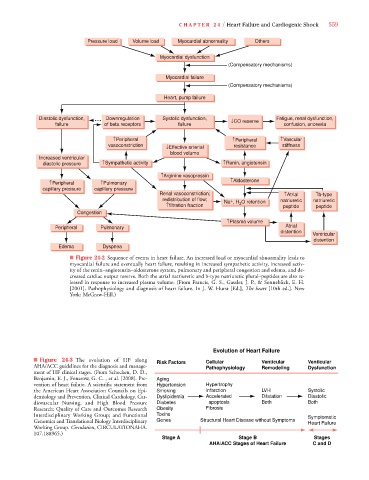
                               ■ Figure 24-2 Sequence of events in heart failure. An increased load or myocardial abnormality leads to
                               myocardial failure and eventually heart failure, resulting in increased sympathetic activity, increased activ-
                               ity of the renin–angiotensin–aldosterone system, pulmonary and peripheral congestion and edema, and de-
                               creased cardiac output reserve. Both the atrial natriuretic and b-type natriuretic plural–peptides are also re-
                               leased in response to increased plasma volume. (From Francis, G. S., Gassler, J. P., & Sonneblick, E. H.
                               [2001]. Pathophysiology and diagnosis of heart failure. In J. W. Hurst [Ed.], The heart [10th ed.]. New
                               York: McGraw-Hill.)
                                                                              Evolution of Heart Failure
                   ■ Figure 24-3 The evolution of HF along  Risk Factors   Cellular           Venticular     Venticular
                   AHA/ACC guidelines for the diagnosis and manage-        Pathophysiology    Remodeling     Dysfunction
                   ment of HF clinical stages. (From Schocken, D. D.,
                   Benjamin, E. J., Fonarow, G. C. , et al. [2008]. Pre-  Aging
                   vention of heart failure. A scientific statement from  Hypertension  Hypertrophy
                   the American Heart Association Councils on Epi-  Smoking  Infarction       LVH            Systolic
                   demiology and Prevention, Clinical Cardiology, Car-  Dyslipidemia  Accelerated  Dilatation  Diastolic
                   diovascular Nursing, and High Blood Pressure  Diabetes    apoptosis        Both           Both
                   Research; Quality of Care and Outcomes Research  Obesity  Fibrosis
                   Interdisciplinary Working Group; and Functional  Toxins                                   Symptomatic
                   Genomics and Translational Biology Interdisciplinary  Genes  Structural Heart Disease without Symptoms  Heart Failure
                   Working Group. Circulation, CIRCULATIONAHA.
                   107.188965.)
                                                             Stage A                  Stage B                  Stages
                                                                            AHA/ACC Stages of Heart Failure   C and D

