


Page 587 - Cardiac Nursing
P. 587
0/0
                              0/0
                             3
                              3
                             3
                                6/2
                                     0
                                     0
                                  009
                                6/2
                                  009
                           xd
                      5-5
                      5-5
                    55
                   p
                    55
                        94.
                          q
                           xd
                          q
                        94.
                          q
                                      1:4
                                                  A
                                                   p
                                                  A
                                                63
                                                63
                                                   p
                                                     ara
                                                     ara
                                                    t
                                                   p
                                                    t
                                              e 5
                                          M
                                          M
                                        3 P
                                      1:4
                                        3 P
                                            Pa
                                              g
                                              e 5
                                              g
                                            Pa
                                              g
         LWBK340-c24_
         LWB
            K34
                 24_
               0-c
         LWB K34 0-c 24_ p pp555-594.qxd  30/06/2009  01:43 PM  Page 563 Aptara
                                                                   C HAPTER 24 / Heart Failure and Cardiogenic Shock  563
                   Table 24-3 ■ NEUROHORMONAL RESPONSE: SHORT- AND LONG-TERM RESPONSES
                   Mechanism               Short-Term Adaptive                   Long-Term Maladaptive
                   Functional              Adaptive Response                     Maladaptive Consequences
                   Salt and water retension  cPreload, maintain cardiac output   Edema, anasarca, pulmonary congestion
                                                                                            p
                   Vasoconstriction        c c cAfterload, maintain blood pressure  T Cardiac output, cenergy expenditure, cardiac necrosis
                   Cardiac  -adrenergic drive  cContractility, cRelaxation       c Cytosolic calcium (arrhythmias, sudden death
                                           cHeart rate                           c Cardiac energy demand (cardiac necrosis)
                   Proinflammatory          “Anti-Other”                          “Anti-Self”
                                           Antimicrobial, antihelminthic         Cachexia (skeletal catabolism)
                                           Adaptive hypertophy                   Skeletal muscle myopathy
                   Proliferative           Adaptive Hypertrophy                  Maladaptive Hypertrophy
                   Transcriptional activation  Cell thickening (normalize wall stress, maintain   Cell elongation (dilation, remodeling, increased wall stress)
                   More sarcomeres           cardiac output)                     Apoptosis
                                           c Sarcomere number                    c Cardiac energy demand (cardiac myocyte necrosis)
                                                                                        t
                                                                                        t
                   Adapted from Katz, A. M., & Konstam, M. A. (2008). Heart failure: Pathophysiology, molecular biology and clinical management. Philadelphia: Lippincott Williams & Wilkins.
                   by the process of remodeling. Myocardial remodeling involves hy-  Activation of the RAAS. The RAAS plays an important role
                   pertrophy and apoptosis of myocytes, regression to a cellular phe-  in HF; AT has a vast range of biologic activities (Fig. 24-9). In ad-
                   notype, and changes in the nature of the extracellular matrix. 11,23  dition to stimulating aldosterone, AT is a potent vasoconstrictor. 11
                     Attenuating the myocardial response to NE is an important  There are four recognized AT receptor sites, but the AT1 receptors,
                   counter-regulatory change in patients with HF. Chronic sympa-  which predominate in adult hearts, exert their regulatory effects in
                   thetic stimulation inhibits  -receptor synthesis and reduces the  myocytes: vasoconstriction, increased myocardial contractility,
                   ability of the  -receptor to respond to the stimulus of NE.  -Re-
                   ceptor downregulation reduces the amount of receptors available
                   to bind to NE. Mechanisms responsible for   1 -receptor downreg-
                   ulation help protect the failing heart from the adverse effects of
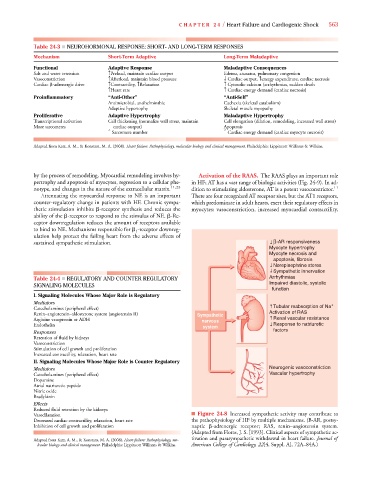
                   sustained sympathetic stimulation.                                            β-AR responsiveness
                                                                                                Myocyte hypertrophy
                                                                                                Myocyte necrosis and
                                                                                                   apoptosis, fibrosis
                                                                                                   Norepinephrine stores
                                                                                                   Sympathetic innervation
                   Table 24-4 ■ REGULATORY AND COUNTER REGULATORY                               Arrhythmias
                   SIGNALING MOLECULES                                                          Impaired diastolic, systolic
                                                                                                  function
                   I. Signaling Molecules Whose Major Role is Regulatory
                   Mediators                                                                                        +
                   Catecholamines (peripheral effect)                                              Tubular reabsorption of Na
                   Renin–angiotensin–aldosterone system (angiotensin II)  Sympathetic           Activation of RAS
                   Arginine vasopressin or ADH                            nervous                  Renal vascular resistance
                   Endothelin                                             system                   Response to natriuretic
                   Responses                                                                       factors
                   Retention of fluid by kidneys
                   Vasoconstriction
                   Stimulation of cell growth and proliferation
                   Increased contractility, relaxation, heart rate
                   II. Signaling Molecules Whose Major Role is Counter Regulatory
                   Mediators                                                                    Neurogenic vasoconstriction
                   Catecholamines (peripheral effect)                                           Vascular hypertrophy
                   Dopamine
                   Atrial natriuretic peptide
                   Nitric oxide
                   Bradykinin
                   Effects
                   Reduced fluid retention by the kidneys
                   Vasodilatation                                      ■ Figure 24-8 Increased sympathetic activity may contribute to
                   Decreased cardiac contractility, relaxation, heart rate  the pathophysiology of HF by multiple mechanisms. (B-AR, postsy-
                   Inhibition of cell growth and proliferation         naptic   -adrenergic receptor; RAS, renin–angiotensin system.
                                                                       (Adapted from Floras, J. S. [1993]. Clinical aspects of sympathetic ac-
                                                                       tivation and parasympathetic withdrawal in heart failure. Journal of
                   Adapted from Katz, A. M., & Konstam, M. A. (2008). Heart failure: Pathophysiology, mo-
                    lecular biology and clinical management. Philadelphia: Lippincott Williams & Wilkins.  American College of Cardiology, 22[4, Suppl. A], 72A–84A.)
                                        t
                                        t

