


Page 586 - Cardiac Nursing
P. 586
6/2
                                  009
                                6/2
                              0/0
                              0/0
                                      1:4
                                      1:4
                                     0
                                  009
                                     0
                             3
                          q
                          q
                        94.
                      5-5
                        94.
                              3
                             3
                           xd
                          q
                           xd
                                        3 P
                                                   p
                                                   p
                                                  A
                                                62
                                                  A
                                                     ara
                                                     ara
                                                    t
                                                   p
                                                    t
                                                62
                                            Pa
                                            Pa
                                          M
                                        3 P
                                          M
                                              e 5
                                              e 5
                                              g
                                              g
                                              g
               0-c
                 24_
            K34
         LWB
         LWBK340-c24_
         LWB K34 0-c 24_ p p pp555-594.qxd  30/06/2009  01:43 PM  Page 562 Aptara
                      5-5
                    55
                    55
                  562    PA R T  I V / Pathophysiology and Management of Heart Disease
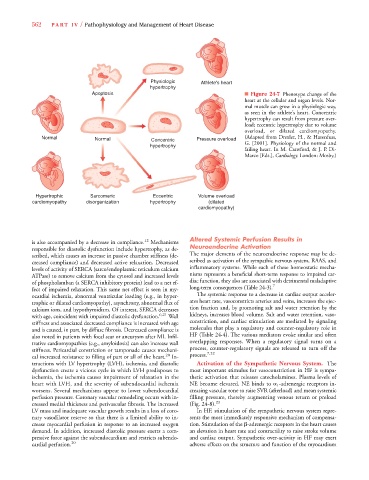
                                                         Physiologic      Athlete's heart
                                                         hypertrophy
                                      Apoptosis                                         ■ Figure 24-7 Phenotype change of the
                                                                                        heart at the cellular and organ levels. Nor-
                                                                                        mal muscle can grow in a physiologic way,
                                                                                        as seen in the athlete’s heart. Concentric
                                                                                        hypertrophy can result from pressure over-
                                                                                        load; eccentric hypertrophy due to volume
                                                                                        overload, or  dilated cardiomyopathy.
                      Normal           Normal            Concentric     Pressure overload  (Adapted from Drexler, H., & Hasenfuss,
                                                         hypertrophy                    G. [2001]. Physiology of the normal and
                                                                                        failing heart. In M. Crawford, & J. P. Di-
                                                                                        Marco [Eds.], Cardiology. London: Mosby.)
                    Hypertrophic      Sarcomeric          Eccentric      Volume overload
                   cardiomyopathy   disorganization      hypertrophy        (dilated
                                                                         cardiomyopathy)
                  is also accompanied by a decrease in compliance. 12  Mechanisms  Altered Systemic Perfusion Results in
                  responsible for diastolic dysfunction include hypertrophy, as de-  Neuroendocrine Activation
                  scribed, which causes an increase in passive chamber stiffness (de-  The major elements of the neuroendocrine response may be de-
                  creased compliance) and decreased active relaxation. Decreased  scribed as activation of the sympathic nervous system, RAAS, and
                  levels of activity of SERCA (sarco/endoplasmic reticulum calcium  inflammatory systems. While each of these homeostatic mecha-
                  ATPase) to remove calcium from the cytosol and increased levels  nisms represents a beneficial short-term response to impaired car-
                  of phospholamban (a SERCA inhibitory protein) lead to a net ef-  diac function, they also are associated with detrimental maladaptive
                                                                                                 7
                  fect of impaired relaxation. This same net effect is seen in my-  long-term consequences (Table 24-3).
                  ocardial ischemia, abnormal ventricular loading (e.g., in hyper-  The systemic response to a decrease in cardiac output acceler-
                  trophic or dilated cardiomyopathy), asynchrony, abnormal flux of  ates heart rate, vasoconstricts arteries and veins, increases the ejec-
                  calcium ions, and hypothyroidism. Of interest, SERCA decreases  tion fraction and, by promoting salt and water retention by the
                  with age, coincident with impaired diastolic dysfunction. 6,21  Wall  kidneys, increases blood volume. Salt and water retention, vaso-
                  stiffness and associated decreased compliance is increased with age  constriction, and cardiac stimulation are mediated by signaling
                  and is caused, in part, by diffuse fibrosis. Decreased compliance is  molecules that play a regulatory and counter-regulatory role in
                  also noted in patients with focal scar or aneurysm after MI. Infil-  HF (Table 24-4). The various mediators evoke similar and often
                  trative cardiomyopathies (e.g., amyloidosis) can also increase wall  overlapping responses.  When a regulatory signal turns on  a
                  stiffness. Pericardial constriction or tamponade causes mechani-  process, counter-regulatory signals are released to turn off the
                                                                            7,22
                  cal increased resistance to filling of part or all of the heart. 20  In-  process.
                  teractions with LV hypertrophy (LVH), ischemia, and diastolic  Activation of the Sympathetic Nervous System. The
                  dysfunction create a vicious cycle in which LVH predisposes to  most important stimulus for vasoconstriction in HF is sympa-
                  ischemia, the ischemia causes impairment of relaxation in the  thetic activation that releases catecholamines. Plasma levels of
                  heart with LVH, and the severity of subendocardial ischemia  NE become elevated. NE binds to   1 -adrenergic receptors in-
                  worsens. Several mechanisms appear to lower subendocardial  creasing vascular tone to raise SVR (afterload) and mean systemic
                  perfusion pressure. Coronary vascular remodeling occurs with in-  filling pressure, thereby augmenting venous return or preload
                  creased medial thickness and perivascular fibrosis. The increased  (Fig. 24-8). 23
                  LV mass and inadequate vascular growth results in a loss of coro-  In HF, stimulation of the sympathetic nervous system repre-
                  nary vasodilator reserve so that there is a limited ability to in-  sents the most immediately responsive mechanism of compensa-
                  crease myocardial perfusion in response to an increased oxygen  tion. Stimulation of the  -adrenergic receptors in the heart causes
                  demand. In addition, increased diastolic pressure exerts a com-  an elevation in heart rate and contractility to raise stroke volume
                  pressive force against the subendocardium and restricts subendo-  and cardiac output. Sympathetic over-activity in HF may exert
                  cardial perfusion. 20                               adverse effects on the structure and function of the myocardium

