


Page 584 - Cardiac Nursing
P. 584
6/2
                                  009
                                6/2
                              0/0
                              0/0
                                      1:4
                                      1:4
                                     0
                                  009
                                     0
                             3
                          q
                          q
                        94.
                      5-5
                        94.
                              3
                             3
                           xd
                          q
                           xd
                                        3 P
                                                   p
                                                   p
                                                  A
                                                60
                                                  A
                                                     ara
                                                     ara
                                                    t
                                                   p
                                                    t
                                                60
                                            Pa
                                            Pa
                                          M
                                        3 P
                                          M
                                              e 5
                                              e 5
                                              g
                                              g
                                              g
                      5-5
                   p
                    55
                    55
                 24_
               0-c
            K34
         LWBK340-c24_
         LWB K34 0-c 24_ p pp555-594.qxd  30/06/2009  01:43 PM  Page 560 Aptara
         LWB
                  560    PA R T  I V / Pathophysiology and Management of Heart Disease
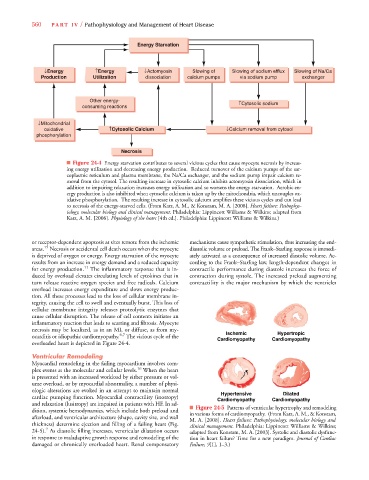
                                                     Energy Starvation
                      ↓Energy          ↑Energy         ↓Actomyosin     Slowing of   Slowing of sodium efflux  Slowing of Na/Ca
                     Production       Utilization       dissociation  calcium pumps   via sodium pump      exchanger
                                     Other energy-
                                                                                      ↑Cytosolic sodium
                                   consuming reactions
                    ↓Mitochondrial
                      oxidative             ↑Cytosolic Calcium                    ↓Calcium removal from cytosol
                    phosphorylation
                                                Necrosis
                              ■ Figure 24-4 Energy starvation contributes to several vicious cycles that cause myocyte necrosis by increas-
                              ing energy utilization and decreasing energy production.  Reduced turnover of the calcium pumps of the sar-
                              coplasmic reticulum and plasma membrane, the Na/Ca exchanger, and the sodium pump impair calcium re-
                              moval from the cytosol. The resulting increase in cytosolic calcium inhibits actomyosin dissociation, which in
                              addition to impairing relaxation increases energy utilization and so worsens the energy starvation.  Aerobic en-
                              ergy production is also inhibited when cytosolic calcium is taken up by the mitochondria, which uncouples ox-
                              idative phosphorylation.  The resulting increase in cytosolic calcium amplifies these vicious cycles and can lead
                              to necrosis of the energy-starved cells. (From Katz, A. M., & Konstam, M. A. [2008]. Heart failure: Pathophys-
                              iology, molecular biology and clinical management. Philadelphia: Lippincott Williams & Wilkins; adapted from
                              Katz, A. M. [2006]. Physiology of the heart [4th ed.]. Philadelphia: Lippincott Williams & Wilkins.)
                  or receptor-dependent apoptosis at sites remote from the ischemic  mechanisms cause sympathetic stimulation, thus increasing the end-
                      15
                  areas. Necrosis or accidental cell death occurs when the myocyte  diastolic volume or preload. The Frank–Starling response is immedi-
                  is deprived of oxygen or energy. Energy starvation of the myocyte  ately activated as a consequence of increased diastolic volume. Ac-
                  results from an increase in energy demand and a reduced capacity  cording to the Frank–Starling law, length-dependent changes in
                  for energy production. 11  The inflammatory response that is in-  contractile performance during diastole increases the force of
                  duced by overload elevates circulating levels of cytokines that in  contraction during systole. The increased preload augmenting
                  turn release reactive oxygen species and free radicals. Calcium  contractility is the major mechanism by which the ventricles
                  overload increases energy expenditure and slows energy produc-
                  tion. All these processes lead to the loss of cellular membrane in-
                  tegrity, causing the cell to swell and eventually burst. This loss of
                  cellular membrane integrity releases proteolytic enzymes that
                  cause cellular disruption. The release of cell contents initiates an
                  inflammatory reaction that leads to scarring and fibrosis. Myocyte
                  necrosis may be localized, as in an MI, or diffuse, as from my-  Ischemic        Hypertropic
                  ocarditis or idiopathic cardiomyopathy. 6,7  The vicious cycle of the  Cardiomyopathy  Cardiomyopathy
                  overloaded heart is depicted in Figure 24-4.
                  Ventricular Remodeling
                  Myocardial remodeling in the failing myocardium involves com-
                  plex events at the molecular and cellular levels. 16  When the heart
                  is presented with an increased workload by either pressure or vol-
                  ume overload, or by myocardial abnormality, a number of physi-
                  ologic alterations are evoked in an attempt to maintain normal  Hypertensive       Dilated
                  cardiac pumping function. Myocardial contractility (inotropy)  Cardiomyopathy  Cardiomyopathy
                  and relaxation (lusitropy) are impaired in patients with HF. In ad-
                  dition, systemic hemodynamics, which include both preload and  ■ Figure 24-5 Patterns of ventricular hypertrophy and remodeling
                                                                      in various forms of cardiomyopathy.  (From Katz, A. M., & Konstam,
                  afterload, and ventricular architecture (shape, cavity size, and wall  M. A. [2008]. Heart failure: Pathophysiology, molecular biology and
                  thickness) determine ejection and filling of a failing heart (Fig.  clinical management. Philadelphia: Lippincott Williams & Wilkins;
                       7
                  24-5). As diastolic filling increases, ventricular dilatation occurs  adapted from Konstam, M. A. [2003]. Systolic and diastolic dysfunc-
                  in response to maladaptive growth response and remodeling of the  tion in heart failure? Time for a new paradigm. Journal of Cardiac
                  damaged or chronically overloaded heart. Renal compensatory  Failure, 9[1], 1–3.)

