


Page 599 - Cardiac Nursing
P. 599
3
                              0/0
                              0/0
                           xd
                              3
                             3
                                6/2
                                     0
                                     0
                                      1:4
                                6/2
                                  009
                                  009
                           xd
                                                     ara
                        94.
                        94.
                      5-5
                      5-5
                                                     ara
                                                    t
                          q
                          q
                          q
                    55
                    55
                                                    t
                                      1:4
                                                   p
                 24_
                 24_
                                                  A
                                                   p
                                                   p
               0-c
         LWB
         LWB
         LWBK340-c24_ p p pp555-594.qxd  30/06/2009  01:43 PM  Page 575 Aptara
               0-c
            K34
            K34
                                                  A
                                          M
                                            Pa
                                            Pa
                                        3 P
                                        3 P
                                          M
                                              g
                                              e 5
                                                75
                                                75
                                              g
                                              g
                                              e 5
                                                                   C HAPTER 24 / Heart Failure and Cardiogenic Shock  575
                   Baseline intelligence and NYHA functional class have been shown  why patients over the age of 65 years require hospitalization. 4
                   to predict the degree of impairment. 136  Increased age, presence of  Three-month rehospitalization rates exceed 50%. 141  The primary
                   comorbidities, and abnormalities of serum sodium, potassium, al-  reason for rehospitalization is volume overload followed by angina
                   bumin, and glucose all increased the relative risk of cognitive im-  and arrhythmias. 142  Common precipitants of readmission include
                   pairment. 137  While the precise mechanisms of impairment re-  medication nonadherence, dietary indiscretion, inappropriate
                   main unclear, included in the  list of  hypotheses are chronic  medications, and delay in seeking care. 143  Identification of the
                   cerebral hypoperfusion and/or hypoxia, and repeated cerebral mi-  early onset of HF symptoms may prompt therapeutic interven-
                   croembolic events. Small observational studies of patients with  tions instituted on an ambulatory basis and prevent rehospitaliza-
                   HF have shown an association between diminished cerebral blood  tion. Coordination of care by a nurse-directed multidisciplinary
                   flow as measured by single photon emission computed tomogra-  team (including nurses, cardiologists, primary care providers, case
                   phy brain imaging and abnormalities noted on neuropsychologi-  managers, dieticians, pharmacists, and cardiac rehabilitation spe-
                   cal testing. 138                                    cialists) can provide HF initiatives to guide evidence-based prac-
                     Cognition changes are often barriers to a patient’s ability to en-  tice, enable self-care at home, and coordinate clinical care across
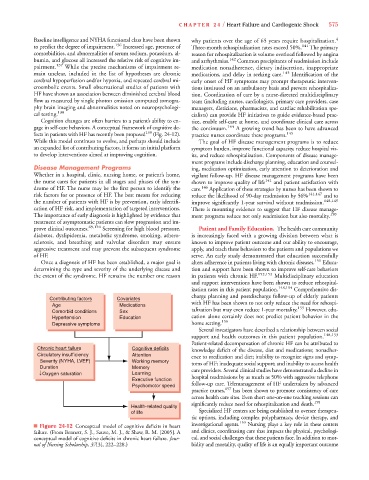
                   gage in self-care behaviors. A conceptual framework of cognitive de-  the continuum. 144  A growing trend has been to have advanced
                   fects in patients with HF has recently been proposed 139  (Fig. 24-12).  practice nurses coordinate these programs. 145
                   While this model continues to evolve, and perhaps should include  The goal of HF disease management programs is to reduce
                   an expanded list of contributing factors, it forms an initial platform  symptom burden, improve functional capacity, reduce hospital vis-
                   to develop interventions aimed at improving cognition.  its, and reduce rehospitalization. Components of disease manage-
                                                                       ment programs include discharge planning, education and counsel-
                   Disease Management Programs                         ing, medication optimization, early attention to deterioration and
                   Whether in a hospital, clinic, nursing home, or patient’s home,  vigilant follow-up. HF disease management programs have been
                   the nurse cares for patients in all stages and phases of the syn-  shown to improve quality of life 141  and patient satisfaction with
                   drome of HF. The nurse may be the first person to identify the  care. 146  Application of these strategies by nurses has been shown to
                   risk factors for or presence of HF. The best means for reducing  reduce the likelihood of 90-day readmission by 56% 141,147  and to
                   the number of patients with HF is by prevention, early identifi-  improve significantly 1-year survival without readmission. 148,149
                   cation of HF risk, and implementation of targeted interventions.  There is mounting evidence to suggest that HF disease manage-
                   The importance of early diagnosis is highlighted by evidence that  ment programs reduce not only readmission but also mortality. 150
                   treatment of asymptomatic patients can slow progression and im-
                   prove clinical outcomes. 69,140  Screening for high blood pressure,  Patient and Family Education. The health care community
                   diabetes, dyslipidemia, metabolic syndrome, smoking, athero-  is increasingly faced with a growing division between what is
                   sclerosis, and  breathing and valvular  disorders may ensure  known to improve patient outcome and our ability to encourage,
                   aggressive treatment and may prevent the subsequent syndrome  apply, and teach these behaviors to the patients and populations we
                   of HF.                                              serve. An early study demonstrated that education successfully
                     Once a diagnosis of HF has been established, a major goal is  alters adherence in patients living with chronic diseases. 151  Educa-
                   determining the type and severity of the underlying disease and  tion and support have been shown to improve self-care behaviors
                   the extent of the syndrome. HF remains the number one reason  in patients with chronic HF. 152,153  Multidisciplinary education
                                                                       and support interventions have been shown to reduce rehospital-
                                                                       ization rates in this patient population. 148,154  Comprehensive dis-
                                                                       charge planning and postdischarge follow-up of elderly patients
                                g
                        Contributing factors  Covariates
                                                                       with HF has been shown to not only reduce the need for rehospi-
                         Age                   Medications
                                                                       talization but may even reduce 1-year mortality. 155  However, edu-
                         Comorbid conditions   Sex
                         Hypertension          Education               cation alone certainly does not predict patient behavior in the
                         Depressive symptoms                           home setting. 156
                                                                         Several investigators have described a relationship between social
                                                                       support and health outcomes in this patient population. 148,153
                                                                       Patient-related decompensation of chronic HF can be attributed to
                                                     g
                    Chronic heart failure          Cognitive deficits  knowledge deficit of the disease, diet and medications; nonadher-
                    Circulatory insufficiency      Attention           ence to medication and diet; inability to recognize signs and symp-
                     Severity (NYHA, LVEF)         Working memory      toms of HF; inadequate social support; and inability to access health
                     Duration                      Memory              care providers. Several clinical studies have demonstrated a decline in
                      Oxygen saturation            Learning
                                                   Executive function  hospital readmissions by as much as 50% with aggressive telephone
                                                   Psychomotor speed   follow-up care. Telemanagement of HF undertaken by advanced
                                                                       practice nurses, 157  has been shown to promote consistency of care
                                                                       across health care sites. Even short one-on-one teaching sessions can
                                                                       significantly reduce need for rehospitalization and death. 158
                                                   Health-related quality
                                                   of life               Specialized HF centers are being established to oversee therapeu-
                                                                       tic options, including complex polypharmacy, device therapy, and
                                                                       investigational agents. 159  Nursing plays a key role in these centers
                   ■ Figure 24-12 Conceptual model of cognitive deficits in heart
                   failure. (From Bennett, S. J., Sauve, M. J., & Shaw, R. M. [2005]. A  and clinics, coordinating care that impacts the physical, psychologi-
                   conceptual model of cognitive deficits in chronic heart failure. Jour-  cal, and social challenges that these patients face. In addition to mor-
                   nal of Nursing Scholarship, 37[3], 222–228.)        bidity and mortality, quality of life is an equally important outcome

