


Page 600 - Cardiac Nursing
P. 600
q
                           xd
                          q
                        94.
                          q
                           xd
                              0/0
                              0/0
                             3
                              3
                             3
                        94.
                                                     ara
                                                     ara
                                                   p
                                                   p
                                                   p
                                                    t
                      5-5
                      5-5
                    55
                                                    t
                    55
                                              g
                                              g
                                              g
                                            Pa
                                            Pa
                                              e 5
                                                  A
                                                  A
                                                76
                                              e 5
                                                76
                                          M
                                  009
                                     0
                                  009
                                6/2
                                6/2
                                     0
                                        3 P
                                          M
                                        3 P
                                      1:4
                                      1:4
            K34
               0-c
                 24_
         LWB K34 0-c 24_ p p pp555-594.qxd  30/06/2009  01:43 PM  Page 576 Aptara
         LWBK340-c24_
         LWB
                  576    PA R T  I V / Pathophysiology and Management of Heart Disease
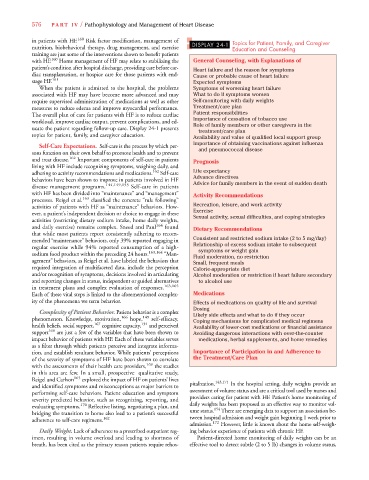
                  in patients with HF. 160  Risk factor modification, management of  Topics for Patient, Family, and Caregiver
                  nutrition, biobehavioral therapy, drug management, and exercise  DISPLAY 24-1  Education and Counseling
                  training are just some of the interventions shown to benefit patients
                  with HF. 160  Home management of HF may relate to stabilizing the  General Counseling, with Explanations of
                  patient’s condition after hospital discharge, providing care before car-  Heart failure and the reason for symptoms
                  diac transplantation, or hospice care for those patients with end-  Cause or probable cause of heart failure
                  stage HF. 161                                        Expected symptoms
                     When the patient is admitted to the hospital, the problems  Symptoms of worsening heart failure
                  associated with HF may have become more advanced and may  What to do if symptoms worsen
                  require supervised administration of medications as well as other  Self-monitoring with daily weights
                  measures to reduce edema and improve myocardial performance.  Treatment/care plan
                  The overall plan of care for patients with HF is to reduce cardiac  Patient responsibilities
                  workload, improve cardiac output, prevent complications, and ed-  Importance of cessation of tobacco use
                  ucate the patient regarding follow-up care. Display 24-1 presents  Role of family members or other caregivers in the
                                                                         treatment/care plan
                  topics for patient, family, and caregiver education.
                                                                       Availability and value of qualified local support group
                     Self-Care Expectations. Self-care is the process by which per-  Importance of obtaining vaccinations against influenza
                  sons function on their own behalf to promote health and to prevent  and pneumococcal disease
                  and treat disease. 162  Important components of self-care in patients  Prognosis
                  living with HF include recognizing symptoms, weighing daily, and
                  adhering to activity recommendations and medications. 162  Self-care  Life expectancy
                  behaviors have been shown to improve in patients involved in HF  Advance directives
                  disease management programs. 144,149,153  Self-care in patients  Advice for family members in the event of sudden death
                  with HF has been divided into “maintenance” and “management”  Activity Recommendations
                  processes. Reigel et al. 163  classified the concrete “rule following”
                  activities of patients with HF as “maintenance” behaviors. How-  Recreation, leisure, and work activity
                  ever, a patient’s independent decision or choice to engage in these  Exercise
                  activities (restricting dietary sodium intake, home daily weights,  Sexual activity, sexual difficulties, and coping strategies
                  and daily exercise) remains complex. Sneed and Paul 164  found  Dietary Recommendations
                  that while most patients report consistently adhering to recom-
                  mended “maintenance” behaviors, only 39% reported engaging in  Consistent and restricted sodium intake (2 to 5 mg/day)
                  regular exercise while 94% reported consumption of a high-  Relationship of excess sodium intake to subsequent
                                                                         symptoms or weight gain
                  sodium food product within the preceding 24 hours. 163,164  “Man-  Fluid moderation, no restriction
                  agement” behaviors, as Reigel et al. have labeled the behaviors that  Small, frequent meals
                  required integration of multifaceted data, include the perception  Calorie-appropriate diet
                  and/or recognition of symptoms, decisions involved in articulating  Alcohol moderation or restriction if heart failure secondary
                  and reporting changes in status, independent or guided alternatives  to alcohol use
                  in treatment plans and complex evaluation of responses. 163,165
                  Each of these vital steps is linked to the aforementioned complex-  Medications
                  ity of the phenomena we term behavior.               Effects of medications on quality of life and survival
                                                                       Dosing
                     Complexity of Patient Behavior. Patient behavior is a complex  Likely side effects and what to do if they occur
                  phenomenon. Knowledge, motivation, 166  hope, 149  self-efficacy,  Coping mechanisms for complicated medical regimens
                  health beliefs, social support, 167  cognitive capacity, 134  and perceived  Availability of lower-cost medications or financial assistance
                  support 168  are just a few of the variables that have been shown to  Avoiding dangerous interactions with over-the-counter
                  impact behavior of patients with HF. Each of these variables serves  medications, herbal supplements, and home remedies
                  as a filter through which patients perceive and integrate informa-
                  tion, and establish resultant behavior. While patients’ perceptions  Importance of Participation in and Adherence to
                  of the severity of symptoms of HF have been shown to correlate  the Treatment/Care Plan
                  with the assessments of their health care providers, 169  the studies
                  in this area are few. In a small, prospective  qualitative study,
                  Reigel and Carlson 165  explored the impact of HF on patients’ lives  143,171
                  and identified symptoms and misconceptions as major barriers to  pitalization.  In the hospital setting, daily weights provide an
                  performing self-care behaviors. Patient education and symptom  assessment of volume status and are a critical tool used by nurses and
                  severity predicted behavior, such as recognizing, reporting, and  providers caring for patient with HF. Patient’s home monitoring of
                  evaluating symptoms. 170  Reflective listing, negotiating a plan, and  daily weights has been proposed as an effective way to monitor vol-
                                                                              154
                  bridging the transition to home also lead to a patient’s successful  ume status.  There are emerging data to support an association be-
                  adherence to self-care regimens. 162                tween hospital admission and weight gain beginning 1 week prior to
                                                                      admission. 172  However, little is known about the home self-weigh-
                     Daily Weight. Lack of adherence to a prescribed outpatient reg-  ing behavior experience of patients with chronic HF.
                  imen, resulting in volume overload and leading to shortness of  Patient-directed home monitoring of daily weights can be an
                  breath, has been cited as the primary reason patients require rehos-  effective tool to detect subtle (2 to 5 lb) changes in volume status,

