


Page 601 - Cardiac Nursing
P. 601
LWBK340-c24_p555-594.qxd  30/06/2009  01:43 PM  Page 577 Aptara


                                                                   C HAP TE R 24 / Heart Failure and Cardiogenic Shock  577

                   often prior to the development of overt symptoms. Two small stud-
                   ies have shown that while most patients with HF recall being asked  Table 24-12 ■ RELATIVE AND ABSOLUTE
                   to monitor their weights at home, and describe this behavior as  CONTRAINDICATIONS TO EXERCISE TRAINING AMONG
                   “important,” only approximately 30% reported engaging in the  PATIENTS WITH STABLE CHRONIC HEART FAILURE
                   behavior. 154, 173  Daily weights were among the five least frequently  Relative Contraindications  Absolute Contraindications
                   performed self-care behaviors. 152
                     Most patients with HF are instructed to weigh themselves   4 lb wt gain over previous 1 to   Progressive dyspnea at rest over
                   one time per day. Although the ideal time of this weight has not  3 days        previous 5 days
                   been studied, it is most likely not as important as the fact that it  Continuous or intermittent dobutamine  Ischemia at low levels of exercise
                   is performed at a consistent time each day. Patients are typically  T In systolic BP with exercise  Uncontrolled diabetes
                                                                       NYHA IV
                                                                                                  Acute systemic illness or fever
                   asked to weigh upon rising in the morning, after urinating and  Complex ventricular arrhythmia at rest  Recent embolism
                   prior to dressing or eating. The accuracy or precision of the home  Complex ventricular arrhythmia   Thrombophlebitis
                   device (scale) used for weighing has likewise not been studied.  with exercise  Active pericarditis or myocarditis
                   However, the accuracy of the measurement probably is not as im-  Supine resting HR  100 beats/min  Severe aortic stenosis
                                                                                                  Myocardial infarction within
                   portant as its reproducibility. Recognizing mild volume overload                previous 3 weeks
                   early on increases the efficacy of treatment interventions, such as             New onset atrial fibrillation with
                   augmentation of diuretic dose and heightened sodium restriction.                rapid ventricular response
                   These interventions can interrupt the cycle of progressive myocar-
                   dial that results in reduced renal perfusion and consequent sodium  Wt, weight; BP, blood pressure; NYHA, New York Heart Association functional class;
                                                                        HR, heart rate.
                   and water retention, manifested clinically as shortness of breath,  Adapted from Working Group on Cardiac Rehabilitation & Exercise Physiology and
                   paroxysmal nocturnal dyspnea, and lower extremity edema.  Working Group on Health Failure of the European Society of Cardiology. (2001).
                                                                        European Heart Journal, 22, 125–135.
                                                                                    l
                                                                                    l
                     Activity and Exercise. A classic symptom associated with HF
                   is exercise intolerance, characterized by fatigue or shortness of
                   breath. Exploring the pathophysiologic mechanisms underlying
                   these symptoms has been the focus of much study over the last
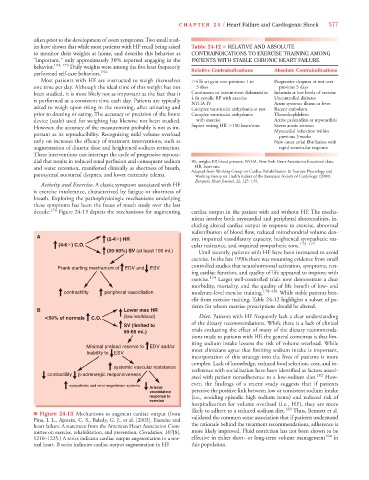
                   decade. 174  Figure 24-13 depicts the mechanisms for augmenting  cardiac output in the patient with and without HF. The mecha-
                                                                       nisms involve both myocardial and peripheral abnormalities, in-
                                                                       cluding altered cardiac output in response to exercise, abnormal
                                                                       redistribution of blood flow, reduced mitochondrial volume den-
                    A
                                           (2-4 ) HR                   sity, impaired vasodilatory capacity, heightened sympathetic vas-
                           (4-6 ) C.O.                                 cular resistance, and impaired sympathetic tone. 175–177
                                           (20-50%) SV (at least 100 mL)  Until recently, patients with HF have been instructed to avoid
                                                                       exercise. In the late 1990s there was mounting evidence from small
                                                                       controlled studies that neurohormonal activation, symptoms, rest-

                           Frank starling mechanism of    EDV and    ESV
                                                                       ing cardiac function, and quality of life appeared to improve with
                                                                       exercise. 174  Larger well-controlled trials now demonstrate a clear
                                                                       morbidity, mortality, and the quality of life benefit of low- and
                             contractility  peripheral vasodilation    moderate-level exercise training. 178–181  While stable patients ben-
                                                                       efit from exercise training, Table 24-12 highlights a subset of pa-
                                                                       tients for whom exercise prescriptions should be altered.
                    B                           Lower max HR
                        50% of normals  C.O.    (low workload)           Diet. Patients with HF frequently lack a clear understanding
                                                                       of the dietary recommendations. While there is a lack of clinical
                                                SV (limited to
                                                50-65 mL)              trials evaluating the effect of many of the dietary recommenda-
                                                                       tions made to patients with HF, the general consensus is that lim-
                                                                       iting sodium intake lessens the risk of volume overload. While
                                    Minimal preload reserve to    EDV and/or

                                                                       most clinicians agree that limiting sodium intake is important,


                                    Inability to    ESV
                                                                       incorporation of this strategy into the lives of patients is more
                                                                       complex. Lack of knowledge, reduced food selection, cost, and in-
                                             systemic vascular resistance
                                                                       terference with socialization have been identified as factors associ-
                        contractility   -adrenergic responsiveness                                              182
                                                                       ated with patient nonadherence to a low-sodium diet.  How-
                                                                       ever, the findings of a recent study suggests that if patients
                               sympathetic and renin-angiotensin systems
                                                         Arterial
                                                         vasodilation  perceive the positive link between low or consistent sodium intake
                                                         response to   (i.e., avoiding episodic high sodium items) and reduced risk of
                                                         exercise
                                                                       hospitalization for volume overload (i.e., HF), they are more
                                                                       likely to adhere to a reduced sodium diet. 183  Thus, Bennett et al.
                   ■ Figure 24-13 Mechanisms to augment cardiac output (from
                   Pina, I. L., Apstein, C. S., Balady, G. J., et al. [2003]. Exercise and  validated the common sense association that if patients understand
                   heart failure: A statement from the American Heart Association Com-  the rationale behind the treatment recommendations, adherence is
                   mittee on exercise, rehabilitation, and prevention. Circulation, 107[8],  more likely improved. Fluid restriction has not been shown to be
                   1210–1225.) A series indicates cardiac output augmentation in a nor-  effective in either short- or long-term volume management 184  in
                   mal heart. B series indicates cardiac output augmentation in HF.  this population.

