


Page 602 - Cardiac Nursing
P. 602
M
                                        3 P
                                          M
                                            Pa
                                            Pa
                    55
                                        3 P
                    55
                   p
                   p
                                              g
                                                  A
                                                78
                                                  A
                                                   p
                                                   p
                                              g
                                              g
                                              e 5
                                                78
                                              e 5
                                      1:4
                                6/2
                                6/2
                              0/0
                             3
                              0/0
                                     0
                                      1:4
                                     0
                                  009
                                  009
                             3
                        94.
                          q
                        94.
                      5-5
                      5-5
                           xd
                              3
                           xd
                          q
                          q
            K34
            K34
         LWB
               0-c
                 24_
                 24_
               0-c
                                                    t
                                                    t
                                                   p
                                                     ara
         LWB
         LWBK340-c24_ pp555-594.qxd  30/06/2009  01:43 PM  Page 578 Aptara
                                                     ara
                  578    PA R T  I V / Pathophysiology and Management of Heart Disease
                     Medications. Important advances have been made in the
                  pharmacologic treatment of patients with HF. But, there are         MYOCARDIAL DYSFUNCTION
                  clearly many barriers to medication adherence in patients with
                                                                                     SYSTOLIC        DIASTOLIC
                  HF. Common sense tells us that if patients are unable to obtain
                  medications or to take their medications correctly, the favorable
                  outcomes observed in clinical trails will not be seen clinically.                 LVEDP
                  Medication nonadherence is highly prevalent in patients with  Cardiac output  Pulmonary congestion
                  HF. 143,185,186  However, a positive association between patients’  Stroke volume
                  perception of the effects of a medication and subsequent adher-
                  ence has been demonstrated. 187  Education and support have like-
                  wise been shown to significantly increase adherence resulting in
                  improvements in functional outcome and reduced emergency  Systemic  Hypotension
                                                                        perfusion
                  room visits and hospitalization. 188,189
                     Social Support and Quality of Life. There is evidence that    Coronary    Hypoxemia
                  a relationship between social support and health outcomes in pa-  perfusion
                  tients with HF exists. Feldman et al. 144  evaluated the impact of  pressure
                  sending e-mail reminders regarding HF-specific clinical recom-
                  mendations to home health nurses. Patients cared for by nurses re-
                  ceiving the prompts were significantly more likely to recognize  Compensatory  ISCHEMIA
                  their medications, less likely to report salting their food, and more  vasoconstriction;
                  likely to weigh themselves. The Kansas City Cardiomyopathy  fluid retention
                  Questionnaire score and health-related quality of life were signifi-                   PROGRESSIVE
                                                                                                         MYOCARDIAL
                  cantly higher in the patients receiving care from a nurse receiving                   DYSFUNCTION
                  the prompts. This study is of interest, as it attempts to demonstrate
                  and measure the link between self-care practice and functional out-
                  comes. Was the improvement in outcome related to improved                               DEATH
                  knowledge and adherence or augmented provider patient interac-
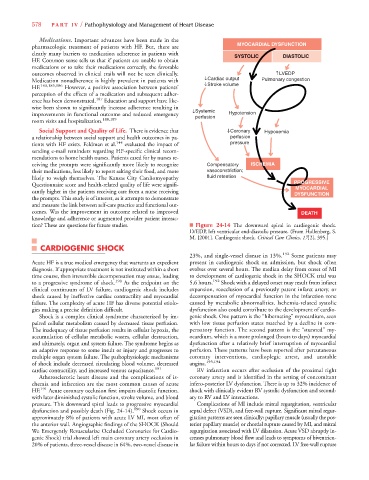
                  tion? These are questions for future studies.       ■ Figure 24-14 The downward spiral in cardiogenic shock.
                                                                      LVEDP, left ventricular end-diastolic pressure. (From Hollenberg, S.
                                                                      M. [2001]. Cardiogenic shock. Critical Care Clinics, 17[2], 395.)
                     CARDIOGENIC SHOCK
                                                                      23%, and single-vessel disease in 13%. 192  Some patients may
                  Acute HF is a true medical emergency that warrants an expedient  present in cardiogenic shock on admission,  but shock often
                  diagnosis. If appropriate treatment is not instituted within a short  evolves over several hours. The median delay from onset of MI
                  time course, then irreversible decompensation may ensue, leading  to development of cardiogenic shock in the SHOCK trial was
                  to a progressive syndrome of shock. 190  As the endpoint on the  5.6 hours. 192  Shock with a delayed onset may result from infarct
                  clinical continuum of LV  failure, cardiogenic shock includes  expansion, reocclusion of a previously patent infarct artery, or
                  shock caused by ineffective cardiac contractility and myocardial  decompensation of myocardial function in the infarction zone
                  failure. The complexity of acute HF has diverse potential etiolo-  caused by metabolic abnormalities. Ischemia-related systolic
                  gies making a precise definition difficult.           dysfunction also could contribute to the development of cardio-
                     Shock is a complex clinical syndrome characterized by im-  genic shock. One pattern is the “hibernating” myocardium, seen
                  paired cellular metabolism caused by decreased tissue perfusion.  with low tissue perfusion states matched by a decline in com-
                  The inadequacy of tissue perfusion results in cellular hypoxia, the  pensatory function. The second pattern is the “stunned” my-
                  accumulation of cellular metabolic wastes, cellular destruction,  ocardium, which is a more prolonged (hours to days) myocardial
                  and ultimately, organ and system failure. The syndrome begins as  dysfunction after a relatively brief interruption of myocardial
                  an adaptive response to some insult or injury and progresses to  perfusion. These patterns have been reported after percutaneous
                  multiple organ system failure. The pathophysiologic mechanisms  coronary interventions, cardioplegic arrest, and unstable
                  of shock include decreased circulating blood volume, decreased  angina. 193,194
                  cardiac contractility, and increased venous capacitance. 191  RV infarction occurs after occlusion of the proximal right
                     Atherosclerotic heart disease and the complications of is-  coronary artery and is identified in the setting of concomitant
                  chemia and infarction are the most common causes of acute  infero-posterior LV dysfunction. There is up to 32% incidence of
                  HF. 191  Acute coronary occlusion first impairs diastolic function,  shock with clinically evident RV systolic dysfunction and second-
                  with later diminished systolic function, stroke volume, and blood  ary to RV and LV interactions.
                  pressure. This downward spiral leads to progressive myocardial  Complications of MI include mitral regurgitation, ventricular
                  dysfunction and possibly death (Fig. 24-14). 190  Shock occurs in  septal defect (VSD), and free-wall rupture. Significant mitral regur-
                  approximately 8% of patients with acute LV MI, most often of  gitation patterns are seen clinically: papillary muscle (usually the pos-
                  the anterior wall. Angiographic findings of the SHOCK (Should  terior papillary muscle) or chordal rupture caused by MI, and mitral
                  We Emergently Revascularize Occluded Coronaries for Cardio-  regurgitation associated with LV dilatation. Acute VSD abruptly in-
                  genic Shock) trial showed left main coronary artery occlusion in  creases pulmonary blood flow and leads to symptoms of biventricu-
                  20% of patients, three-vessel disease in 64%, two-vessel disease in  lar failure within hours to days if not corrected. LV free-wall rupture

