


Page 604 - Cardiac Nursing
P. 604
0
                                     0
                                  009
                                  009
                                      1:4
                                        3 P
                                          M
                                      1:4
                                        3 P
                              3
                             3
                           xd
                           xd
                             3
                                6/2
                                6/2
                              0/0
                              0/0
                                          M
                                                   p
                                                   p
                                                  A
                                                  A
                                                   p
                                                     ara
                                                     ara
                                                    t
                                                    t
                                              g
                                              g
                                            Pa
                                            Pa
                                              g
                                                80
                                                80
                                              e 5
                                              e 5
                    55
                   p
         LWB
                    55
               0-c
                 24_
         LWBK340-c24_
            K34
         LWB K34 0-c 24_ p pp555-594.qxd  30/06/2009  01:43 PM  Page 580 Aptara
                          q
                        94.
                          q
                          q
                      5-5
                      5-5
                        94.
                  580    PA R T  I V / Pathophysiology and Management of Heart Disease
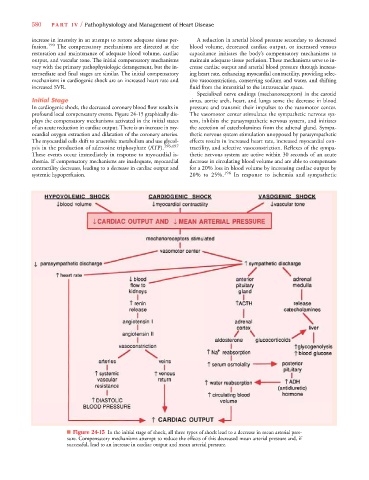
                  increase in intensity in an attempt to restore adequate tissue per-  A reduction in arterial blood pressure secondary to decreased
                  fusion. 190  The compensatory mechanisms are directed at the  blood volume, decreased cardiac output, or increased venous
                  restoration and maintenance of adequate blood volume, cardiac  capacitance initiates the  body’s compensatory mechanisms to
                  output, and vascular tone. The initial compensatory mechanisms  maintain adequate tissue perfusion. These mechanisms serve to in-
                  vary with the primary pathophysiologic derangement, but the in-  crease cardiac output and arterial blood pressure through increas-
                  termediate and final stages are similar. The initial compensatory  ing heart rate, enhancing myocardial contractility, providing selec-
                  mechanisms in cardiogenic shock are an increased heart rate and  tive vasoconstriction, conserving sodium and water, and shifting
                  increased SVR.                                      fluid from the interstitial to the intravascular space.
                                                                        Specialized nerve endings (mechanoreceptors) in the carotid
                  Initial Stage                                       sinus, aortic arch, heart, and lungs sense the decrease in blood
                  In cardiogenic shock, the decreased coronary blood flow results in  pressure and transmit their impulses to the vasomotor center.
                  profound local compensatory events. Figure 24-15 graphically dis-  The vasomotor center stimulates the sympathetic nervous sys-
                  plays the compensatory mechanisms activated in the initial states  tem, inhibits the parasympathetic nervous system, and initiates
                  of an acute reduction in cardiac output. There is an increase in my-  the secretion of catecholamines from the adrenal gland. Sympa-
                  ocardial oxygen extraction and dilatation of the coronary arteries.  thetic nervous system stimulation unopposed by parasympathetic
                  The myocardial cells shift to anaerobic metabolism and use glycol-  effects results in increased heart rate, increased myocardial con-
                  ysis in the production of adenosine triphosphate (ATP). 196,197  tractility, and selective vasoconstriction. Reflexes of the sympa-
                  These events occur immediately in response to myocardial is-  thetic nervous system are active within 30 seconds of an acute
                  chemia. If compensatory mechanisms are inadequate, myocardial  decrease in circulating blood volume and are able to compensate
                  contractility decreases, leading to a decrease in cardiac output and  for a 20% loss in blood volume by increasing cardiac output by
                  systemic hypoperfusion.                             20% to 25%. 196  In response to ischemia and sympathetic


                              ■ Figure 24-15 In the initial stage of shock, all three types of shock lead to a decrease in mean arterial pres-
                              sure. Compensatory mechanisms attempt to reduce the effects of this decreased mean arterial pressure and, if
                              successful, lead to an increase in cardiac output and mean arterial pressure.

