


Page 603 - Cardiac Nursing
P. 603
LWBK340-c24_p555-594.qxd  30/06/2009  01:43 PM  Page 579 Aptara


                                                                   C HAP TE R 24 / Heart Failure and Cardiogenic Shock  579

                   occurs in less than 1% of acute MIs but carries a high mortality  Extracardiac Obstructive Shock
                   rate. 195
                     Non-MI-related acute valvular problems involve the mitral and  Pericardial Tamponade
                   aortic valve. Acute mitral regurgitation can be caused by sponta-  The accumulation of fluid within the pericardial sac increases
                   neous chordal rupture, infective endocarditis, inflammatory disor-  pressure, causing extracardiac obstruction to filling that results in a
                   ders (e.g., rheumatic fever), or trauma. Acute aortic insufficiency  decrease in ventricular preload and cardiac output. What deter-
                   may be caused by infective endocarditis with leaflet destruction  mines whether pericardial effusion will cause shock is how rapidly
                   (most common), acute aortic dissection, or traumatic injury.  the fluid accumulates. Patients at risk for shock caused by tampon-
                   Shock may be caused by aortic stenosis with increasing metabolic  ade are those with malignancy (especially lung and breast cancer,
                   demands or with concomitant LV failure. Mitral stenosis rarely  lymphoma, leukemia, or melanoma), infection, aortic dissection,
                   causes shock without rapid atrial fibrillation. 195  Prosthetic valve  or severe pericarditis.
                   dysfunction, especially left-sided, most often causes shock because
                   of valvular insufficiency. Acute prosthetic valvular insufficiency  Pulmonary Embolism
                   occurs because of dehiscence of the sewing ring, infective endo-  When embolic material, such as thrombus, fat, tumor, or air, ob-
                   carditis, or catastrophic mechanical failure.       structs 30% or more or the pulmonary vasculature, the RV can-
                     Infiltrative disease, such as amyloidosis, sarcoidosis, and he-  not provide adequate pressure to compensate for the increased re-
                   mochromatosis, are examples of infiltrative diseases in their later  sistance to blood flow. RV failure ensues, with increased RV
                   stages that may be associated with shock. Shock caused by trauma  end-diastolic and RA pressures, and finally a decrease in cardiac
                   is usually seen secondary to myocardial or aortic rupture, or  output and shock.
                   caused by acute volume loss secondary to hemorrhage.
                     Acute decompensation of chronic HF represents a somewhat  Compensatory Mechanisms
                   different pathophysiologic state, because these patients have a
                   marked reduction in LV systolic function at baseline as com-  The following equations illustrate the physiologic relation of the
                   pared to those patients with acute HF without prior LV dys-  hemodynamic variables. Here CO, cardiac output; SV, stroke
                   function. 190  Patients with chronic HF are likely to be using  volume; HR, heart rate; MAP, mean arterial pressure; and SVR,
                   combination therapy, usually an ACE-I, diuretic,  -blocker,  systemic vascular resistance compose the equations:
                   and/or digoxin. There is already activation of the neurohor-
                   monal compensatory mechanisms, including increased sympa-             CO   SV   HR
                   thetic stimulation of the heart, activation of the RAAS, increased   MAP   CO   SVR
                   vasoconstriction, fluid retention by the kidneys, increased ven-  In the pathophysiologic state of cardiogenic shock, the de-
                   tricular preload, and LV hypertrophy and remodeling. When a  crease in MAP is brought about by an alteration in one of the vari-
                   precipitating event occurs, there is further derangement of  ables. The reduction in cardiac output results from a decrease in
                   these compensatory mechanisms. Factors leading to acute de-  stroke volume:
                   compensation in chronic HF may include the following: acute
                   myocardial ischemia, poorly treated or untreated hypertension,       TCO   TSV   HR
                   new-onset atrial fibrillation, concurrent infections (e.g., pneu-  The deduction in MAP results from the decrease in cardiac
                   monia, influenza), medication noncompliance, excess dietary  output:
                   sodium, cardiac depressant drugs, NSAIDs, and endocrine ab-
                   normalities (e.g., poorly controlled diabetes, hyperthy-            TMAP   TCO   SVR
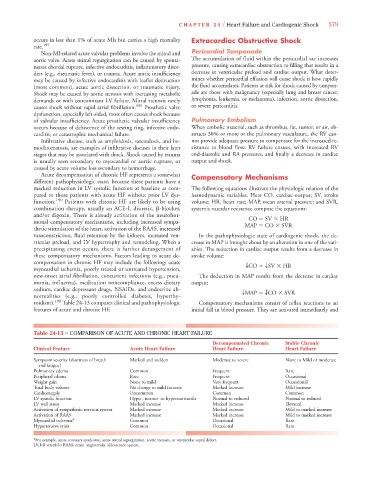
                   roidism). 190  Table 24-13 compares clinical and pathophysiologic  Compensatory mechanisms consist of reflex reactions to an
                   features of acute and chronic HF.                   initial fall in blood pressure. They are activated immediately and


                   Table 24-13 ■ COMPARISON OF ACUTE AND CHRONIC HEART FAILURE
                                                                              Decompensated Chronic  Stable Chronic
                   Clinical Feature               Acute Heart Failure         Heart Failure          Heart Failure
                   Symptom severity (shortness of breath  Marked and sudden   Moderate to severe     None to Mild or moderate
                     and fatigue)
                   Pulmonary edema                Common                      Frequent               Rare
                   Peripheral edema               Rare                        Frequent               Occasional
                   Weight gain                    None to mild                Very frequent          Occassional
                   Total body volume              No change to mild increase  Marked increase        Mild increase
                   Cardiomegaly                   Uncommon                    Common                 Common
                   LV systolic function           Hypo-, normo- or hypercontractile  Normal to reduced  Normal to reduced
                   LV wall stress                 Marked increase             Marked increase        Elevated
                   Activation of sympathetic nervous system  Marked increase  Marked increase        Mild to marked increase
                   Activation of RAAS             Marked increase             Marked increase        Mild to marked increase
                   Myocardial ischemia*           Common                      Occasional             Rare
                   Hypertensive crisis            Common                      Occasional             Rare

                   *For example, acute coronary syndrome, acute mitral regurgitation, aortic stenosis, or ventricular septal defect.
                   LV, left ventricle; RAAS, renin–angiotensin–aldosterone system.

