


Page 74 - Cardiac Nursing
P. 74
3
2-0
2-0
68.
5:3
5:3
68.
3
p
Pa
Pa
p
Pa
04
04
1
xd
0
0
xd
q
q
q
0
009
009
1
0/2
6/3
6/3
0/2
r
02_
02_
ta
ta
r
0-c
LWB
LWB
LWBK340-c02_ pp042-068.qxd 06/30/2009 15:33 Page 50 Aptara a a
0-c
K34
K34
e 5
g
e 5
0 A
0 A
g
p
p
g
p
50 PA R T I / Anatomy and Physiology
Synthesis of endothelin and its regulation
Stimulation Endothelial cell
Mechanical
stress prepro-endothelin-1
Hypoxia
Hormones Furin-like
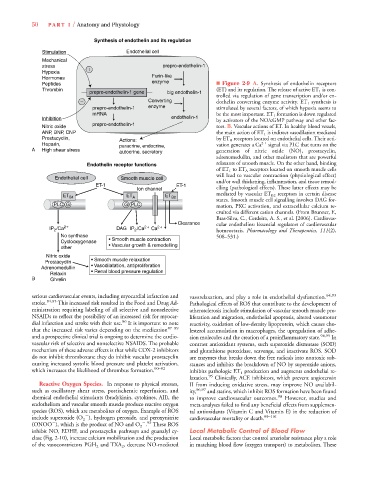
Peptides enzyme ■ Figure 2-9 A. Synthesis of endothelin receptors
Thrombin (ET) and its regulation. The release of active ET 1 is con-
prepro-endothelin-1 gene big endothelin-1
trolled via regulation of gene transcription and/or en-
Converting dothelin converting enzyme activity. ET 1 synthesis is
prepro-endothelin-1 enzyme stimulated by several factors, of which hypoxia seems to
mRNA be the most important. ET 1 formation is down regulated
Inhibition endothelin-1 by activators of the NO/cGMP pathway and other fac-
prepro-endothelin-1
Nitric oxide tors. B. Vascular actions of ET. In healthy blood vessels,
ANP, BNP, CNP the main action of ET 1 is indirect vasodilation mediated
Prostacyclin, Actions: by ET B receptors located on endothelial cells. Their acti-
Heparin, paracrine, endocrine, vation generates a Ca 2
signal via PLC that turns on the
A High shear stress autocrine, secretory generation of nitric oxide (NO), prostacyclin,
adrenomedullin, and other mediators that are powerful
relaxants of smooth muscle. On the other hand, binding
Endothelin receptor functions
T
of ET 1 to ET A receptors located on smooth muscle cells
will lead to vascular contraction (physiological effect)
Endothelial cell Smooth muscle cell
and/or wall thickening, inflammation, and tissue remod-
ET-1 ET-1
Ion channel elling (pathological effects). These latter effects may be
mediated by vascular ET B2 receptors in certain disease
ET B1 ET A ET B2
states. Smooth muscle cell signalling involves DAG for-
PLC
PLC
PLC
PLC
C
PLC
PLC
PLC
PLC
PLC
PLC
PLC
PLC
PLC
PLC
PLC
PLC
PLC
PLC
PLC
PLC
PLC
PLC
PLC
PLC G G G G G G G G G G G G G G G G G G G G G G G G G G G G G G G G G G G G G G G G G G G G G G G G G G G G G G G G G G G G G G G G G G G G G G G G G G G G G G G G G G G G G G G G G G G G G G G G G G G G G G G G G G G G G G G G G G G G G G G G G G G G G G G G G G G G G G G G G G G G G G G G G G G G G G PLC mation, PKC activation, and extracellular calcium re-
PLC
PLC
PLC
PLC
C
C C
PLC
PLC
PLC
PLC
PLC
PLC
PLC
PLC
PLC
PLC
PLC
PLC
PLC
PLC
PLC
PLC
PLC
PLC
PLC
PLC
PLC
PLC
PLC
PLC
PLC
PLC
PLC
PLC
PLC
PLC
PLC
PLC
PLC
PLC
PLC
PLC
PLC
PLC
PLC
PLC
PLC
PLC
PLC
PLC
PLC
PLC
PLC
PLC
PLC
PLC
PLC
PLC
PLC
PLC
PLC
PLC
PLC
PLC
PLC
PLC
PLC
PLC
PLC
PLC
PLC
PLC
PLC
PLC
PLC
PLC
PLC
PLC
PLC
PLC
PLC
PLC
PLC
PLC
PLC
PLC
PLC
PLC
PLC
PLC
PLC
PLC
PLC
PLC
PLC
PLC
PLC
PLC
PLC
PLC
C C
C
PLC
PLC
PLC
PLC
PLC
PLC
PLC
PLC
PLC
PLC
PLC
PLC
PLC
PLC
PLC
PLC
PLC
PLC
PLC
PLC
PLC
PLC
PLC
cruited via different cation channels. (From Brunner, F.,
Bras-Silva, C., Cerdeira, A. S., et al. [2006]. Cardiovas-
Clearance cular endothelins: Essential regulators of cardiovascular
IP /Ca 2
DAG IP /Ca 2
Ca 2
homeostasis. Pharmacology and Therapeutics, 111(2),
2
2
No synthase 508–531.)
Cyclooxygenase • Smooth muscle contraction
other • Vascular growth & remodelling
Nitric oxide
Prostacyclin • Smooth muscle relaxation
Adrenomedullin • Vasodilatation, antiproliferation
• Renal blood pressure regulation
Relaxin
B Ghrelin
serious cardiovascular events, including myocardial infarction and vasorelaxation, and play a role in endothelial dysfunction. 64,93
stroke. 84,85 This increased risk resulted in the Food and Drug Ad- Pathological effects of ROS that contribute to the development of
ministration requiring labeling of all selective and nonselective atherosclerosis include stimulation of vascular smooth muscle pro-
NSAIDs to reflect the possibility of an increased risk for myocar- liferation and migration, endothelial apoptosis, altered vasomotor
dial infarction and stroke with their use. 86 It is important to note reactivity, oxidation of low-density lipoprotein, which causes cho-
that the increased risk varies depending on the medication 87–89 lesterol accumulation in macrophages, the upregulation of adhe-
and a prospective clinical trial is ongoing to determine the cardio- sion molecules and the creation of a proinflammatory state. 94,95 In
vascular risk of selective and nonselective NSAIDS. The probable contrast antioxidant systems, such superoxide dismutase (SOD)
mechanism of these adverse effects is that while COX-2 inhibitors and glutathione peroxidase, scavenge, and inactivate ROS. SOD
do not inhibit thromboxane they do inhibit vascular prostacyclin are enzymes that breaks down the free radicals into nontoxic sub-
causing increased systolic blood pressure and platelet activation, stances and inhibits the breakdown of NO by superoxide anions,
which increases the likelihood of thrombus formation. 90–92 inhibits pathologic ET 1 production and augments endothelial re-
laxation. 95 Clinically, ACE inhibitors, which prevent angiotensin
Reactive Oxygen Species. In response to physical stresses, II from inducing oxidative stress, may improve NO availabil-
such as oscillatory shear stress, postischemic reperfusion, and ity, 96,97 and statins, which inhibit ROS formation have been found
chemical endothelial stimulants (bradykinin, cytokines, AII), the to improve cardiovascular outcomes. 98 However, studies and
endothelium and vascular smooth muscle produce reactive oxygen meta-analyses failed to find any beneficial effects from supplemen-
species (ROS), which are metabolites of oxygen. Example of ROS tal antioxidants (Vitamin C and Vitamin E) in the reduction of
include superoxide (O 2 ), hydrogen peroxide, and peroxynitrite cardiovascular mortality or death. 99–101
93
(ONOO ), which is the product of NO and O 2 . These ROS
inhibit NO, EDHF, and prostacyclin pathways and guanalyl cy- Local Metabolic Control of Blood Flow
clase (Fig. 2-10), increase calcium mobilization and the production Local metabolic factors that control arteriolar resistance play a role
A
of the vasoconstrictors PGH 2 and TXA 2 , decrease NO-mediated in matching blood flow (oxygen transport) to metabolism. These

