


Page 701 - Cardiac Nursing
P. 701
92806_c28.qxd  11/21/11  11:03 AM  Page 677


                                                        C H A P T E R   2 8 / Pacemakers and Implantable Defibrillators  677


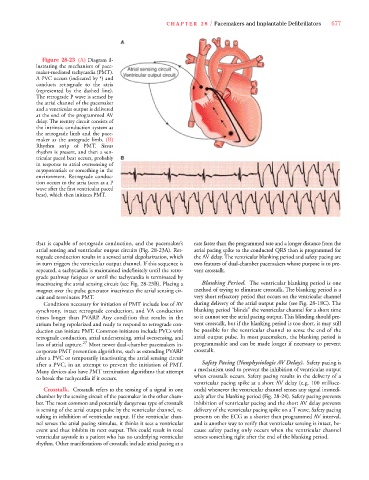
                F i g u re 28-23 ( A ) Diagram il-
              lustrating the mechanism of pace-
              maker-mediated tachyc a rdia (PMT) .
              A PVC occurs (indicated by *) and
              conducts  re t rograde  to  the  atria
              ( re p resented  by  the  dashed  line).
              The retrograde P wave is sensed by
              the atrial channel of the pacemaker
              and a ventricular output is delivered
              at the end of the programmed AV
              delay. The reentry circuit consists of
              the intrinsic conduction system as
              the re t rograde limb and the pace-
              maker  as  the  antegrade  limb.  ( B )
              Rhythm  strip  of  PMT.  Si n u s
              rhythm is present, and then a ve n-
              tricular paced beat occurs, probably
              in response to atrial oversensing of
              m yopotentials or something in the
              e n v i ronment.  Re t rograde  conduc-
              tion occurs to the atria (seen as a P
              wave after the first ventricular paced
              beat), which then initiates PMT.


              that is capable of re t rograde conduction, and the pacemaker’s  rate faster than the programmed rate and a longer distance from the
              atrial sensing and ventricular output circuits (Fig. 28-23A). Ret-  atrial pacing spike to the conducted QRS than is programmed for
              rograde conduction results in a sensed atrial depolarization, which  the AV delay. The ventricular blanking period and safety pacing are
              in turn triggers the ventricular output channel. If this sequence is  two features of dual-chamber pacemakers whose purpose is to pre-
              repeated, a tachycardia is maintained indefinitely until the retro-  vent cro s s t a l k .
              grade pathway fatigues or until the tachycardia is terminated by
              inactivating the atrial sensing circuit (see Fig. 28-23B). Placing a  Blanking Pe r i o d . The ventricular blanking period is one
              magnet over the pulse generator inactivates the atrial sensing cir-  method of trying to eliminate crosstalk. The blanking period is a
              cuit and terminates PMT.                           very short refractory period that occurs on the ventricular channel
                Conditions necessary for initiation of PMT include loss of AV  during delivery of the atrial output pulse (see Fig. 28-18C). The
              s y n c h ro n y, intact re t rograde conduction, and VA conduction  blanking period “blinds” the ventricular channel for a short time
              times  longer  than  PVA R P.  Any  condition  that  results  in  the  so it cannot see the atrial pacing output. This blinding should pre-
              atrium being repolarized and ready to respond to retrograde con-  vent crosstalk, but if the blanking period is too short, it may still
              duction can initiate PMT. Common initiators include PVCs with  be possible for the ventricular channel to sense the end of the
              retrograde conduction, atrial undersensing, atrial oversensing, and  atrial output pulse. In most pacemakers, the blanking period is
              loss of atrial capture. 27  Most newer dual-chamber pacemakers in-  p rogrammable and can be made longer if necessary to pre ve n t
              corporate PMT prevention algorithms, such as extending PVARP  crosstalk.
              after a PVC or temporarily inactivating the atrial sensing circuit
              after a PVC, in an attempt to pre vent the initiation of PMT.  Safety Pacing (Nonphysiologic AV Delay). Safety pacing is
              Many devices also have PMT termination algorithms that attempt  a mechanism used to prevent the inhibition of ventricular output
              to break the tachycardia if it occurs.             when crosstalk occurs. Safety pacing results in the delive ry of a
                                                                 ventricular pacing spike at a short AV delay (e.g. 100 millisec-
                Cro s s t a l k . Crosstalk refers to the sensing of a signal in one  onds) whenever the ventricular channel senses any signal immedi-
              chamber by the sensing circuit of the pacemaker in the other cham-  ately after the blanking period (Fig. 28-24). Safety pacing prevents
              b e r. The most common and potentially dangerous type of cro s s t a l k  inhibition of ventricular pacing and the short AV delay prevents
              is sensing of the atrial output pulse by the ventricular channel, re-  delivery of the ventricular pacing spike on a T wave. Safety pacing
              sulting in inhibition of ventricular output. If the ventricular chan-  presents on the ECG as a shorter than programmed AV interval,
              nel senses the atrial pacing stimulus, it thinks it sees a ve n t r i c u l a r  and is another way to verify that ventricular sensing is intact, be-
              e vent and thus inhibits its next output. This could result in total  cause safety pacing only occurs when the ventricular channel
              ventricular asystole in a patient who has no underlying ve n t r i c u l a r  senses something right after the end of the blanking period.
              rhythm. Other manifestations of crosstalk include atrial pacing at a

