


Page 703 - Cardiac Nursing
P. 703
7
                                /1/
                                 09
                           qxd
                    p65
                       5-7
                         04.
                                               679
                                                  Ap
                                                    tar
                                             g
                                     49
                                        AM
                                           P
         LWB
         LWBK340-c28_p655-704.qxd  7/1/09  9:9:49 AM  Page 679 Aptara
         LWB K34 0-c 28_ p65 5-7 04. qxd  7 /1/ 09  9: 49  AM  P a a g e e  679  Ap tar a a
                 28_
               0-c
            K34
                                                              C HAPTER 2 8 / Pacemakers and Implantable Defibrillators  679
                                                           e 60
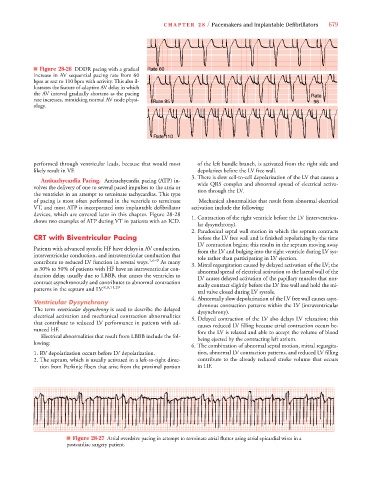
                   ■ Figure 28-26 DDDR pacing with a gradual  Rate 60
                                                         ate 6
                                                        Rate 60
                                                        Rate 60
                                                         a
                   increase in AV sequential pacing rate from 60
                   bpm at rest to 110 bpm with activity. This also il-
                   lustrates the feature of adaptive AV delay in which
                   the AV interval gradually shortens as the pacing                                           Rate
                   rate increases, mimicking normal AV node physi-  Ra a  e  e e e e e e t t t at at ate 8 85  96
                                                          Ra
                                                          Ra
                                                               5 5 5
                                                               5
                                                              85
                                                          R R R R R R R R R Rate 85
                                                              8 8 8 8 8 8
                                                              85
                   ology.
                                                          R Ra
                                                          R R R R R R Rate 1 1 1 1 11 1 1 1 110
                                                          Ra
                                                                0 0 0 0 0 0 00
                                                              11
                                                             e 1
                                                              11
                                                             e  e e e e t t at at a a
                   performed through ventricular leads, because that would most  of the left bundle branch, is activated from the right side and
                   likely result in VF.                                  depolarizes before the LV free wall.
                                                                       3. There is slow cell-to-cell depolarization of the LV that causes a
                     Antitachycardia Pacing. Antitachycardia pacing (ATP) in-  wide QRS complex and abnormal spread of electrical activa-
                   volves the delivery of one to several paced impulses to the atria or  tion through the LV.
                   the ventricles in an attempt to terminate tachycardias. This type
                   of pacing is most often performed in the ventricle to terminate  Mechanical abnormalities that result from abnormal electrical
                   VT, and most ATP is incorporated into implantable defibrillator  activation include the following:
                   devices, which are covered later in this chapter. Figure 28-28  1. Contraction of the right ventricle before the LV (interventricu-
                   shows two examples of ATP during VT in patients with an ICD.
                                                                         lar dysynchrony).
                                                                       2. Paradoxical septal wall motion in which the septum contracts
                   CRT with Biventricular Pacing                         before the LV free wall and is finished repolarizing by the time
                                                                         LV contraction begins; this results in the septum moving away
                   Patients with advanced systolic HF have delays in AV conduction,  from the LV and bulging into the right ventricle during LV sys-
                   interventricular conduction, and intraventricular conduction that  tole rather than participating in LV ejection.
                   contribute to reduced LV function in several ways. 1,6–9  As many  3. Mitral regurgitation caused by delayed activation of the LV; the
                   as 30% to 50% of patients with HF have an intraventricular con-  abnormal spread of electrical activation to the lateral wall of the
                   duction delay, usually due to LBBB, that causes the ventricles to  LV causes delayed activation of the papillary muscles that nor-
                   contract asynchronously and contributes to abnormal contraction  mally contract slightly before the LV free wall and hold the mi-
                   patterns in the septum and LV. 8,9,11,29
                                                                         tral valve closed during LV systole.
                                                                       4.Abnormally slow depolarization of the LV free wall causes asyn-
                   Ventricular Dysynchrony                               chronous contraction patterns within the LV (intraventricular
                   The term ventricular dysynchrony is used to describe the delayed  dysynchrony).
                   electrical activation and mechanical contraction abnormalities  5. Delayed contraction of the LV also delays LV relaxation; this
                   that contribute to reduced LV performance in patients with ad-  causes reduced LV filling because atrial contraction occurs be-
                   vanced HF.                                            fore the LV is relaxed and able to accept the volume of blood
                     Electrical abnormalities that result from LBBB include the fol-  being ejected by the contracting left atrium.
                   lowing:
                                                                       6. The combination of abnormal septal motion, mitral regurgita-
                   1. RV depolarization occurs before LV depolarization.  tion, abnormal LV contraction patterns, and reduced LV filling
                   2. The septum, which is usually activated in a left-to-right direc-  contribute to the already reduced stroke volume that occurs
                     tion from Purkinje fibers that arise from the proximal portion  in HF.


                              ■ Figure 28-27 Atrial overdrive pacing in attempt to terminate atrial flutter using atrial epicardial wires in a
                              postcardiac surgery patient.

