


Page 211 - ACCCN's Critical Care Nursing
P. 211
188  P R I N C I P L E S   A N D   P R A C T I C E   O F   C R I T I C A L   C A R E

         impetus for blood through the pulmonary and systemic
         vascular systems. The phases of the cardiac cycle are char-                                 Increased
         acterised  by  pressure  changes  within  each  of  the  heart                              contractility
         chambers,  resulting  in  blood  flow  from  areas  of  high   125
         pressure to areas of lower pressure.
         During late ventricular diastole (rest), pressures are lowest   100                         Normal
                                                                                                     contractility
         in the heart and blood returns passively to fill the atria.
         This flow also moves into the ventricle through the open   Ventricular stroke work (mmHg)  75
         AV valves, producing 70–80% of ventricular filling. The                                     Decreased
         pulmonic and aortic valves are closed, preventing back-    50                               contractility
         flow from the pulmonary and systemic systems into the
         ventricles. Depolarisation of the atria then occurs, some-
         times referred to as atrial kick, stimulating atrial contrac-  25
         tion and completing the remaining 20–30% of ventricular
         filling.
         During  ventricular  systole  (contraction),  the  atria  relax   0    4      8       12     16
         while  the  ventricles  depolarise,  resulting  in  ventricular   Left ventricular end-diastolic filling pressure (LVEDP)
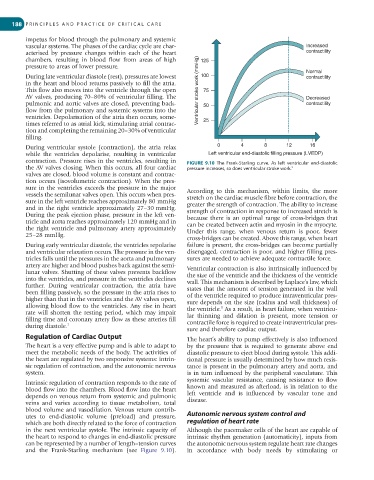
         contraction. Pressure rises in the ventricles, resulting in   FIGURE  9.10  The  Frank-Starling  curve.  As  left  ventricular  end-diastolic
         the AV valves closing. When this occurs, all four cardiac   pressure increases, so does ventricular stroke work.   5
         valves are closed, blood volume is constant and contrac-
         tion occurs (isovolumetric contraction). When the pres-
         sure in the ventricles exceeds the pressure in the major   According  to  this  mechanism,  within  limits,  the  more
         vessels the semilunar valves open. This occurs when pres-  stretch on the cardiac muscle fibre before contraction, the
         sure in the left ventricle reaches approximately 80 mmHg   greater the strength of contraction. The ability to increase
         and in the right ventricle approximately 27–30 mmHg.   strength of contraction in response to increased stretch is
         During the peak ejection phase, pressure in the left ven-  because  there  is  an  optimal  range  of  cross-bridges  that
         tricle and aorta reaches approximately 120 mmHg and in   can be created between actin and myosin in the myocyte.
         the right ventricle and pulmonary artery approximately   Under  this  range,  when  venous  return  is  poor,  fewer
         25–28 mmHg.
                                                              cross-bridges can be created. Above this range, when heart
         During early ventricular diastole, the ventricles repolarise   failure is present, the cross-bridges can become partially
         and ventricular relaxation occurs. The pressure in the ven-  disengaged, contraction is poor, and higher filling pres-
         tricles falls until the pressures in the aorta and pulmonary   sures are needed to achieve adequate contractile force.
         artery are higher and blood pushes back against the semi-  Ventricular contraction is also intrinsically influenced by
         lunar valves. Shutting of these valves prevents backflow   the size of the ventricle and the thickness of the ventricle
         into the ventricles, and pressure in the ventricles declines   wall. This mechanism is described by Laplace’s law, which
         further.  During  ventricular  contraction,  the  atria  have   states that the amount of tension generated in the wall
         been filling passively, so the pressure in the atria rises to   of the ventricle required to produce intraventricular pres-
         higher than that in the ventricles and the AV valves open,   sure depends on the size (radius and wall thickness) of
         allowing blood flow to the ventricles. Any rise in heart   the ventricle.  As a result, in heart failure, when ventricu-
                                                                         1
         rate  will  shorten  the  resting  period,  which  may  impair   lar  thinning  and  dilation  is  present,  more  tension  or
         filling time and coronary artery flow as these arteries fill   contractile force is required to create intraventricular pres-
         during diastole. 1
                                                              sure and therefore cardiac output.
         Regulation of Cardiac Output                         The heart’s ability to pump effectively is also influenced
         The heart is a very effective pump and is able to adapt to   by  the  pressure  that  is  required  to  generate  above  end
         meet the metabolic needs of the body. The activities of   diastolic pressure to eject blood during systole. This addi-
         the heart are regulated by two responsive systems: intrin-  tional pressure is usually determined by how much resis-
         sic regulation of contraction, and the autonomic nervous   tance is present in the pulmonary artery and aorta, and
         system.                                              is in turn influenced by the peripheral vasculature. This
                                                              systemic  vascular  resistance,  causing  resistance  to  flow
         Intrinsic regulation of contraction responds to the rate of
         blood flow into the chambers. Blood flow into the heart   known and measured as afterload, is in relation to the
         depends on venous return from systemic and pulmonic   left  ventricle  and  is  influenced  by  vascular  tone  and
         veins  and  varies  according  to  tissue  metabolism,  total   disease.
         blood volume and vasodilation. Venous return contrib-
         utes  to  end-diastolic  volume  (preload)  and  pressure,   Autonomic nervous system control and
         which are both directly related to the force of contraction   regulation of heart rate
         in  the  next  ventricular  systole.  The  intrinsic  capacity  of   Although the pacemaker cells of the heart are capable of
         the heart to respond to changes in end-diastolic pressure   intrinsic rhythm generation (automaticity), inputs from
         can be represented by a number of length–tension curves   the autonomic nervous system regulate heart rate changes
         and  the  Frank-Starling  mechanism  (see  Figure  9.10).   in  accordance  with  body  needs  by  stimulating  or

