


Page 222 - ACCCN's Critical Care Nursing
P. 222
Cardiovascular Assessment and Monitoring  199

             INVASIVE CARDIOVASCULAR MONITORING
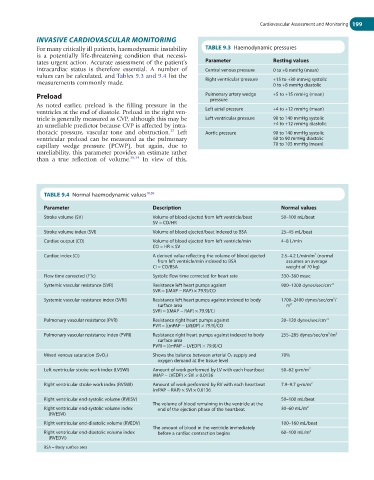
             For many critically ill patients, haemodynamic instability   TABLE 9.3  Haemodynamic pressures
             is  a  potentially  life-threatening  condition  that  necessi-
             tates urgent action. Accurate assessment of the patient’s   Parameter        Resting values
             intracardiac  status  is  therefore  essential.  A  number  of   Central venous pressure  0 to +8 mmHg (mean)
             values can be calculated, and Tables 9.3 and 9.4 list the
             measurements commonly made.                            Right ventricular pressure  +15 to +30 mmHg systolic
                                                                                          0 to +8 mmHg diastolic
             Preload                                                Pulmonary artery wedge   +5 to +15 mmHg (mean)
                                                                      pressure
             As  noted  earlier,  preload  is  the  filling  pressure  in  the
             ventricles at the end of diastole. Preload in the right ven-  Left atrial pressure  +4 to +12 mmHg (mean)
             tricle is generally measured as CVP, although this may be   Left ventricular pressure  90 to 140 mmHg systolic
             an unreliable predictor because CVP is affected by intra-                    +4 to +12 mmHg diastolic
             thoracic  pressure,  vascular  tone  and  obstruction.   Left   Aortic pressure  90 to 140 mmHg systolic
                                                         37
             ventricular  preload  can  be  measured  as  the  pulmonary                  60 to 90 mmHg diastolic
             capillary  wedge  pressure  (PCWP),  but  again,  due  to                    70 to 105 mmHg (mean)
             unreliability, this parameter provides an estimate rather
             than  a  true  reflection  of  volume. 38,39   In  view  of  this,


               TABLE 9.4  Normal haemodynamic values 10,36

               Parameter                           Description                               Normal values
               Stroke volume (SV)                  Volume of blood ejected from left ventricle/beat  50–100 mL/beat
                                                   SV = CO/HR
               Stroke volume index (SVI)           Volume of blood ejected/beat indexed to BSA  25–45 mL/beat
               Cardiac output (CO)                 Volume of blood ejected from left ventricle/min  4–8 L/min
                                                   CO = HR × SV
               Cardiac index (CI)                  A derived value reflecting the volume of blood ejected   2.5–4.2 L/min/m  (normal
                                                                                                        2
                                                     from left ventricle/min indexed to BSA    assumes an average
                                                   CI = CO/BSA                                 weight of 70 kg)
               Flow time corrected (FTc)           Systolic flow time corrected for heart rate  330–360 msec
               Systemic vascular resistance (SVR)  Resistance left heart pumps against       900–1300 dynes/sec/cm −5
                                                   SVR = [(MAP − RAP) × 79.9]/CO
               Systemic vascular resistance index (SVRI)  Resistance left heart pumps against indexed to body   1700–2400 dynes/sec/cm /
                                                                                                              5
                                                     surface area                              m 2
                                                   SVRI = [(MAP − RAP) × 79.9]/CI
               Pulmonary vascular resistance (PVR)  Resistance right heart pumps against     20–120 dynes/sec/cm −5
                                                   PVR = [(mPAP − LVEDP) × 79.9]/CO
                                                                                                            5
               Pulmonary vascular resistance index (PVRI)  Resistance right heart pumps against indexed to body   255–285 dynes/sec/cm /m 2
                                                     surface area
                                                   PVRI = [(mPAP − LVEDP) × 79.9]/CI
               Mixed venous saturation (SvO 2 )    Shows the balance between arterial O 2 supply and   70%
                                                     oxygen demand at the tissue level
               Left ventricular stroke work index (LVSWI)  Amount of work performed by LV with each heartbeat  50–62 g-m/m 2
                                                   (MAP – LVEDP) × SVI × 0.0136
               Right ventricular stroke work index (RVSWI)  Amount of work performed by RV with each heartbeat  7.9–9.7 g-m/m 2
                                                   (mPAP – RAP) × SVI × 0.0136
               Right ventricular end-systolic volume (RVESV)                                 50–100 mL/beat
                                                   The volume of blood remaining in the ventricle at the
               Right ventricular end-systolic volume index   end of the ejection phase of the heartbeat  30–60 mL/m 2
                 (RVESVI)
               Right ventricular end-diastolic volume (RVEDV)                                100–160 mL/beat
                                                   The amount of blood in the ventricle immediately
               Right ventricular end-diastolic volume index   before a cardiac contraction begins  60–100 mL/m 2
                 (RVEDVI)
               BSA = Body surface area

