


Page 225 - ACCCN's Critical Care Nursing
P. 225
202  P R I N C I P L E S   A N D   P R A C T I C E   O F   C R I T I C A L   C A R E


                     Flow-directed
                        catheter


                        Pressure   Right atrium    Right ventricle  Pulmonary artery  Pulmonary artery wedge (PAOP)
                          30
                         mmHg


                          20
                         mmHg

                          10
                         mmHg


                          0
                         mmHg
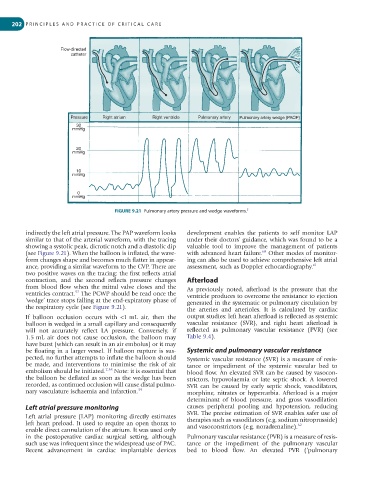
                                       FIGURE 9.21  Pulmonary artery pressure and wedge waveforms.   5


         indirectly the left atrial pressure. The PAP waveform looks   development  enables  the  patients  to  self  monitor  LAP
         similar to that of the arterial waveform, with the tracing   under their doctors’ guidance, which was found to be a
         showing a systolic peak, dicrotic notch and a diastolic dip   valuable  tool  to  improve  the  management  of  patients
         (see Figure 9.21). When the balloon is inflated, the wave-  with advanced heart failure.  Other modes of monitor-
                                                                                       60
         form changes shape and becomes much flatter in appear-  ing can also be used to achieve comprehensive left atrial
         ance, providing a similar waveform to the CVP. There are   assessment, such as Doppler echocardiography. 61
         two positive waves on the tracing: the first reflects atrial
         contraction,  and  the  second  reflects  pressure  changes   Afterload
         from  blood  flow  when  the  mitral  valve  closes  and  the   As  previously  noted,  afterload  is  the  pressure  that  the
         ventricles contract.  The PCWP should be read once the   ventricle produces to overcome the resistance to ejection
                          57
         ‘wedge’ trace stops falling at the end-expiratory phase of   generated in the systematic or pulmonary circulation by
         the respiratory cycle (see Figure 9.21).             the  arteries  and  arterioles.  It  is  calculated  by  cardiac
         If  balloon  occlusion  occurs  with  <1 mL  air,  then  the   output studies: left heart afterload is reflected as systemic
         balloon is wedged in a small capillary and consequently   vascular  resistance  (SVR),  and  right  heart  afterload  is
         will  not  accurately  reflect  LA  pressure.  Conversely,  if   reflected  as  pulmonary  vascular  resistance  (PVR)  (see
         1.5 mL  air  does  not  cause  occlusion,  the  balloon  may   Table 9.4).
         have burst (which can result in an air embolus) or it may
         be  floating  in  a  larger  vessel.  If  balloon  rupture  is  sus-  Systemic and pulmonary vascular resistance
         pected, no further attempts to inflate the balloon should   Systemic vascular resistance (SVR) is a measure of resis-
         be made, and interventions to minimise the risk of air   tance  or  impediment  of  the  systemic  vascular  bed  to
         embolism should be initiated. 7,58  Note: it is essential that   blood flow. An elevated SVR can be caused by vasocon-
         the balloon be deflated as soon as the wedge has been   strictors,  hypovolaemia  or  late  septic  shock.  A  lowered
         recorded, as continued occlusion will cause distal pulmo-  SVR  can  be  caused  by  early  septic  shock,  vasodilators,
         nary vasculature ischaemia and infarction. 59        morphine, nitrates or hypercarbia. Afterload is a major
                                                              determinant  of  blood  pressure,  and  gross  vasodilation
         Left atrial pressure monitoring                      causes  peripheral  pooling  and  hypotension,  reducing
                                                              SVR. The precise estimation of SVR enables safer use of
         Left  atrial  pressure  (LAP)  monitoring  directly  estimates   therapies such as vasodilators (e.g. sodium nitroprusside)
         left heart preload. It used to require an open thorax to   and vasoconstrictors (e.g. noradrenaline). 62
         enable direct cannulation of the atrium. It was used only
         in  the  postoperative  cardiac  surgical  setting,  although   Pulmonary vascular resistance (PVR) is a measure of resis-
         such use was infrequent since the widespread use of PAC.   tance  or  the  impediment  of  the  pulmonary  vascular
         Recent  advancement  in  cardiac  implantable  devices   bed  to  blood  flow.  An  elevated  PVR  (‘pulmonary

