


Page 227 - ACCCN's Critical Care Nursing
P. 227
204  P R I N C I P L E S   A N D   P R A C T I C E   O F   C R I T I C A L   C A R E

            circulating blood volumes, particularly when a patient   from the end of diastole to the end of the ejection phase
            is  artificially  ventilated.  Derived  normal  value  for   is measured and combined with an individual calibration
                                                         2
            intrathoracic blood volume index 850–1000 mL/m .  factor. The algorithm is capable of computing each single
         ●  Extravascular lung water (EVLW): the amount of water   stroke volume after being calibrated by an initial trans-
            content  in  the  lungs;  allows  quantification  of  the   pulmonary thermodilution.
            degree of pulmonary oedema (not evident with X-ray   PiCCO preload indicators of intrathoracic blood volume
            or blood gases). Derived normal value for extravascu-  (ITBV) and global end-diastolic volume (GEDV) are more
            lar  lung  water  index  is  3–7 mL/kg.  EVLW  has  been   sensitive and specific to cardiac preload than the standard
            shown to be useful as a guide for fluid management   cardiac filling pressures of CVP and PCWP, as well as right
                                67
            in critically ill patients.  An elevated EVLW may be an   ventricular  end-diastolic  volume.   One  advantage  of
                                                                                            40
            effective  indicator  of  severity  of  illness,  particularly   ITBV and GEDV is that they are not affected by mechani-
            after  acute  lung  injury  or  in  ARDS,  when  EVLW  is   cal ventilation and therefore give correct information on
                                                         72
            elevated due to alterations in hydrostatic pressures.    the preload status under almost any condition. Extravas-
            Other patients at risk of high EVLW are those with left   cular lung water correlates moderately well with severity
            heart failure, severe pneumonia, and burns. There may   of ARDS, length of ventilation days, ICU stay and mortal-
            be an association between a high EVLW and increased   ity,   and  appears  to  be  of  greater  accuracy  than  the
                                                                 74
            mortality, the need for mechanical ventilation and a   traditional  assessment  of  lung  oedema  by  chest  X-ray.
                                            72
            higher risk of nosocomial infection.  A decision tree   Disadvantages of PiCCO include its potential unreliabil-
            outlining processes of care guided by information pro-  ity  when  heart  rate,  blood  pressure  and  total  vascular
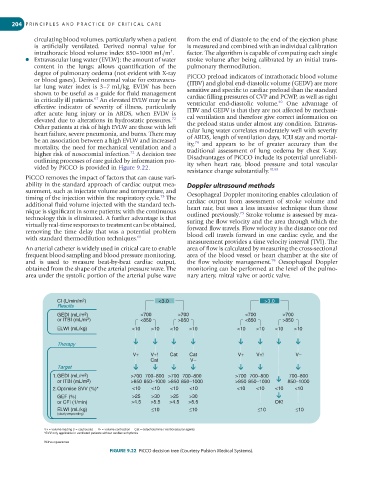
            vided by PiCCO is provided in Figure 9.22.
                                                              resistance change substantially. 10,68
         PiCCO removes the impact of factors that can cause vari-
         ability in the standard approach of cardiac output mea-  Doppler ultrasound methods
         surement, such as injectate volume and temperature, and
                                                      73
         timing of the injection within the respiratory cycle.  The   Oesophageal Doppler monitoring enables calculation of
         additional fluid volume injected with the standard tech-  cardiac  output  from  assessment  of  stroke  volume  and
         nique is significant in some patients; with the continuous   heart rate, but uses a less invasive technique than those
                                                                                75
         technology this is eliminated. A further advantage is that   outlined previously.  Stroke volume is assessed by mea-
         virtually real-time responses to treatment can be obtained,   suring the flow velocity and the area through which the
         removing  the  time  delay  that  was  a  potential  problem   forward flow travels. Flow velocity is the distance one red
         with standard thermodilution techniques. 61          blood cell travels forward in one cardiac cycle, and the
                                                              measurement provides a time velocity interval (TVI). The
         An arterial catheter is widely used in critical care to enable   area of flow is calculated by measuring the cross-sectional
         frequent blood sampling and blood pressure monitoring,   area of the blood vessel or heart chamber at the site of
                                                                                          76
         and  is  used  to  measure  beat-by-beat  cardiac  output,   the  flow  velocity  management.   Oesophageal  Doppler
         obtained from the shape of the arterial pressure wave. The   monitoring can be performed at the level of the pulmo-
         area under the systolic portion of the arterial pulse wave   nary artery, mitral valve or aortic valve.


                            2
                    CI (L/min/m )                    <3.0                               >3.0
                    Results
                    GEDI (mL/m 2 )             <700        >700                  <700        >700
                              2
                    or ITBI (mL/m )            <850        >850                  <850        >850
                    ELWI (mL/kg)            <10   >10    <10   >10             <10   >10   <10   >10

                    Therapy
                                            V+    V+!    Cat   Cat             V+    V+!          V–
                                                  Cat          V–
                    Target
                  1.GEDI (mL/m 2 )          >700 700–800 >700 700–800         >700 700–800      700–800
                    or ITBI (mL/m )         >850 850–1000 >850 850–1000       >850 850–1000    850–1000
                              2
                  2.Optimise SVV (%)*       <10    <10   <10   <10             <10   <10   <10   <10
                    GEF (%)                 >25    >30   >25   >30
                    or CFI (1/min)          >4.5  >5.5   >4.5  >5.5                        OK!
                    ELWI (mL/kg)                   ≤10         ≤10                   ≤10          ≤10
                    (slowly responding)

                V+ = volume loading (! = cautiously)      V- = volume contraction     Cat = catecholamine / cardiovascular agents
                *SVV only applicable in ventilated patients without cardiac arrhythmia
                Without guarantee
                                     FIGURE 9.22  PiCCO decision tree (Courtesy Pulsion Medical Systems).

