


Page 217 - ACCCN's Critical Care Nursing
P. 217
194  P R I N C I P L E S   A N D   P R A C T I C E   O F   C R I T I C A L   C A R E

                                                 8
         the muscle strength of ventricular contraction.  Duration   plus >25% of R wave height) may indicate a previous
         of activity within the ECG is measured by a series of verti-  myocardial infarction, however, not every myocardial
                                                                                                          18
         cal  lines  also  1 mm  apart  (see  Figure  9.14).  The  time   infarction will result in a pathological Q wave  and
         interval between each line is 0.04 sec. Every 5th line is   some  abnormal  Q  waves,  in  combination  of  other
         printed in bold, producing large squares. Each represents   ECG  changes  and  patient  symtoms,  may  indicate  a
                                                                                           19
         0.5 mV (vertically) and 0.2 sec (horizontally).         current myocardial infarction.  Pathological Q waves
                                                                 could also be seen in non-ischaemic conditions such
         Key Components of the ECG                               as Wolff–Parkinson–White syndrome (WPW). 20
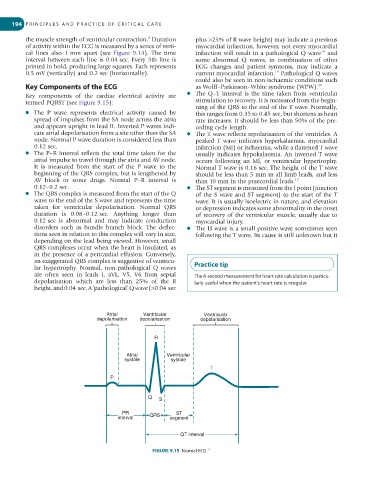
         Key  components  of  the  cardiac  electrical  activity  are   ●  The  Q–T  interval  is  the  time  taken  from  ventricular
         termed PQRST (see Figure 9.15):                         stimulation to recovery. It is measured from the begin-
                                                                 ning of the QRS to the end of the T wave. Normally,
         ●  The  P  wave  represents  electrical  activity  caused  by   this ranges from 0.35 to 0.45 sec, but shortens as heart
            spread of impulses from the SA node across the atria   rate increases. It should be less than 50% of the pre-
            and appears upright in lead II. Inverted P waves indi-  ceding cycle length.
            cate atrial depolarisation from a site other than the SA   ●  The T wave reflects repolarisation of the ventricles. A
            node. Normal P wave duration is considered less than   peaked  T  wave  indicates  hyperkalaemia,  myocardial
            0.12 sec.                                            infarction (MI) or ischaemia, while a flattened T wave
         ●  The P–R interval reflects the total time taken for the   usually  indicates  hypokalaemia.  An  inverted  T  wave
            atrial impulse to travel through the atria and AV node.   occurs  following  an  MI,  or  ventricular  hypertrophy.
            It  is  measured  from  the  start  of  the  P  wave  to  the   Normal T wave is 0.16 sec. The height of the T wave
            beginning of the QRS complex, but is lengthened by   should be less than 5 mm in all limb leads, and less
            AV  block  or  some  drugs.  Normal  P–R  interval  is   than 10 mm in the praecordial leads. 17
            0.12–0.2 sec.                                     ●  The ST segment is measured from the J point (junction
         ●  The QRS complex is measured from the start of the Q   of the S wave and ST segment) to the start of the T
            wave to the end of the S wave and represents the time   wave. It is usually isoelectric in nature, and elevation
            taken  for  ventricular  depolarisation.  Normal  QRS   or depression indicates some abnormality in the onset
            duration  is  0.08–0.12 sec.  Anything  longer  than   of recovery of the ventricular muscle, usually due to
            0.12 sec  is  abnormal  and  may  indicate  conduction   myocardial injury.
            disorders  such  as  bundle  branch  block.  The  deflec-  ●  The U wave is a small positive wave sometimes seen
            tions seen in relation to this complex will vary in size,   following the T wave. Its cause is still unknown but it
            depending on the lead being viewed. However, small
            QRS complexes occur when the heart is insulated, as
            in the presence of a pericardial effusion. Conversely,
            an exaggerated QRS complex is suggestive of ventricu-
            lar  hypertrophy.  Normal,  non-pathological  Q  waves   Practice tip
            are  often  seen  in  leads  I,  aVL,  V5,  V6  from  septal   The 6-second measurement for heart rate calculation is particu-
            depolarisation  which  are  less  than  25%  of  the  R   larly useful when the patient’s heart rate is irregular.
            height, and 0.04 sec. A ‘pathological’ Q wave (>0.04 sec


                                    Atrial      Ventricular         Ventricular
                                 depolarisation  depolarisation    depolarisation

                                                   R


                                          Atrial        Ventricular
                                          systole        systole
                                                                      T
                                     P


                                                  Q  S


                                         PR                ST
                                        interval  QRS    segment

                                                            QT interval

                                                   FIGURE 9.15  Normal ECG.
                                                                     17

