


Page 224 - ACCCN's Critical Care Nursing
P. 224
Cardiovascular Assessment and Monitoring  201


                     A


                     B


                     C

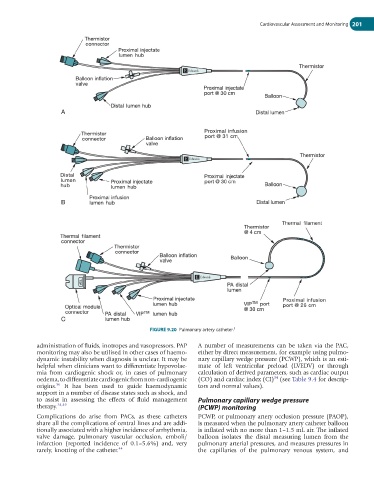
                                                  FIGURE 9.20  Pulmonary artery catheter.   5

             administration of fluids, inotropes and vasopressors. PAP   A  number  of  measurements  can  be  taken  via  the  PAC,
             monitoring may also be utilised in other cases of haemo-  either by direct measurement, for example using pulmo-
             dynamic instability when diagnosis is unclear. It may be   nary capillary wedge pressure (PCWP), which is an esti-
             helpful when clinicians want to differentiate hypovolae-  mate  of  left  ventricular  preload  (LVEDV)  or  through
             mia  from  cardiogenic  shock  or,  in  cases  of  pulmonary   calculation of derived parameters, such as cardiac output
                                                                                           34
             oedema, to differentiate cardiogenic from non-cardiogenic   (CO) and cardiac index (CI)  (see Table 9.4 for descrip-
             origins.   It  has  been  used  to  guide  haemodynamic   tors and normal values).
                   56
             support in a number of disease states such as shock, and
             to  assist  in  assessing  the  effects  of  fluid  management   Pulmonary capillary wedge pressure
             therapy. 34,49                                       (PCWP) monitoring
             Complications  do  arise  from  PACs,  as  these  catheters   PCWP, or pulmonary artery occlusion pressure (PAOP),
             share all the complications of central lines and are addi-  is measured when the pulmonary artery catheter balloon
             tionally associated with a higher incidence of arrhythmia,   is inflated with no more than 1–1.5 mL air. The inflated
             valve  damage,  pulmonary  vascular  occlusion,  emboli/  balloon  isolates  the  distal  measuring  lumen  from  the
             infarction  (reported  incidence  of  0.1–5.6%)  and,  very   pulmonary arterial pressures, and measures pressures in
             rarely, knotting of the catheter. 44                 the  capillaries  of  the  pulmonary  venous  system,  and

