


Page 228 - ACCCN's Critical Care Nursing
P. 228
Cardiovascular Assessment and Monitoring  205

                   Decreased preload        Increased preload     or perforation, severe bleeding problems, or with patients
                                                                  on an intra-aortic balloon pump. 77
                               Fluids                             The Doppler probe that sits in the oesophagus is approxi-
                                                                  mately the size of a nasogastric tube, is semirigid and is
                                                                                               77
                                                                  inserted using a similar technique.  The patient is usually
                                                                                                           82
                                                                  sedated but it has been used in awake patients.  In such
                                                                  cases, however, the limitation is that the probe is more
                                                                  likely to require more frequent repositioning. 76
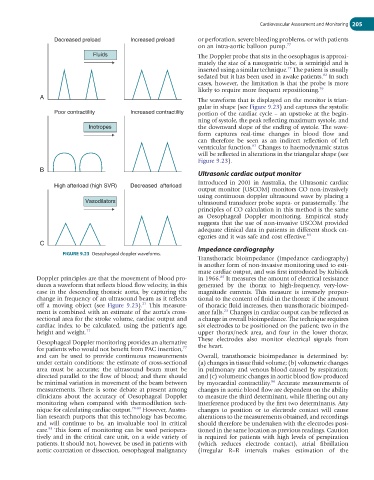
              A                                                   The waveform that is displayed on the monitor is trian-
                                                                  gular in shape (see Figure 9.23) and captures the systolic
                   Poor contractility       Increased contractility  portion of the cardiac cycle – an upstroke at the begin-
                                                                  ning of systole, the peak reflecting maximum systole, and
                              Inotropes                           the downward slope of the ending of systole. The wave-
                                                                  form  captures  real-time  changes  in  blood  flow  and
                                                                  can  therefore  be  seen  as  an  indirect  reflection  of  left
                                                                                    83
                                                                  ventricular function.  Changes to haemodynamic status
                                                                  will be reflected in alterations in the triangular shape (see
                                                                  Figure 9.23).
              B
                                                                  Ultrasonic cardiac output monitor
                                                                  Introduced  in  2001  in  Australia,  the  Ultrasonic  cardiac
                   High afterload (high SVR)  Decreased  afterload
                                                                  output monitor (USCOM) monitors CO non-invasively
                                                                  using continuous doppler ultrasound wave by placing a
                             Vasodilators                         ultrasound transducer probe supra- or parasternally. The
                                                                  principles of CO calculation in this method is the same
                                                                  as  Oesophageal  Doppler  monitoring.  Empirical  study
                                                                  suggests that the use of non-invasive USCOM provided
                                                                  adequate clinical data in patients in different shock cat-
                                                                  egories and it was safe and cost effective. 84
              C
                                                                  Impedance cardiography
                      FIGURE 9.23  Oesophageal doppler waveforms.
                                                                  Transthoracic  bioimpedance  (impedance  cardiography)
                                                                  is another form of non-invasive monitoring used to esti-
                                                                  mate cardiac output, and was first introduced by Kubicek
                                                                         85
             Doppler principles are that the movement of blood pro-  in 1966.  It measures the amount of electrical resistance
             duces a waveform that reflects blood flow velocity, in this   generated  by  the  thorax  to  high-frequency,  very-low-
             case  in  the  descending  thoracic  aorta,  by  capturing  the   magnitude  currents.  This  measure  is  inversely  propor-
             change in frequency of an ultrasound beam as it reflects   tional to the content of fluid in the thorax: if the amount
                                                23
             off  a  moving  object  (see  Figure  9.23).   This  measure-  of thoracic fluid increases, then transthoracic bioimped-
             ment is combined with an estimate of the aorta’s cross-  ance falls.  Changes in cardiac output can be reflected as
                                                                          23
             sectional area for the stroke volume, cardiac output and   a change in overall bioimpedance. The technique requires
             cardiac  index  to  be  calculated,  using  the  patient’s  age,   six electrodes to be positioned on the patient: two in the
             height and weight. 77                                upper  thorax/neck  area,  and  four  in  the  lower  thorax.
                                                                  These  electrodes  also  monitor  electrical  signals  from
             Oesophageal Doppler monitoring provides an alternative
                                                             77
             for patients who would not benefit from PAC insertion,    the heart.
             and  can  be  used  to  provide  continuous  measurements   Overall,  transthoracic  bioimpedance  is  determined  by:
             under certain conditions: the estimate of cross-sectional   (a) changes in tissue fluid volume; (b) volumetric changes
             area  must  be  accurate;  the  ultrasound  beam  must  be   in pulmonary and venous blood caused by respiration;
             directed parallel to the flow of blood; and there should   and (c) volumetric changes in aortic blood flow produced
             be minimal variation in movement of the beam between   by myocardial contractility.  Accurate measurements of
                                                                                          86
             measurements. There is some debate at present among   changes in aortic blood flow are dependent on the ability
             clinicians  about  the  accuracy  of  Oesophageal  Doppler   to measure the third determinant, while filtering out any
             monitoring  when  compared  with  thermodilution  tech-  interference produced by the first two determinants. Any
             nique for calculating cardiac output. 78-80  However, Austra-  changes  to  position  or  to  electrode  contact  will  cause
             lian research purports that this technology has become,   alterations to the measurements obtained, and recordings
             and  will  continue  to  be,  an  invaluable  tool  in  critical   should therefore be undertaken with the electrodes posi-
                 81
             care.  This form of monitoring can be used periopera-  tioned in the same location as previous readings. Caution
             tively and in the critical care unit, on a wide variety of   is required for patients with high levels of perspiration
             patients. It should not, however, be used in patients with   (which  reduces  electrode  contact),  atrial  fibrillation
             aortic coarctation or dissection, oesophageal malignancy   (irregular  R–R  intervals  makes  estimation  of  the

