


Page 232 - ACCCN's Critical Care Nursing
P. 232
Cardiovascular Assessment and Monitoring  209


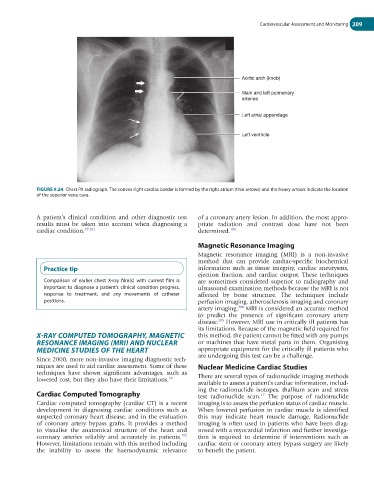
                                                                                Aortic arch (knob)

                                                                                Main and left pulmonary
                                                                                arteries

                                                                                Left atrial appendage


                                                                                Left ventricle


             FIGURE 9.24  Chest PA radiograph. The convex right cardiac border is formed by the right atrium (thin arrows) and the heavy arrows indicate the location
             of the superior vena cava.


             A  patient’s  clinical  condition  and  other  diagnostic  test   of a coronary artery lesion. In addition, the most appro-
             results  must  be  taken  into  account  when  diagnosing  a   priate  radiation  and  contrast  dose  have  not  been
             cardiac condition. 99,101                            determined. 103

                                                                  Magnetic Resonance Imaging
                                                                  Magnetic  resonance  imaging  (MRI)  is  a  non-invasive
                                                                  method  that  can  provide  cardiac-specific  biochemical
               Practice tip                                       information such as tissue integrity, cardiac aneurysms,
                                                                  ejection  fraction,  and  cardiac  output.  These  techniques
               Comparison  of  earlier  chest  X-ray  film(s)  with  current  film  is   are  sometimes  considered  superior  to  radiography  and
               important to diagnose a patient’s clinical condition progress,   ultrasound examination methods because the MRI is not
               response  to  treatment,  and  any  movements  of  catheter   affected  by  bone  structure.  The  techniques  include
               positions.                                         perfusion imaging, atherosclerosis imaging and coronary
                                                                               104
                                                                  artery imaging.  MRI is considered an accurate method
                                                                  to  predict  the  presence  of  significant  coronary  artery
                                                                  disease.  However, MRI use in critically ill patients has
                                                                        105
                                                                  its limitations. Because of the magnetic field required for
             X-RAY COMPUTED TOMOGRAPHY, MAGNETIC                  this method, the patient cannot be fitted with any pumps
             RESONANCE IMAGING (MRI) AND NUCLEAR                  or machines that have metal parts in them. Organising
             MEDICINE STUDIES OF THE HEART                        appropriate equipment for the critically ill patients who
             Since 2000, more non-invasive imaging diagnostic tech-  are undergoing this test can be a challenge.
             niques are used to aid cardiac assessment. Some of these   Nuclear Medicine Cardiac Studies
             techniques  have  shown  significant  advantages,  such  as
             lowered cost, but they also have their limitations. 66  There are several types of radionuclide imaging methods
                                                                  available to assess a patient’s cardiac information, includ-
                                                                  ing  the  radionuclide  isotopes,  thallium  scan  and  stress
             Cardiac Computed Tomography                          test  radionuclide  scan.   The  purpose  of  radionuclide
                                                                                      17
             Cardiac computed tomography (cardiac CT) is a recent   imaging is to assess the perfusion status of cardiac muscle.
             development  in  diagnosing  cardiac  conditions  such  as   When lowered perfusion in cardiac muscle is identified
             suspected coronary heart disease, and in the evaluation   this  may  indicate  heart  muscle  damage.  Radionuclide
             of  coronary  artery  bypass  grafts.  It  provides  a  method     imaging  is  often  used  in  patients  who  have  been  diag-
             to  visualise  the  anatomical  structure  of  the  heart  and   nosed with a myocardial infarction and further investiga-
                                                            102
             coronary  arteries  reliably  and  accurately  in  patients.    tion  is  required  to  determine  if  interventions  such  as
             However, limitations remain with this method including   cardiac stent or coronary artery bypass surgery are likely
             the  inability  to  assess  the  haemodynamic  relevance    to benefit the patient.

