


Page 283 - ACCCN's Critical Care Nursing
P. 283
260  P R I N C I P L E S   A N D   P R A C T I C E   O F   C R I T I C A L   C A R E


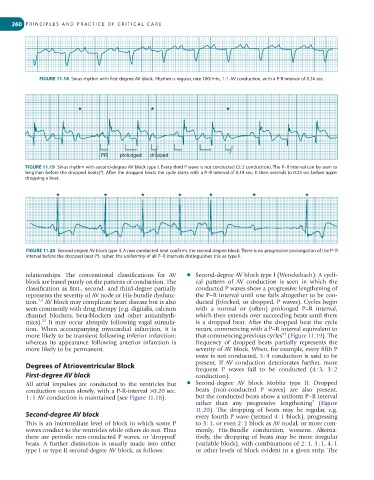
              FIGURE 11.18  Sinus rhythm with first-degree AV block. Rhythm is regular, rate 100/min, 1 : 1 AV conduction, with a P-R interval of 0.24 sec.


                           *                      *                        *


                                  PR    prolonged  dropped
         FIGURE 11.19  Sinus rhythm with second-degree AV block type I. Every third P wave is not conducted (3 : 2 conduction). The P–R interval can be seen to
         lengthen before the dropped beats(*). After the dropped beats the cycle starts with a P–R interval of 0.18 sec. It then extends to 0.25 sec before again
         dropping a beat.

                   *               *           *           *         *              *                *


         FIGURE 11.20  Second degree AV block type II. A non conducted beat confirms the second degree block. There is no progressive prolongation of the P–R
         interval before the dropped beat (*), rather, the uniformity of all P–R intervals distinguishes this as type II.

         relationships.  The  conventional  classifications  for  AV   ●  Second-degree AV block type I (Wenckebach): A cycli-
         block are based purely on the patterns of conduction. The   cal  pattern  of  AV  conduction  is  seen  in  which  the
         classification as first-, second- and third-degree partially   conducted P waves show a progressive lengthening of
         represents the severity of AV node or His-bundle dysfunc-  the P–R interval until one fails altogether to be con-
              7,9
         tion.  AV block may complicate heart disease but is also   ducted (blocked, or dropped, P waves). Cycles begin
         seen commonly with drug therapy (e.g. digitalis, calcium   with  a  normal  or  (often)  prolonged  P–R  interval,
         channel  blockers,  beta-blockers  and  other  antiarrhyth-  which then extends over succeeding beats until there
               20
         mics).   It  may  occur  abruptly  following  vagal  stimula-  is  a  dropped  beat.  After  the  dropped  beat  the  cycle
         tion.  When  accompanying  myocardial  infarction,  it  is   recurs, commencing with a P–R interval equivalent to
                                                                                             63
         more likely to be transient following inferior infarction;   that commencing previous cycles  (Figure 11.19). The
         whereas  its  appearance  following  anterior  infarction  is   frequency  of  dropped  beats  partially  represents  the
         more likely to be permanent.                            severity of AV block. When, for example, every fifth P
                                                                 wave is not conducted, 5 : 4 conduction is said to be
         Degrees of Atrioventricular Block                       present.  If  AV  conduction  deteriorates  further,  more
                                                                 frequent  P  waves  fail  to  be  conducted  (4 : 3,  3 : 2
         First-degree AV block                                   conduction).
         All  atrial  impulses  are  conducted  to  the  ventricles  but   ●  Second-degree  AV  block  Mobitz  type  II:  Dropped
         conduction occurs slowly, with a P-R-interval >0.20 sec.   beats  (non-conducted  P  waves)  are  also  present,
         1 : 1 AV conduction is maintained (see Figure 11.18).   but the conducted beats show a uniform P–R interval
                                                                                                       9
                                                                 rather  than  any  progressive  lengthening   (Figure
                                                                 11.20).  The  dropping  of  beats  may  be  regular,  e.g.
         Second-degree AV block                                  every fourth P wave (termed 4 : 1 block), progressing
         This is an intermediate level of block in which some P   to 3 : 1, or even 2 : 1 block as AV nodal, or more com-
         waves conduct to the ventricles while others do not. Thus   monly,  His-Bundle  conduction,  worsens.  Alterna-
         there are periodic non-conducted P waves, or ‘dropped’   tively,  the  dropping  of  beats  may  be  more  irregular
         beats.  A  further  distinction  is  usually  made  into  either   (variable block), with combinations of 2 : 1, 3 : 1, 4 : 1
         type I or type II second-degree AV block, as follows:   or other levels of block evident in a given strip. The

