


Page 296 - ACCCN's Critical Care Nursing
P. 296
Cardiac Rhythm Assessment and Management  273


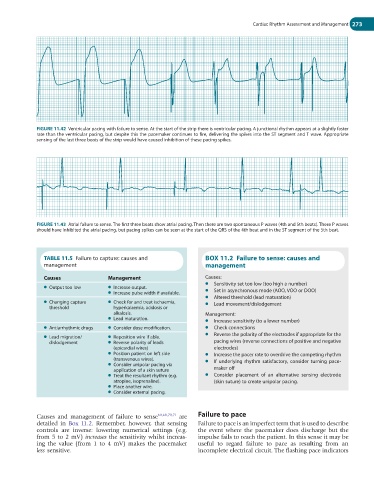
             FIGURE 11.42  Ventricular pacing with failure to sense. At the start of the strip there is ventricular pacing. A junctional rhythm appears at a slightly faster
             rate than the ventricular pacing, but despite this the pacemaker continues to fire, delivering the spikes into the ST segment and T wave. Appropriate
             sensing of the last three beats of the strip would have caused inhibition of these pacing spikes.


             FIGURE 11.43  Atrial failure to sense. The first three beats show atrial pacing. Then there are two spontaneous P waves (4th and 5th beats). These P waves
             should have inhibited the atrial pacing, but pacing spikes can be seen at the start of the QRS of the 4th beat and in the ST segment of the 5th beat.


               TABLE 11.5  Failure to capture: causes and           BOX 11.2  Failure to sense: causes and
               management                                           management

               Causes               Management                      Causes:
                                                                    ●  Sensitivity set too low (too high a number)
               ●  Output too low    ●  Increase output.
                                    ●  Increase pulse width if available.  ●  Set in asynchronous mode (AOO, VOO or DOO)
                                                                    ●  Altered threshold (lead maturation)
               ●  Changing capture   ●  Check for and treat ischaemia,   ●  Lead movement/dislodgement
                 threshold            hyperkalaemia, acidosis or
                                      alkalosis.                    Management:
                                    ●  Lead maturation.
                                                                    ●  Increase sensitivity (to a lower number)
               ●  Antiarrhythmic drugs  ●  Consider dose modification.  ●  Check connections
                                                                    ●  Reverse the polarity of the electrodes if appropriate for the
               ●  Lead migration/   ●  Reposition wire if able.
                 dislodgement       ●  Reverse polarity of leads       pacing wires (reverse connections of positive and negative
                                      (epicardial wires)               electrodes)
                                    ●  Position patient on left side   ●  Increase the pacer rate to overdrive the competing rhythm
                                      (transvenous wires).          ●  If  underlying  rhythm  satisfactory,  consider  turning  pace-
                                    ●  Consider unipolar pacing via
                                      application of a skin suture     maker off
                                    ●  Treat the resultant rhythm (e.g.   ●  Consider  placement  of  an  alternative  sensing  electrode
                                      atropine, isoprenaline).         (skin suture) to create unipolar pacing.
                                    ●  Place another wire.
                                    ●  Consider external pacing.


             Causes  and  management  of  failure  to  sense 60,68,70,71   are   Failure to pace
             detailed  in  Box  11.2.  Remember,  however,  that  sensing   Failure to pace is an imperfect term that is used to describe
             controls  are  inverse:  lowering  numerical  settings  (e.g.   the  event  where  the  pacemaker  does  discharge  but  the
             from 5 to 2 mV) increases the sensitivity whilst increas-  impulse fails to reach the patient. In this sense it may be
             ing  the  value  (from  1  to  4  mV)  makes  the  pacemaker   useful  to  regard  failure  to  pace  as  resulting  from  an
             less sensitive.                                      incomplete electrical circuit. The flashing pace indicators

