


Page 297 - ACCCN's Critical Care Nursing
P. 297
274  P R I N C I P L E S   A N D   P R A C T I C E   O F   C R I T I C A L   C A R E


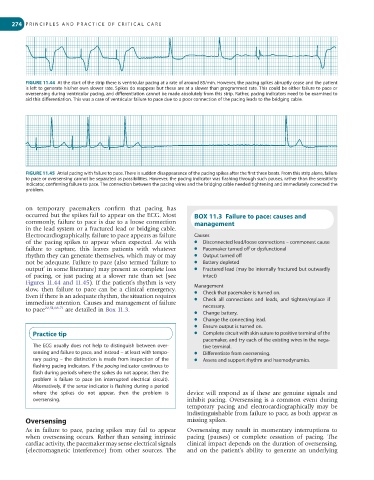
         FIGURE 11.44  At the start of the strip there is ventricular pacing at a rate of around 85/min. However, the pacing spikes abruptly cease and the patient
         is left to generate his/her own slower rate. Spikes do reappear but these are at a slower than programmed rate. This could be either failure to pace or
         oversensing during ventricular pacing, and differentiation cannot be made absolutely from this strip. Rather, pacing indicators need to be examined to
         aid this differentiation. This was a case of ventricular failure to pace due to a poor connection of the pacing leads to the bridging cable.


         FIGURE 11.45  Atrial pacing with failure to pace. There is sudden disappearance of the pacing spikes after the first three beats. From this strip alone, failure
         to pace or oversensing cannot be separated as possibilities. However, the pacing indicator was flashing through such pauses, rather than the sensitivity
         indicator, confirming failure to pace. The connection between the pacing wires and the bridging cable needed tightening and immediately corrected the
         problem.


         on  temporary  pacemakers  confirm  that  pacing  has
         occurred but the spikes fail to appear on the ECG. Most   BOX 11.3  Failure to pace: causes and
         commonly, failure to pace is due to a loose connection   management
         in the lead system or a fractured lead or bridging cable.
         Electrocardiographically, failure to pace appears as failure   Causes
         of  the  pacing  spikes  to  appear  when  expected.  As  with   ●  Disconnected lead/loose connections – commonest cause
         failure  to  capture,  this  leaves  patients  with  whatever   ●  Pacemaker turned off or dysfunctional
         rhythm they can generate themselves, which may or may   ●  Output turned off
         not be adequate. Failure to pace (also termed ‘failure to   ●  Battery depleted
         output’ in some literature) may present as complete loss   ●  Fractured lead (may be internally fractured but outwardly
         of  pacing,  or  just  pacing  at  a  slower  rate  than  set  (see   intact)
         Figures 11.44 and 11.45). If the patient’s rhythm is very
         slow,  then  failure  to  pace  can  be  a  clinical  emergency.   Management
         Even if there is an adequate rhythm, the situation requires   ●  Check that pacemaker is turned on.
         immediate attention. Causes and management of failure   ●  Check  all  connections  and  leads,  and  tighten/replace  if
         to pace 22,51,68-71  are detailed in Box 11.3.            necessary.
                                                                 ●  Change battery.
                                                                 ●  Change the connecting lead.
                                                                 ●  Ensure output is turned on.
            Practice tip                                         ●  Complete circuit with skin suture to positive terminal of the
                                                                   pacemaker, and try each of the existing wires in the nega-
            The  ECG  usually  does  not  help  to  distinguish  between  over-  tive terminal.
            sensing and failure to pace, and instead – at least with tempo-  ●  Differentiate from oversensing.
            rary  pacing  –  the  distinction  is  made  from  inspection  of  the   ●  Assess and support rhythm and haemodynamics.
            flashing pacing indicators. If the pacing indicator continues to
            flash during periods where the spikes do not appear, then the
            problem  is  failure  to  pace  (an  interrupted  electrical  circuit).
            Alternatively, if the sense indicator is flashing during a period
            where  the  spikes  do  not  appear,  then  the  problem  is   device  will  respond  as  if  these  are  genuine  signals  and
            oversensing.                                      inhibit  pacing.  Oversensing  is  a  common  event  during
                                                              temporary  pacing  and  electrocardiographically  may  be
                                                              indistinguishable from failure to pace, as both appear as
         Oversensing                                          missing spikes.
         As  in  failure  to  pace,  pacing  spikes  may  fail  to  appear   Oversensing  may  result  in  momentary  interruptions  to
         when  oversensing  occurs.  Rather  than  sensing  intrinsic   pacing  (pauses)  or  complete  cessation  of  pacing.  The
         cardiac activity, the pacemaker may sense electrical signals   clinical impact depends on the duration of oversensing,
         (electromagnetic  interference)  from  other  sources.  The   and  on  the  patient’s  ability  to  generate  an  underlying

