


Page 295 - ACCCN's Critical Care Nursing
P. 295
272  P R I N C I P L E S   A N D   P R A C T I C E   O F   C R I T I C A L   C A R E


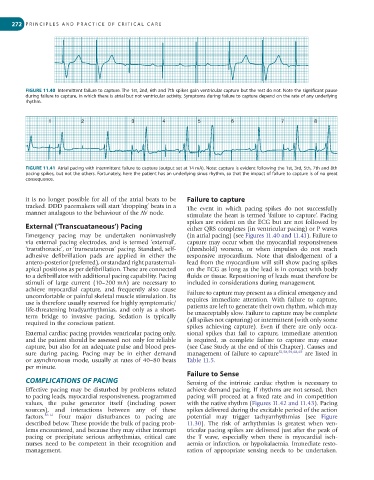
         FIGURE 11.40  Intermittent failure to capture. The 1st, 2nd, 6th and 7th spikes gain ventricular capture but the rest do not. Note the significant pause
         during failure to capture, in which there is atrial but not ventricular activity. Symptoms during failure to capture depend on the rate of any underlying
         rhythm.


                 1          2               3         4           5          6               7          8


         FIGURE 11.41  Atrial pacing with intermittent failure to capture (output set at 14 mA). Note: capture is evident following the 1st, 3rd, 5th, 7th and 8th
         pacing spikes, but not the others. Fortunately, here the patient has an underlying sinus rhythm, so that the impact of failure to capture is of no great
         consequence.


         it is no longer possible for all of the atrial beats to be   Failure to capture
         tracked. DDD pacemakers will start ‘dropping’ beats in a   The  event  in  which  pacing  spikes  do  not  successfully
         manner analagous to the behaviour of the AV node.    stimulate the heart is termed ‘failure to capture’. Pacing
                                                              spikes are evident on the ECG but are not followed by
         External (‘Transcuataneous’) Pacing                  either QRS complexes (in ventricular pacing) or P waves
         Emergency  pacing  may  be  undertaken  noninvasively    (in atrial pacing) (see Figures 11.40 and 11.41). Failure to
         via  external  pacing  electrodes,  and  is  termed  ‘external’,   capture may occur when the myocardial responsiveness
         ‘transthoracic’, or ‘transcutaneous’ pacing. Standard, self-  (threshold)  worsens,  or  when  impulses  do  not  reach
         adhesive  defibrillation  pads  are  applied  in  either  the   responsive  myocardium.  Note  that  dislodgement  of  a
         antero-posterior (preferred), or standard right parasternal-  lead from the myocardium will still show pacing spikes
         apical positions as per defibrillation. These are connected   on the ECG as long as the lead is in contact with body
         to a defibrillator with additional pacing capability. Pacing   fluids or tissue. Repositioning of leads must therefore be
         stimuli  of  large  current  (10–200 mA)  are  necessary  to   included in considerations during management.
         achieve  myocardial  capture,  and  frequently  also  cause
         uncomfortable or painful skeletal muscle stimulation. Its   Failure to capture may present as a clinical emergency and
         use is therefore usually reserved for highly symptomatic/  requires  immediate  attention.  With  failure  to  capture,
         life-threatening  bradyarrhythmias,  and  only  as  a  short-  patients are left to generate their own rhythm, which may
         term  bridge  to  invasive  pacing.  Sedation  is  typically   be unacceptably slow. Failure to capture may be complete
         required in the conscious patient.                   (all spikes not capturing) or intermittent (with only some
                                                              spikes  achieving  capture).  Even  if  there  are  only  occa-
         External cardiac pacing provides ventricular pacing only,   sional  spikes  that  fail  to  capture,  immediate  attention
         and the patient should be assessed not only for reliable   is  required,  as  complete  failure  to  capture  may  ensue
         capture, but also for an adequate pulse and blood pres-  (see Case Study at the end of this Chapter). Causes and
         sure  during  pacing.  Pacing  may  be  in  either  demand    management of failure to capture 51,58,59,68,69  are listed in
         or asynchronous mode, usually at rates of 40–80 beats   Table 11.5.
         per minute.
                                                              Failure to Sense
         COMPLICATIONS OF PACING                              Sensing  of  the  intrinsic  cardiac  rhythm  is  necessary  to
         Effective  pacing  may  be  disturbed  by  problems  related     achieve demand pacing. If rhythms are not sensed, then
         to pacing leads, myocardial responsiveness, programmed   pacing  will  proceed  at  a  fixed  rate  and  in  competition
         values,  the  pulse  generator  itself  (including  power   with the native rhythm (Figures 11.42 and 11.43). Pacing
         sources),  and  interactions  between  any  of  these     spikes delivered during the excitable period of the action
         factors. 56-61   Four  major  disturbances  to  pacing  are   potential  may  trigger  tachyarrhythmias  (see  Figure
         described below. These provide the bulk of pacing prob-  11.30).  The  risk  of  arrhythmias  is  greatest  when  ven-
         lems encountered, and because they may either interrupt   tricular pacing spikes are delivered just after the peak of
         pacing  or  precipitate  serious  arrhythmias,  critical  care   the  T  wave,  especially  when  there  is  myocardial  isch-
         nurses  need  to  be  competent  in  their  recognition  and   aemia or infarction, or hypokalaemia. Immediate resto-
         management.                                          ration  of  appropriate  sensing  needs  to  be  undertaken.

